
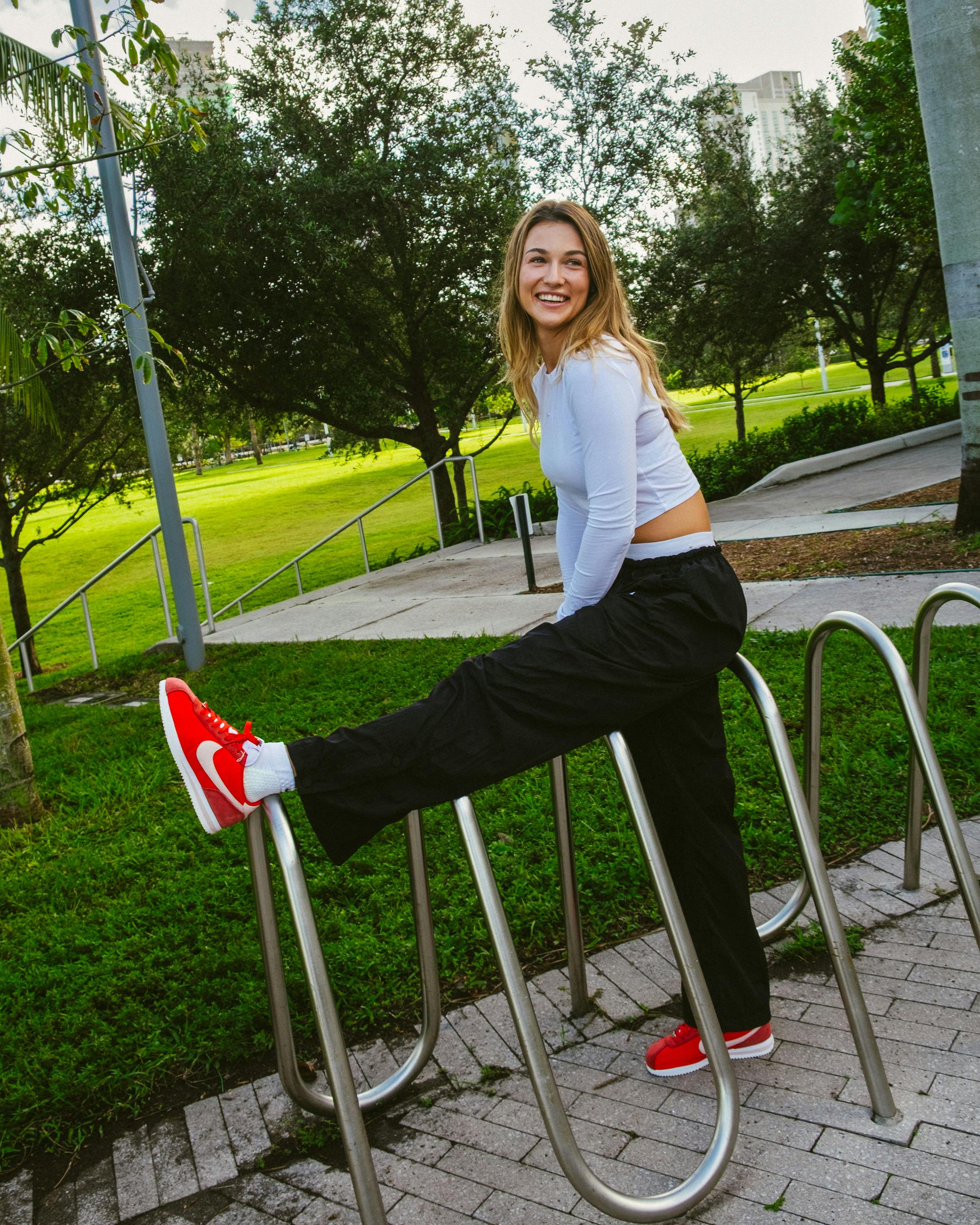
Sometimes, the best way to win is to stop trying so hard. Sounds… counterintuitive? But not for Anna Kalinskaya, whose career is marked by a surprising amount of chill for a top-25-ranked women's singles tennis player.The 27-year-old pro’s path to the top of her sport has been less straightforward than her ranking might suggest. At the start of this year’s French Open, Kalinskaya was dealing with an injury, low expectations, and the mindset of someone who wasn’t entirely sure she would play at all. To avoid letting the pressure cooker of Roland-Garros get to her, Kalinskaya went to Paris first on a vacation with her friends. “Since that moment, I really changed my mind about the French Open because I could see it as a fan, and I think from that moment I started to appreciate how special this tournament is,” as she tells Highsnobiety in an interview. This mental change of court (and probably a few exceptional croissants) shifted something for her, and she decided to compete in the French Open despite her misgivings. She went on to reach the quarterfinals at Roland-Garros for the first time in her career. The takeaway? Go on that Euro summer vacay, and the rest will fall into place. For Kalinskaya, this stage in her career looks different than when she was a teenager. It is less about simply working hard (which of course, she does plenty), and more about understanding her body's limitations, preventing injury, and managing stress on and off the court. It is a refreshingly human approach to a sport that can often feel relentlessly optimized and publicly broadcasted. Especially when, As Kalinskaya puts it, “nobody sees you crying in the locker room.”We chatted with Kalinskaya about her ability to keep tennis fun and joyful, her Roland-Garros breakthrough, the importance of switching off, and why podcasts (no music) are her pre-match soundtrack.When did your love for the game begin?My cousin, who is older than me by six years, used to play growing up, and I used to spend a lot of time with her. I just wanted to try, and I loved it from the first moment. Both your parents were pro badminton players and your brother is a soccer player, so there's a lot of sports energy on both sides of your family. What was it like being in that environment growing up? Did it instill inspiration, pressure encouragement?I didn't feel any pressure growing up that I had to be successful or anything. Doing sports was just a part of life; it was a lifestyle. Then when I started to have results, it became a profession.How has your training process over the years changed as you've climbed the rankings? I would say it's a little bit easier mentally because I'm more mature and I know my body better. It changed because I'm not 18 years old anymore. You can manage different amounts of stress in your body and physical activities in a different way when you are younger. Now it's more about doing a lot of prevention to not get injured, and it's a lot about details at this level. On that mental aspect, I heard you say that you take the clay season very easy mentally. How did adjusting that expectation affect how you played? Clearly well, given your Roland-Garros performance.I think it's very important. You can have an amazing forehand and backhand, but if you're not ready mentally to compete and if you don't put your heart on the court, then it doesn't make sense to play a tournament because you need to be 100%. I got a little injury before this French Open, so I didn't know what to expect. I went to Paris just for a vacation with my friends, and since that moment, I really changed my mind about the French Open because I could see it as a fan, and I think from that moment I started to appreciate how special this tournament is. I was just very excited to be on the court and be present every minute, and so far it was my best result.That's a good progression — go on vacation, get some inspiration, make it to the quarterfinal! And against Potapova in the fourth round, a three-set match that lasted almost three hours there — that's intense. What was going through your head? It was a little bit of an emotional match for me because she's my friend, and we know each other from childhood. So dealing with those emotions, with the discomfort playing against someone you know for so long. It was a lot of emotions, and doing that for three hours was definitely unforgettable. When you have such an intense match, you don't have time to think about your feelings. When I finished the match, I just had a moment to relax and look around. I had goosebumps. It was a very special feeling.Do you have a pre-match routine that puts you in the right head space for these more high pressure moments?I definitely need to put on my headphones and just be with myself. I don't speak to anyone just to save my energy. I like to listen to podcasts. But no music. Any favorite podcasts?I like Jay Shetty.What are you most looking forward to next?I'm looking forward to going further in tournaments and to see how much I can still improve because I believe I have a lot of room to do it, but without losing the joy. The joy aspect is interesting. It’s common for people who work doing what they love to say something similar — needing to hold onto that element of joy. How do you keep that spark?Over the years, it's been more difficult, I'm not going to lie. We travel to the same places, it's more or less the same people. For me, number one is to have a good team that you feel comfortable with, to have this balance of work and life, even during the tournament. Even if it's one hour a day going to the city, it really helps. And very important to have breaks from tennis. Whenever I have a few days off, I try to fly home just to disconnect and not to hit the wall mentally and physically. You need to rest, you need to recharge so you don't get to the limit fast.I heard you talk about the difference between your playing styles with your coach, who you've been with for many years now. Do you also see a difference in your attitude on the court? Trainings are more fun. I'm willing to work on court more. I don't feel like it's my job. It gives me — how do you say in English? “Make your job a hobby so you don't have to work a day.” It kind of feels this way when I train. When I started working with my coach, I started to love the sport more. Of course we work hard, but we have fun at the same time. We have a different mentality — you can laugh on court. I never experienced that before with any coach. Everything was very serious for me in the past, so it took me a lot of time to adjust, and same for her. Talking about the game style, I'm more an aggressive player than she was, so she has to adjust and understand that for me it's not easy to do a drop shot or a tricky shot. It's easy for her. I still cannot do some shots that she can. Is there anything that fans might misunderstand or take out of proportion about the game?It's probably difficult for a fan to understand how many things are going behind the court. On Instagram you see people post only happy things or good moments, so nobody really posts of you crying in the locker room or something like that. Tennis is now popular and more commercialized. Seeing those influencers at the US Open taking pictures with the flash, they come for an experience, they come with friends to have fun, to post things. I'm not going to say, "Oh my God, it's horrible." No, I think it's good for sport, for tennis to be promoted even more.It's a shift for sure.Yeah. I think it's also like, how can they know about behind the scenes if we don't post that stuff?Has that changed recently — the need to show more of your personal life behind the scenes on social media?I would like for people to start doing it more. It takes courage because it's not very common on Instagram, but in reality, nobody's happy all the time. So it's good to show people that we are humans and we have our feelings, we have our emotions, we have our doubts like everyone else, and I think it will help tennis fans to be more kind and connected. Tennis fashion has crossed into streetwear or sometimes even high fashion over the past couple of years. Do you feel that from inside the sport; how do you personally relate to that?I love it because I think tennis is such a beautiful sport and you can dress up on court. Seeing a few big brands coming to tennis industry is amazing. I really like what Coco Gauff is doing with Miu Miu. I don't remember any big brand like this doing collaboration before; it's very special.Last question. What does a perfect day off look like for you?I would wake up, shower, cook breakfast, maybe go to the beach with my friends or with my family if I'm in Miami. Then have some lunch, take some rest, go walk around or shop and go to eat dinner somewhere.
Anna Kalinskaya Is Learning to Stop Taking Tennis So Seriously
Full Article
Original Source
Read the full article at Highsnobiety →KhanList aggregates and links to publicly available news content. We do not host full articles from third-party sources. Always verify important information with original sources.