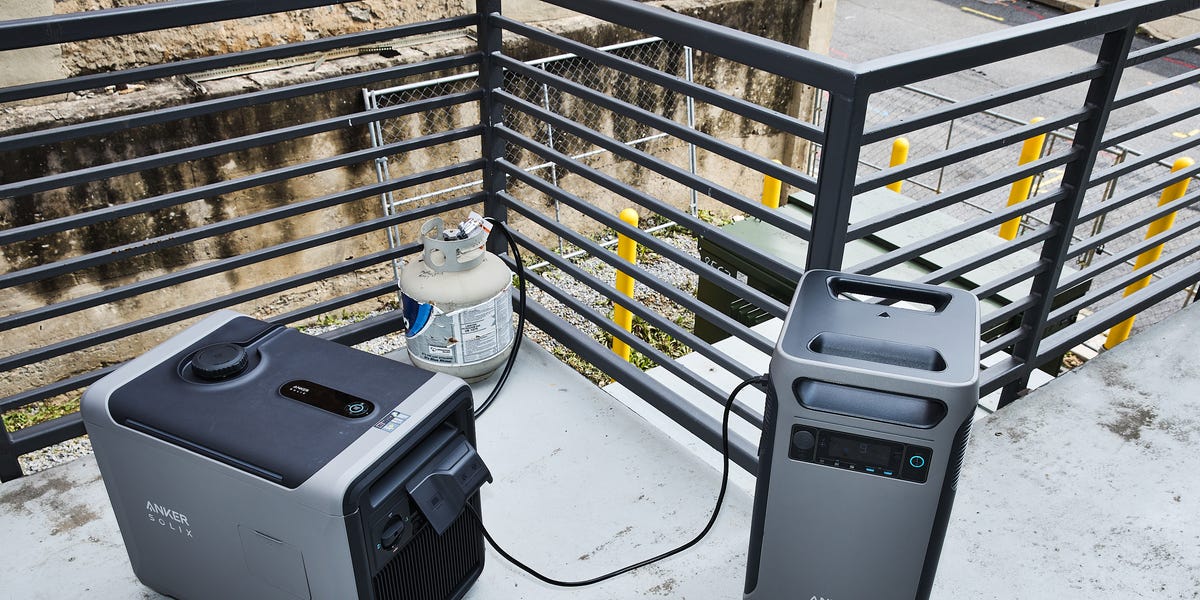
5 min readYou might be surprised to learn that Anker, maker of chargers and power banks, has created a fuel-based generator. Even more surprising, perhaps, is the fact that it’s not alone. More and more power station brands, such as Anker, Jackery, Bluetti, and EcoFlow, are turning out large whole-home power systems to keep things running when the electricity goes out.Most power stations can use a solar panel to recharge, but if the outage is prolonged and the batteries deplete, it can take at least 12 hours to recharge them using solar. That’s where a device like Anker’s Solix 5500 Tri-Fuel Smart Generator can play an important role.I first heard about this generator while reading about Anker’s Solix E10 whole-home backup system, a 6-kilowatt-hour expandable platform that can reach capacity levels of 90 kilowatt-hours if you add two more E10 units and 15 expansion batteries (the average home uses 29 to 30 kilowatt-hours per day, according to the U.S. Energy Information Administration).Pros400-volt direct DC output for faster and more efficient charging of select Anker power stationsAdvanced smart controls over Bluetooth or WiFiThe inverter provides quiet operationConsOnly one 20-amp, 120-volt outlet (most generators in this price range have at least four)30-amp outlet limited to 120 volts, which seems lacking for this price rangeOuter casing is a bit on the weak sideKey SpecsPowerUp to 3,600 W AC (5,500 W surge), or 4,500 W DCFuelGasoline, propane, or natural gasFuel Capacity2.64 gal (gasoline)Outlets1 x 120 V; 1 x 30 A, 120 V; 1 x 400 V DCWeight110.8 lbThe Solix 5500 is designed to complement this system in an emergency, offering fast high-voltage direct current (DC) recharging (available only for select compatible Anker power stations) using gasoline, propane, or natural gas. This is Anker’s first stab at building this type of portable generator, and I was eager to test it out.I must admit that the price is on the expensive side for an inverter generator, but given that it’s designed to support systems that already cost several thousand dollars and has advanced features other models do not, the extra cost isn’t completely out of line.Faster Than AC Charging With Direct DCTwo things make the Solix 5500 stand out from many other fuel-based generators: 400-volt, direct DC charging and smart operation over WiFi or Bluetooth. The first is fairly specific to Anker’s platform. To accomplish direct DC charging, you need a proprietary cable (a 10-foot cable is included with the Solix 5500) and a station that can accept it. Right now, only two Anker stations are compatible: the Solix E10 and the Solix F2000 portable power station. But it’s not just the cable that’s proprietary; the software controlling the communication and voltage regulation is specific to Anker’s platform.So, what’s the benefit? Speed is the top one. The direct 400-volt DC connection on this generator delivers up to 4,500 watts, depending on the fuel you use (propane and natural gas deliver slightly less, up to 4,000 watts). To give you some perspective, if you were to plug a power station into the Solix 5500’s alternating-current (AC) outlet, you’ll only get up to 1,800 watts of power. Depending on the capacity of your battery—or array of expansion batteries—the DC connection can significantly cut down your recharging time.Trevor RaabThe Anker mobile app allows you to turn the generator on/off remotely, monitor fuel levels remotely, operate advanced features, and pair it with other power stations over Bluetooth.Advanced Smart OperationThe second notable feature of this generator is its suite of smart operations. After filling the generator’s oil bay with propane, I installed and configured the app. It was pretty impressive. It gave me a readout of everything I needed to know, including fuel level (estimated by entering tank weight), oil level, and power output.You can also control the generator remotely, turning it on and off via Bluetooth or WiFi or switching between AC and DC output (if the DC cable is connected). The app also keeps track of maintenance timing and lets you know if something needs to be checked or cleaned, including oil changes, air filter changes, spark plugs, etc.You can also automate operation by pairing it with a power station in the app. I tested this function by plugging a Solix F3800 power station into the AC outlet and leaving the generator off with the fuel selector dial set to my chosen fuel source. I paired the devices in one step and set it up so the generator would start when the power station’s total capacity dipped to 20 percent and shut off when it reached 80 percent (you can set whatever levels you prefer). It worked flawlessly.Operation as a Stand-Alone GeneratorBeyond its smart capabilities, the Solix 5500 operates like most tri-fuel generators in its class, outputting up to 3,600 running watts (5,500 watts surge), though it does not offer a high number of outputs. It features just one 20-amp, 120-volt outlet and one 30-amp, 120-volt outlet. That means you can only connect one AC device or appliance at a time, or connect it to a manual transfer switch to power a few 120-volt circuits in your home. It can’t support 240-volt circuits on its own, but if you’re using it to recharge a station that outputs 240 volts, it can charge at 120 volts while the station outputs the higher voltage.Trevor RaabOn the front of the generator is the fuel selection knob, a 20-amp 120-volt AC outlet, a 30-amp 120-volt AC outlet, and a 400-volt DC port that connects only to select Anker power stations for delivering high-speed recharging.Like many inverter generators, this one has a closed frame, but the outer shell is entirely plastic. While that’s relatively water-resistant—there’s a sensor that detects rising water levels and shuts down in excess of 1.6 inches—the shell doesn’t feel thick, and it scratches easily. While it rolls on wheels and has a very nice built-in handle that folds flush to the generator, it isn’t designed to get banged around. I also found the access doors for the propane gas connection would pop open at times, and the door to the manual starter cord was a bit loose, too.When up and running, it’s fairly quiet. Like any inverter generator, this one automatically throttles the engine lower or higher depending on how much power is being drawn. While running at approximately a 50 percent AC load, I measured it at 64 decibels from around 25 feet away. That’s pretty good. A standard generator would be much louder than that.If you’re recharging an Anker battery system using DC, there’s a quiet mode that limits output to 2,000 watts and can be set for certain times. That extends the recharge time but keeps noise down.The Final VerdictThe cold, hard truth is that, as good as battery backup systems are, they can’t recharge themselves. If you live in an area that experiences prolonged service outages and your capacity is running low, a fuel-based generator is going to top it off a lot faster than using solar panels and praying for a perfectly sunny day. If your choice of platform is Anker (notably, the E10 backup system), then its Solix 5500 is the solution. Its direct DC charging outpaces standard inverter generators, and its smart, automated features are a true boon. It’s not the right generator for everyone (it’s expensive compared to other inverter generators), but it’s a great addition to the Anker ecosystem.Shop the Anker Solix 5500 Smart Tri-Fuel GeneratorOther Inverter Generators We RecommendBest For Powering Sensitive ElectronicsGenerac iQ3800 3,800-Watt Dual-Fuel Portable Inverter GeneratorNow 9% OffChampion Power Equipment 4,500-Watt Dual-Fuel Portable Inverter GeneratorDuroMax XP11000iHT 11,000-Watt Tri-Fuel Inverter GeneratorDavid is a Reviews Editor for Hearst’s Enthusiast Group, contributing to Popular Mechanics, Runner’s World, Bicycling, Best Products, and Biography. He has over 25 years of experience writing about and reviewing consumer electronics, kitchen appliances, DIY products, outdoor gear, and more. He also spent years covering the ever-changing world of online retail. To relax, he loves experimenting with new recipes, tweaking his smart home setup, and spending time outdoors on his bike or camping. Rachel is the Deputy Editor of Reviews for Hearst's Enthusiast and Wellness Group where she supports Popular Mechanics, Runner's World, and Best Products. Her background is in service journalism and earlier in her career she worked as a daily newspaper reporter and book editor. She spent more than a decade as a staff editor and writer at TripAdvisor and Penguin Random House and her byline has appeared in Time Out New York, the New York Daily News, and New York Magazine. Outside of work, Rachel can be found planning her next trip, visiting museums and galleries, and walking her wirehaired dachshund in Central Park.
Anker’s Solix 5500 Tri-Fuel Generator Delivers Fast Backup Power When Solar Isn’t an Option
Full Article
Original Source
Read the full article at Popularmechanics →KhanList aggregates and links to publicly available news content. We do not host full articles from third-party sources. Always verify important information with original sources.