
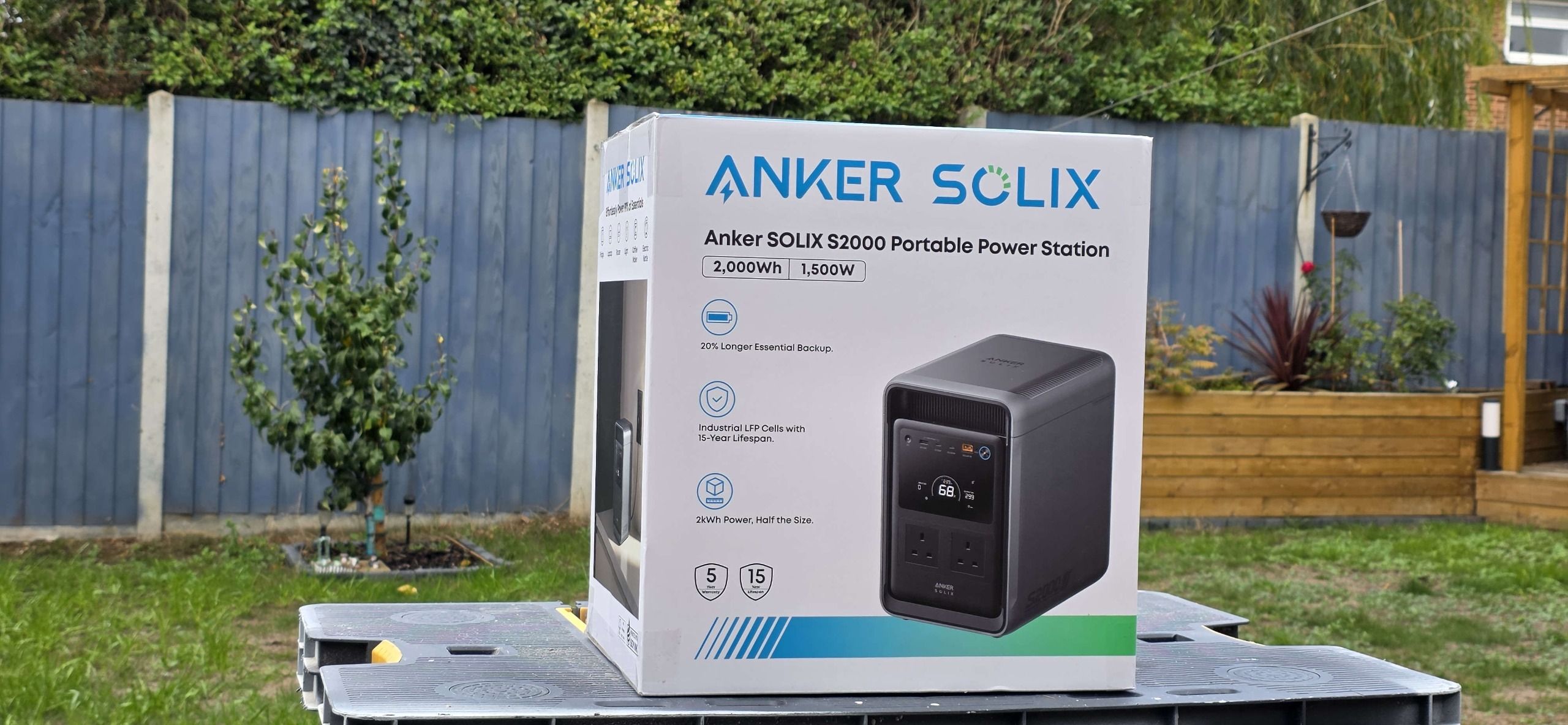
TechRadar Verdict The Anker Solix S2000 made a strong first impression by being useful immediately. Starting at 59%, it covered my intermittent vacuum use throughout a working day and finished with charge remaining. Its biggest strengths are that useful battery capacity, sensible socket layout and an app that makes the controls understandable. The output ceiling needs consideration, but for compatible equipment, DIY jobs and household backup, there’s plenty to like. Reasons to buy +Handled repeated 1,200W vacuum sessions without trouble. +Substantial battery capacity in a compact enclosure. +Four UK sockets, sensibly split front and rear. +Straightforward app with helpful explanations. +Mains, solar and vehicle charging options. Reasons to avoid -1,500W output restricts higher-powered appliances. -Still a substantial lift at 16.2kg. -Only one USB-C port supports 100W. -Alternative charging methods require suitable cables or accessories. Why you can trust TechRadar We spend hours testing every product or service we review, so you can be sure you're buying the best. Find out more about how we test. Jump To: Specifications Design and connections Performance Charging options The app Backup power Portable power stations are useful for everything from keeping your broadband running during a power cut to powering equipment away from a convenient socket. The Anker Solix S2000 fits both roles, combining a substantial battery with a relatively compact upright design.What impressed me most, though, was how little fuss it involved. It handled repeated sessions with a 1,200W wet/dry vacuum straight out of the box, while the accompanying app was easy to set up and refreshingly clear about what its settings actually do.Anker Solix S2000: specifications (Image credit: Future) Swipe to scroll horizontally Specification Details Battery capacity 2,000Wh Battery chemistry Lithium iron phosphate, also known as LFP or LiFePO₄ Continuous AC output 1,500W total UK mains outlets Four Type G sockets: two front, two rear USB-A One port, up to 12W USB-C Two ports: up to 15W and 100W Shared USB limit USB-A and 15W USB-C share an 18W maximum Standard AC charging Up to 1,150W Solar charging Up to 400W through the XT60i input UPS transfer time Approximately 10ms, manufacturer-rated Dimensions 208 × 282 × 323.3mm Weight 16.2kg Warranty Five years Specifications are manufacturer figures; socket layout and port labels were also checked against the UK review unit.Latest Videos FromTechRadarDesign and connectionsThe S2000 has an understated appearance: a dark grey enclosure, rounded edges and a glossy front panel. It looks perfectly at home beside a desk, although mine was soon earning its keep around DIY equipment.Its upright shape gives it a reasonably small footprint. At 16.2kg, however, “portable” still involves a deliberate lift. Moving it between rooms or taking it out to the garden is one thing; carrying it a long distance is another.The UK version has four proper Type G sockets, split evenly between the front and rear. That arrangement makes sense. You can keep regularly connected equipment plugged in behind the unit, leaving the front sockets available for things you connect occasionally.There is a trade-off: you’ll need access to both sides if you want to use every socket. Bear that in mind before squeezing it into a tight space, and leave the ventilation clear.Are you a pro? Subscribe to our newsletterSign up to the TechRadar Pro newsletter to get all the top news, opinion, features and guidance your business needs to succeed!The USB connections sit above the display. The 100W USB-C port is the one to choose for a compatible laptop, while the other USB-C connection is limited to 15W. They look similar, so it’s worth checking the labels.The screen puts the remaining battery percentage front and centre, alongside input and output wattage and an estimated remaining time. That gives you the information you need without reaching for your phone.Performance: a proper day’s workMy S2000 arrived with a 59% state of charge. Rather than charging it fully before doing anything useful, I put it straight to work powering a 1,200W wet/dry vacuum.Between approximately 10am and 5pm, I used the vacuum repeatedly in sessions lasting around five to ten minutes. The Anker handled those sessions without any problems, and by the time I finished, it still showed 13% remaining.To be clear, that was intermittent use across a seven-hour working day, rather than seven hours of continuous vacuuming. Even so, it was a useful practical test: repeated use of a fairly demanding appliance, starting with little more than half a battery.The benefit was simple. I could get on with the job without running an extension lead back to a mains socket, and the power station had enough charge to cover the work I needed to do.This wasn’t a controlled capacity test. I didn’t record the vacuum’s total running time or measure the energy delivered at the socket, so it wouldn’t be fair to calculate an efficiency figure from the percentage drop.What I can say is that it coped comfortably with this particular vacuum and pattern of use.The main limitation is the 1,500W continuous output. Battery capacity tells you how much energy is stored; output determines which appliances it can run. A large battery doesn’t automatically mean it can power a typical high-wattage UK kettle or several demanding tools together.Check appliance ratings, allow for starting demands, and remember that the output limit is shared across the AC sockets.Charging options (Image credit: Future)For everyday charging, the S2000 connects directly to the mains using the supplied AC cable. There’s no separate external power brick to find space for.During one charging session, the front display showed approximately 1,068W going in. An app screenshot taken during charging showed around 1,077W, with UltraFast charging switched off. These are snapshots rather than a timed charging test, but they show a substantial charging rate in normal use.There’s also an app-controlled UltraFast option when a quicker turnaround matters.Away from home, the S2000 supports compatible solar panels and vehicle charging, provided you have the correct cables and accessories. Solar input is capped at 400W, with Anker specifying a maximum open-circuit voltage of 60V. Panel compatibility matters as well as the connector.Those alternatives add flexibility, although a normal car accessory socket will be much slower than mains charging. Think of it as a way to replenish charge while travelling, rather than expecting a quick refill of a 2kWh battery.The app: easy to set up, easy to understand (Image credit: Future || Anker)The app was one of the nicest surprises.Finding it in the Google Play Store was straightforward, as were signing in and getting started. The S2000 was detected straight away, added without difficulty and ready to control. An iPhone version also appears to be available, although my experience here was with Android.The main screen presents the battery percentage, temperature, charging estimate and power flow clearly. You can see what’s happening at a glance.More useful still is the depth of control. There are multiple UPS and power-management modes, charging timers, adjustable AC charging power and battery charge limits. You also get AC output scheduling, a countdown to switch the sockets off, screen controls and power-usage history.Crucially, the explanations are good. Rather than leaving you to decipher a vaguely named mode, the app helps you understand what a setting does and decide whether it suits your needs.Some power-station apps make configuration feel like educated guesswork. Here, the guidance makes the extra features more approachable, particularly if this is your first battery system.Backup power and everyday useThe UPS function adds another potential role: keeping suitable equipment powered when the mains fails. Anker quotes a transfer time of around 10ms, although I haven’t independently measured that or tested compatibility with individual computers.For a home office, the combination of rear sockets, battery monitoring and configurable operating modes is appealing. You can leave equipment connected and manage the unit without constantly handling it. Image 1 of 5 (Image credit: Future) For more off-grid essentials, we've tested the best portable power stations. Managing Editor, TechRadar Pro Désiré has been musing and writing about technology during a career spanning four decades. He dabbled in website builders and web hosting when DHTML and frames were in vogue and started narrating about the impact of technology on society just before the start of the Y2K hysteria at the turn of the last millennium. You must confirm your public display name before commenting Please logout and then login again, you will then be prompted to enter your display name.
Anker Solix S2000 review
Full Article
Original Source
Read the full article at Techradar →KhanList aggregates and links to publicly available news content. We do not host full articles from third-party sources. Always verify important information with original sources.