
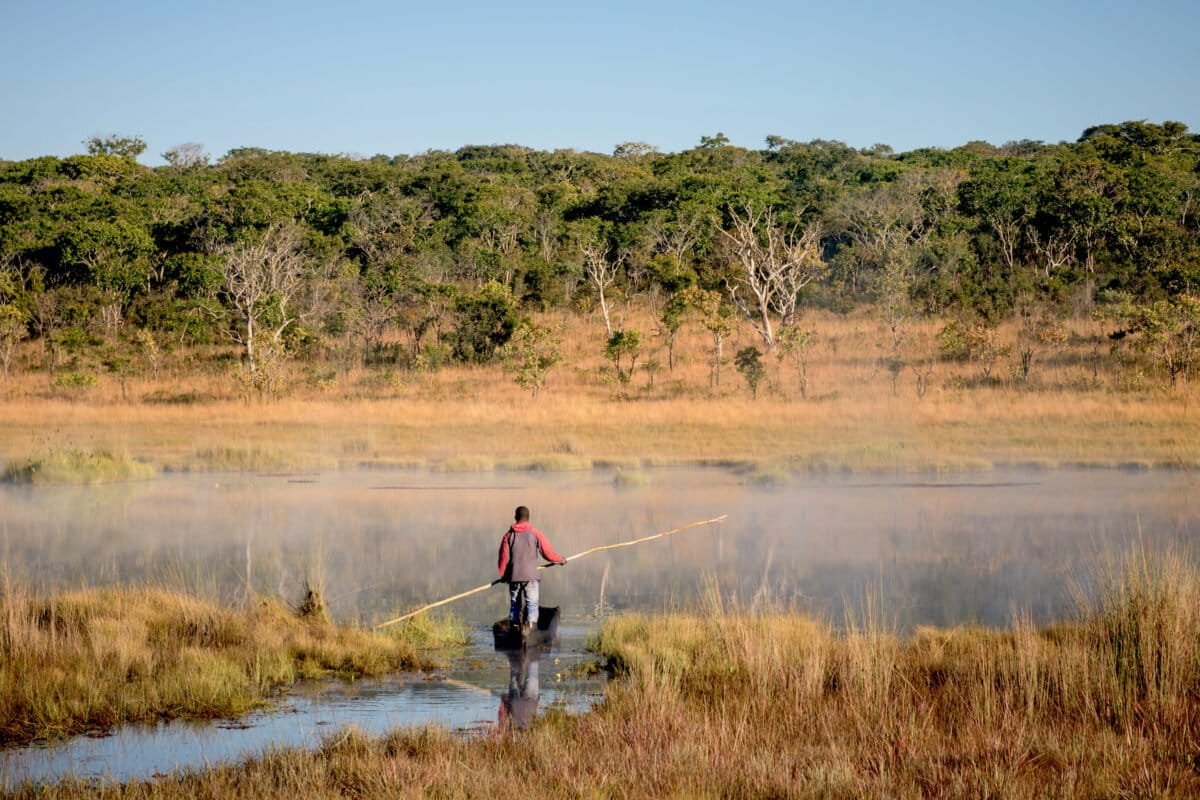
Conservationists in the central and southeastern Angolan highlands have an unlikely ally in their work to protect wildlife and forests: hunters.Local leaders have chosen experienced hunters from the Luchaze and other communities to be Watchers to curb illegal hunting and monitor and report any changes in the ecosystem.The work is a critical component to safeguarding a region that is also the source of major rivers that sustain millions of people in neighboring countries. Four years ago, elders from several different communities in Angola’s southeastern highlands approached environmental anthropologist Kerllen Costa, saying they’d noticed an influx of people from outside the highlands coming there to hunt for bushmeat without obtaining permission from local chiefs. Sometimes the outsiders recruited locals to hunt on their behalf. These hunting parties were disregarding local hunting rules, the elders told Costa. They weren’t following traditional leaders’ prescriptions on where and when to hunt, how many animals to kill, or how much of their haul to share with villagers. “They asked for help to reinforce the traditional ways,” said Costa, who is Angola director of the National Geographic Okavango Wilderness Project (NGOWP) and co-founder of Fundação Lisima, a conservation group. Months of discussions ensued, at the end of which each village across the landscape nominated one Watcher. Their job is to keep watch over their woodlands, monitor popular hunting trails, and ensure that the animals are hunted in line with traditional rules. “They have a concept that every single person in the landscape is a watcher,” Costa said. “The farmer, the fisherman, the beekeeper — they’re always watching what’s happening, whether it be what a person is doing or a change in the ecosystem.” The source lake of the Cuito river, in Moxico province. The Cuito is one of two major rivers feeding the Okavango river and Botswana’s giant Okavango delta. Image courtesy of Kostadin Luchansky/AIB/NGOWP. The landscape they’re watching over is the Lisima Lya Mwono, or “the source of life.” It’s the name the local Luchaze people give to Angola’s water tower, comprising more than 150,000 square kilometers (58,000 square miles) of miombo woodland interspersed with lakes, wetlands and peatlands. Lisima is the source of several major river systems, including those that drain into the Okavango Delta in Botswana, and the Zambezi River, Africa’s fourth longest that supplies water to millions of people in several countries across the region. Camera traps monitored by the Watchers have documented Lisima wildlife that includes roan antelope (Hippotragus equinus), common duiker (Sylvicapra grimmia) and the marsh-dwelling sitatunga (Tragelaphus spekii), but also predators such as lions (Panthera leo), leopards (Panthera pardus), cheetahs (Acinonyx jubatus) and wild dogs (Lycaon pictus). The recruitment of the Watchers is in line with an approach Costa has taken for the last 10 years: Documenting traditions, then using those traditions to create conservation programs. “This is basically trying to show the world that [the Lisima] forests are as pristine as they are because of the way the people live and the traditions that they have and the things that they believe.” Lisima’s Watchers use smartphones to record the coordinates of hunting camps; take pictures to document the state of the source lakes and the forests that surround them; report illegal hunting (via audio messages in their own language) to their leaders back in their villages to prevent illegally-hunted bushmeat from leaving the area; and report why, where and when fires are lit, and whether they’re burning in ecologically-sensitive areas. Seventy-five experienced hunters have been recruited by local chiefs to act as Watchers across the Lisima Lya Mwono landscape. They work to uphold traditional hunting practices, and to record, biodiversity hotspots, out-of-season fires and unauthorised natural resource extraction among other things. Image courtesy of Tucunaré Lopez/NGOWP. Fire ‘plays an ecological and social role’ The communities in Lisima have “co-evolved” with fire, says Luisa Escobar-Alvarado, an environmental scientist who studies historical and current fire use by communities in Moxico province, part of the Lisima Lya Mwono, and works to develop science-based approaches to forest conservation there. Not only are there many fire-adapted plant species within the miombo woodland, such as the mukula tree (Pterocarpus angolensis) and the mucosso (Erythrophleum africanum), but local communities use fire as a tool for subsistence, including agriculture, hunting and grass regeneration, among other uses, she says. But she adds: “As much as it plays an ecological and social role in Lisima, it can also be destructive and cause accidents and harm to people and the environment.” Escobar-Alvarado, who is also a research advisor to the NGOWP, is working with colleagues to develop a fire management plan for Lisima, taking into account existing fire practices and identifying how fire can be managed in ways that sustain both people’s livelihoods and the environment. “I would not say that fire is a serious threat in this landscape,” she said. “The real threat would be an expansion of agricultural development or timber harvesting, which I would expect to come from external actors and which could make fire more prominent.” That’s something that bothers Costa too. In the Lisima landscape, residents use fire as a tool to prepare lands, hunt or promote the growth of grass or medicinal plants. Image courtesy of Luisa Escobar-Alvarado. More than 50,000 km2 (19,300 mi2) of the Lisima landscape in Moxico province was recently designated a wetland of international importance by the Ramsar Convention, an international treaty to safeguard wetlands, but it and the surrounding areas still lack formal protection under Angolan law. Costa says that while hunting, beekeeping and (in the eastern parts) fishing are important sources of livelihood for the communities that live in the highlands, shifting agriculture — in which farmers clear new land every few years — could expand rapidly. If no viable alternative livelihoods are found, this could undermine conservation efforts, and the long-entrenched tradition of local stewardship. “There needs to be a strong push to create livelihood systems that the communities themselves will manage,” he said. “There needs to be a fine merging between what we do, what the government programs are and how people are absorbing the concept that they are the true guardians and the true watchers [of the landscape].” Watchers set up a high-definition camera trap in one of the most remote areas of the Moxico Province to try to document an elusive population of ‘ghost elephants’. Image courtesy of Tucunaré Lopez (for NGOWP). Watchers have deep knowledge There are currently 75 Watchers, though Costa says the plan is to increase that number to 100. As an example of how their work is guided by their own deep ecological knowledge, Costa discusses one of the Watchers, veteran hunter António Luhoke. Luhoke can identify seven different types of woodland within the miombo biome where most Western-trained scientists would see only one. “He would explain, ‘You see, this one is more sparse; there’s more grassland, less trees; this one has a little bit more trees, less grassland; this one is full of trees and moss. This one, no moss and a lot of trees,'” Costa recalled. “The local people have different names for each kind of [forest type], which shows that there is a lot more complexity than what we are assuming scientifically.” Environmental scientist Luisa Escobar-Alvarado undertakes participatory mapping with Andre Linhango, a resident of Sete village, to identify and map locally recognized vegetation types. Image courtesy of Lorenza Fontana. Tiago de Valladares Pacheco is the Nairobi-based Africa Forestry Director for The Nature Conservancy, an environmental nonprofit, which is helping the Angolan government to develop sustainable management practices for miombo woodlands across southeastern Angola. Pacheco said using local hunters to keep watch over Lisima’s woodlands is similar to the approach TNC promotes in Zambia, in the so-called Game Management Areas that are either buffer zones around that country’s national parks or a part of critical wildlife corridors between them. “As TNC we’ve been trying to look exactly at these types of community-based approaches for game management and wildlife habitat management,” he said. “This community-based approach with hunting associations or with hunting groups is a reasonable and effective way of being able to reinforce the roles that communities can play as custodians and guardians.” Banner image: One of the Watchers, or Tunyiungi va Lisima, poling a dugout on one of the region’s freshwater lakes, which local tradition considers the lakes to be sacred. Image courtesy of Kostadin Luchansky/AIB/NGOWP. Citations: Escobar-Alvarado, L. F., Fontana, L. B., Fisher, J. A., Kaula, E., António, T. E., & Dexter, K. G. (2025). Fires of war: how civil war shaped fire regimes in East Angola. ECOLOGY & SOCIETY, 30(4), 1-44. doi:10.5751/ES-16658-300444 Escobar-Alvarado, L. F., Fontana, L. B., António, T. E. M., & Vannucci, A. (2026). Performing Fire Governance: Co-Creating an Integrated Fire Management Plan Through Legislative Theatre in Eastern Angola. Fire, 9(9), 366. doi:10.3390/fire9090366 New study pushes for protection of one of Africa’s ‘least understood treasures’ All conservation is local: Interview with Angolan conservationist Kerllen Costa FEEDBACK: Use this form to send a message to the author of this post. If you want to post a public comment, you can do that at the bottom of the page. Credits Topics
Angolan hunters protect Southern Africa’s internationally important wetland
Full Article
Original Source
Read the full article at News →KhanList aggregates and links to publicly available news content. We do not host full articles from third-party sources. Always verify important information with original sources.