
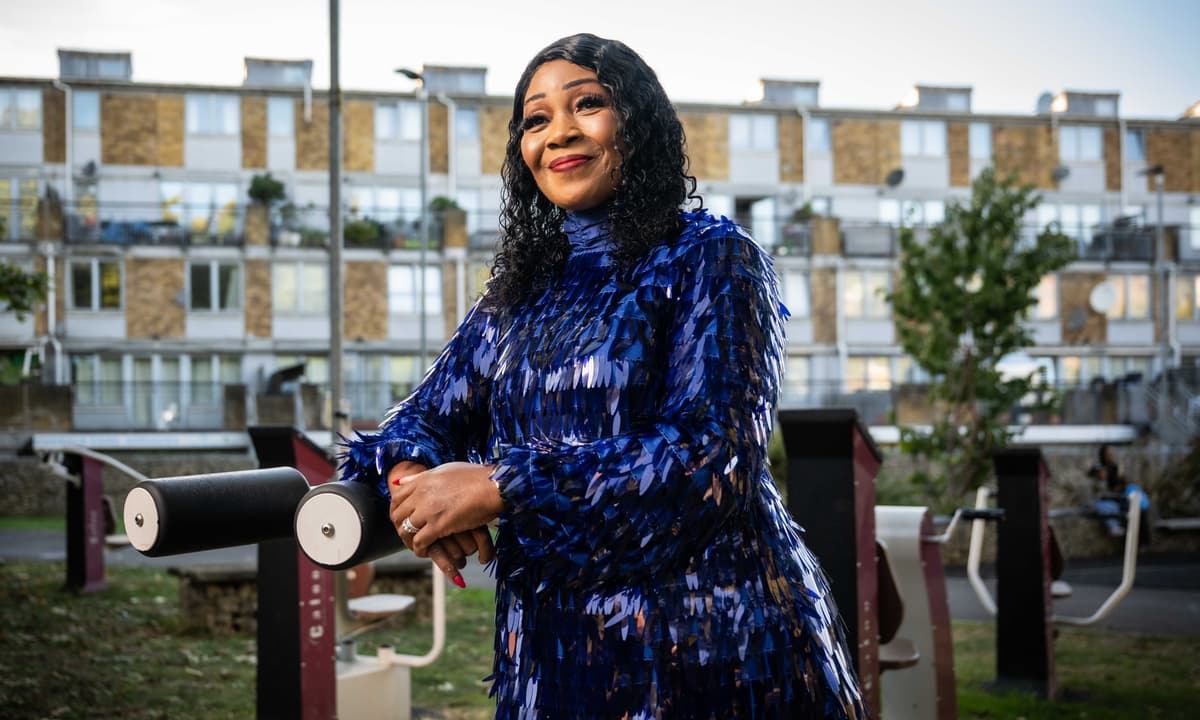
Angell Town 10 years on: 'You came into a very dark place and you not only brought hope but also investment'10 years after Angell Town, The Standard and Comic Relief launch a winter campaign to tackle the root causes of poverty by supporting community-led, place-based initiatives, with £1M from This Day and £500K from Comic Relief — and backing from boxer Nicola Adams — to get it startedBack then Angell Town, home to around 4,000 people, was synonymous with gang violence and, indeed, just after midnight on the second night of my stay, a 24-year-old young man, Ogarra Dixon, was shot and killed on the estate, just around the block from where I slept. It was 17 June 2015, the fifth time in 18 months that a young man had lost his life because of tensions in, or linked to, Angell Town.The estate suffered from institutional neglect, high youth unemployment and two generations of gangs. The police scored it “red” on the Gangs Matrix, the most serious classification, with the estate home to the infamous GAS gang (Guns and Shanks), and before them the PDC, or Poverty Driven Children. More than half the estate lived in poverty. At the same time, there were plenty of creative ideas and talent on the estate, but residents felt intensely frustrated by the lack of resources to back them.A pamphlet calling residents to a public meeting read: “Angell Town youth have a voice! There’s nothing to do!!! Where’s the facilities for youth to reach their full potentials?”At that meeting, in a tiny, run-down community centre called Angell Delight, around 60 people crammed into the low-roofed space. A woman called Lorraine Jones, whose son Dwayne, 20, had been killed the year before while acting as peacekeeper to protect a friend, stood up to speak and the room went respectfully silent. “We are crying out here!” she began, addressing the violence, but also the broken flooring, malfunctioning toilets, and dilapidated football cage outside.Lorraine Jones Burrell, who founded a boxing charity after her son was killedJohn Nguyen/JNVisualsThe challenge seemed enormous, but the Standard heard their cry and launched a campaign, The Estate We’re In, to turn the best ideas proposed by the community into reality.Backed by the Standard’s Dispossessed Fund and a city bank, we funded a new 3G Astroturf football pitch, an outdoor gym, football coaching, boxing training, fitness sessions, business start-up training, a craft market and field trips to London attractions. The following year we backed another dozen projects, including: gardening and food growing, an after-school programme, music lessons, rowing club, GCSE revision, jewellery making, parenting workshops, career workshops, an elderly support group and community organiser training. We also moved a RHS Chelsea Flower Show garden onto the estate and got Mayor Sadiq Khan to open it.We put £200,000 into Angell Town over two years in what was then a ground-breaking place-based approach to tackling the problems of left-behind communities. The ambitious aim? To empower residents to change the trajectory of their estate.10 years after ‘The Estate We’re In’A few months ago, I went back to Angell Town to see what lasting difference our campaign had made. The purpose of my visit was to apply lessons from Angell Town to our thinking about a new campaign in partnership with Comic Relief that we are announcing today — a campaign that also takes a place-based approach to areas of high deprivation, not just in London, but outside the capital as well.Armed with a £1 million donation from This Day foundation and £500,000 from Comic Relief, we have worked with UK Community Foundations to shine a light on groups that are community-led and take a place-based approach to tackling the root causes of poverty — as well as providing emergency support for people struggling with the cost-of-living crisis.The Standard has joined forces with Comic Relief to tackle the root causes of poverty and provide relief from the cost-of-living crisis by backing community-led, place-based initiatives. A Place to Turn launches with £1.5 million already pledged — £1 million from This Day foundation and £500,000 from Comic Relief. Itruns until Christmas and we are asking corporations, foundations, philanthropists, and you, our readers, to donate generously. Dwaynamics and Urban Synergy are among the projects we are working with through The London Community Foundation, which is a member of UK Community Foundations. The more we raise, the more powerful initiatives we can support.The wider context is that Andy Burnham’s success in transforming Manchester by focusing on local empowerment after becoming mayor in 2017 has raised the profile of place-based approaches and made them increasingly influential in anti-poverty policy. At its heart, a place-based approach seeks to address one overarching question: What would it take to transform the life chances of people living in an underserved community by concentrating resources on that place? Rather than tackling poverty, crime, joblessness and educational inequality as discrete problems, a place-based approach recognises that these issues are interconnected and often concentrated geographically — and that local people have the highest motivation to change their own community.In the case of Nicola Adams, former flyweight world champion and Olympic gold medallist who features on our print edition cover, it was her local boxing club, Burmantofts, that provided a vital refuge from a turbulent home life and gave her the support and confidence to thrive.Former world flyweight champion, Nicola AdamsAFP/Getty“There wasn’t much to do on the estate in east Leeds where I grew up,” she said. “There was a lot of crime, stolen cars, and drug dealing — and boxing was my diversion and my safe space. I was dealing with domestic violence at home — first from my father and then from subsequent partners of my mother after my parents split up — and I slept with a hammer under my bed for protection.”She added: “My coaches were so supportive. I could talk to them about what was going on at home, and on the occasions I couldn’t afford bus fare, they came and picked me up. That boxing club was like an extended family to me and without it, I hate to think what my life would have become. That is why I am backing this campaign. The community projects you are spotlighting are exactly the sort of thing that can make the difference for a young person who might otherwise turn to crime.”Dan Berelowitz, CEO of This Day, articulates the campaign mission. “We believe that where you live shouldn't determine your future. We want to back local leaders who understand their communities and invest not just in responding to problems people face today, but build the conditions for communities to thrive tomorrow. This campaign brings together national ambition with local knowledge and relationships with community foundations across the country, and gives us the opportunity to alleviate hardship and tackle its deeper causes. For This Day, it’s part of a wider ambition: to learn from and invest in what works and build stronger communities across the UK.” We had tried to do that in Angell Town in 2015/16. Before embarking on our 2026 campaign to support projects in communities experiencing some of the highest levels of poverty — such as East Marsh in Grimsby, Beeston in Leeds, and pockets of south London — we wanted to understand whether our approach to Angell Town had worked.Our new campaign would therefore begin with what I discovered when I ventured back to Angell Town. I would need to go back to go forward. I had kept in touch with some Angell Town projects for a few years, but I hadn’t been down since Covid. As I approached an entrance once known as “murder alley”, my heart was in my mouth.I walked through the estate and saw that the Astroturf football pitch looked well maintained, and that the calisthenics bars and outdoor gym equipment were still there. Posters announced boxing and football coaching and there were some promising new developments too — a Londis convenience store had opened and many of the previously shuttered units around the football pitch were now occupied.The Astroturf football pitch funded by The Standard’s Dispossessed Fund 10 years agoJohn Nguyen/JNVisualsThe first person I arranged to meet was Lorraine, 54, now Lorraine Jones Burrell following her marriage, and whose boxing charity, Dwaynamics, we had funded with a £17,341 grant. Her powerful advocacy on behalf of the estate had led locals to dub her “the angel of Angell Town”.We sat on a bench in the middle of the estate and I asked: “Do you think we made a difference?” I was taken back by the vehemence of her response.“What!” exclaimed Lorraine, her eyes wide with indignation. “You made a massive difference. You came into a very dark place and you brought hope. Not just hope. By investing in us, you turned it into reality. That campaign was like a massive ball of light that showed outsiders what was going on here. It put the spotlight on the institutional neglect and it showcased the resilience of the community.“Those weeks of coverage not only told our story, but when you and I sat with the Borough Commander in my living room, and when the police started doing boxing with our youth — that was a landmark moment. It was the beginning of a profound change in the attitude of the police towards our youth, and of our youth towards the police — because they got to know each other in a non-criminal context.” She entreated me: “Listen.” She gestured around. “It’s 5pm yet so peaceful. There’s still crime here and we have sadly lost more lives to knife and gun crime in the last decade, but it’s not how it was. The estate doesn’t feel intimidating anymore. The energy is different.”Lorraine added: “That campaign was the turning point. It set off a positive chain of events that continue to this day. The football pitch has become the heartbeat of the estate. Dwaynamics has not just survived, it has expanded. As well as the boxing gym, we opened the Dwaynamics Community Centre, which is a food nourishment hub and an after-school club.”“That campaign was the turning point. It set off a positive chain of events that continue to this day”Our investment turned out to be just the start, attracting other investors and giving Dwaynamics a wider profile, she said. “David Cameron gave me a Point of Light Award in 2016, Queen Camilla came to visit our boxing gym, other media came down to highlight our work tackling youth violence, including the BBC, Sky, and ITV, and the Daily Mail made me their Inspirational Woman of the Year in 2019. And last year,” she beamed, “I was awarded an MBE. I am now Lorraine Jones Burrell MBE!”Lorraine’s impassioned work on behalf of young people has also been recognised by the Home Office and the police. She became a member of the Government’s Coalition to Tackle Knife Crime and was appointed vice-chair of the Metropolitan Police Learning & Development Reference Group. Her contribution has evolved from advising local Lambeth police to influencing how policing nationally learns from community experience.Community-led projects at Angell TownBut what did other stakeholders think?Jack Reynolds is chief executive of Football Beyond Borders (FBB), which in 2015 had partnered with several young men from Angell Town to petition the council for a new high-quality Astroturf football pitch, raising over 1,000 signatures — but securing no investment. Our campaign had backed them and funded the new pitch, and we had also supported FBB to run football coaching.Jack said: “The feel of the estate today is very different to 11 years ago. It used to be scary to be there, especially after dark with firecrackers going off, and the safety of our staff and the young people was my number one concern. I don’t have those worries anymore.”There are two reasons for the change, Jack suggested. “The investment in the infrastructure and the collective ownership that ensued.”FBB has since moved its base onto Angell Town and now occupies a unit alongside the pitch. These days, however, FBB does coaching in schools rather than on the estate, where coaching is instead provided by another group called The Streetz Football. “The great thing about Streetz is that it’s locally led,” said Jack. “They stepped into the space and have created collective estate ownership of the pitch. They have built a hugely successful football coaching business across south London and employ people on the estate to help, so it’s a real Angell Town success story.”“What the Standard sowed has brought so much fruit”Indeed, the co-founder of The Streetz is Lorraine’s son, Malachi Simpson, 25, whose story formed part of our original coverage. “Malachi works with thousands of kids in south London, peacefully bringing together boys and girls who were in warring postcodes,” said Lorraine. “He’s turned his pain at losing his brother into passion and purpose and he’s literally exploded. They run coaching academies, community events, and have over 250,000 YouTube followers. But it all started in Angell Town. What the Standard sowed has brought so much fruit. Another legacy of the campaign is the vegetable-growing and gardening project, which continues to this day, despite funding having dried up years ago. Simon Ghartey, 53, founder of the social enterprise Progress, was initially funded to create a gardening group. Ten years later, he still comes down every weekend to tend to the vegetables in the raised beds they built and to guide a dozen enthusiastic children and adults from the estate.Simon Ghartey with 9-year-old Marios at the garden projectJohn Nguyen/JNVisualsSimon said: “We’re growing spinach, coriander, tomatoes, strawberries, artichokes, cabbage, beetroot, and lots more. I still come down because I couldn’t walk away. What you did gave the community a voice. Angell Town is a thriving place today.”Between the Londis and the hairdresser, I bumped into Medg Sullivan, 66, whose charity Brixton Wings we funded to provide music and rowing lessons for local young people. “We are still going strong, helping up to 100 children a week,” she declared with characteristic indefatigability.“Our kids represented Lambeth in rowing at the London Youth Games and they won gold and others have gone on to row for their university. Their music prowess is what helps them get into uni. Ten years ago, people here felt not listened to and not believed. That condition tends to transfer to the next generation and creates a bad mindset. The activities that were funded blew apart that mindset and today the vibe on the estate feels more upbeat. People feel more listened to and believed.”The impact on Angell Town seemed overwhelmingly positive, but it was also clear that many of the groups we funded had not survived. That was to be expected, but were there lessons we could learn?Four stood out for me. First, the chances of success rise when the project is community-led and people who live in the community, or have strong connections to it, take the lead. Second, the founder or leaders need to display passion and drive. Third, successful leaders work with other stakeholders in the community. Fourth, the project needs to attract sustained investment beyond the initial grant. Ultimately, with a place-based approach, you are backing local leaders to build on the initial support provided. In the case of Angell Town, our faith had been repaid many times over.A Place to TurnWith this approach in mind, we embarked on our new campaign to find similar projects making a tangible difference in their communities.My first stop was to meet a remarkable woman, Leila Thomas, who had left her high-powered IT job at the London Stock Exchange to help marginalised young Lewisham residents achieve a level of social mobility beyond anything they had ever imagined.Leila’s charity, Urban Synergy, takes local role models into local schools in low-income areas to speak at assemblies in a scheme that creates “relatable role models” and broadens horizons. The charity also arranges work experience placements at leading employers — such as Salesforce, Reuters, WTW insurance brokers, and UK Power Networks — and provides students with one-to-one mentors for three months. Last year it reached 9,000 young people.It all started 20 years ago when Leila’s City employer, Reuters, asked her: “How do we find more people like you?” By this, she said, they meant more Black and ethnic minority women, and it caused Leila to reflect on her own background as the working-class daughter of a forklift driver and a care-home nurse, whose “eyes had been opened to the City” because of a fortuitous work experience placement at 17.Founder and CEO of Urban Synergy, Leila Thomas (right) with teenager Hope, who the charity helped into a careerJohn Nguyen/JNVisualsLeila said: “Many young people in poorly performing schools in Lewisham have no awareness of the City, and the City does not know how to access this diverse pool of talent, so there is a mismatch that is catastrophic for life chances. Some of these young people can see Canary Wharf’s flashing light from their bedroom window, but to them it’s an alien world: they don’t know anyone who works there and conclude it’s not a world they can enter.”She added: “I realised the solution was to link successful local people — including CEOs, barristers and bankers — with young people to create relatable role models. There was nothing operating in that space, so I started organising these relatable role models to speak in local schools and it grew from there. At first, I did it in my spare time, but in 2020 my employer allowed me to go on secondment with three years of funding and that was when I went full-time and the charity took off.”The key to Urban Synergy’s success, said Leila, is the extensive web of connections it has forged, working with 50 local schools and providing work experience for pupils at 20 top employers. “The evidence shows that young people who have multiple interactions with employers are 86 per cent less likely to become NEET (not in education, employment or training),” she said.The Standard’s winter campaign — A Place to Turn — is run in partnership with Comic ReliefLSHer championship of the community and role as a trusted neighbourhood anchor was recognised by the borough when Urban Synergy was named the official Mayoral Charity for Lewisham in 2024 under Mayor Brenda Dacres, and later Leila was herself appointed Honorary Mayoress of Lewisham.But it’s the life-changing progress of students from underrepresented backgrounds Urban Synergy has helped that most excites Leila. One young person the charity has helped is Hope, 18, who joined accountants Grant Thornton on a Level 7 apprenticeship and is on track to become a chartered accountant.Hope said: “When I entered sixth form, my plan was to become a midwife, but when Urban Synergy came to our school, I did a 180-degree turn. I took up a work experience placement and realised that becoming an accountant was for me. Until then, I did not even know what a degree apprenticeship was.”She added: “I am dyslexic, but my Urban Synergy mentor convinced me it shouldn’t hold me back, and the way they prepared me for my job interview meant I nailed it. They supported me to change my life path and I am very grateful for that.”I was struck, too, by something Leila said, almost in passing, which revealed just how high the stakes are for underserved communities under pressure. “One reason I started Urban Synergy was because a young mother I knew lost her son when he was gunned down at an ice rink. The community was in shock and felt helpless, but also, there was this feeling, hang on, we are the community.“If nobody shows you how to channel your talent in the right way, you do it in the wrong way. It’s such a waste. Intervening to make that connection for our young people was the best decision I ever made. For me, it is a calling.”£10 Could help provide a family with food and essential items for a week£25 Could give a young person a youth worker and safe space when they have nowhere to turn£50 Could support a youth organisation helping young people access digital spaces£100 Could help a community hub provide food, essentials and advice to families facing hardship£250 Could support volunteers to provide help to people experiencing loneliness and isolationJoin the conversation online #APlaceToTurn
Angell Town 10 years on: 'You came into a very dark place and you not only brought hope but also investment'
Full Article
Original Source
Read the full article at Standard →KhanList aggregates and links to publicly available news content. We do not host full articles from third-party sources. Always verify important information with original sources.