
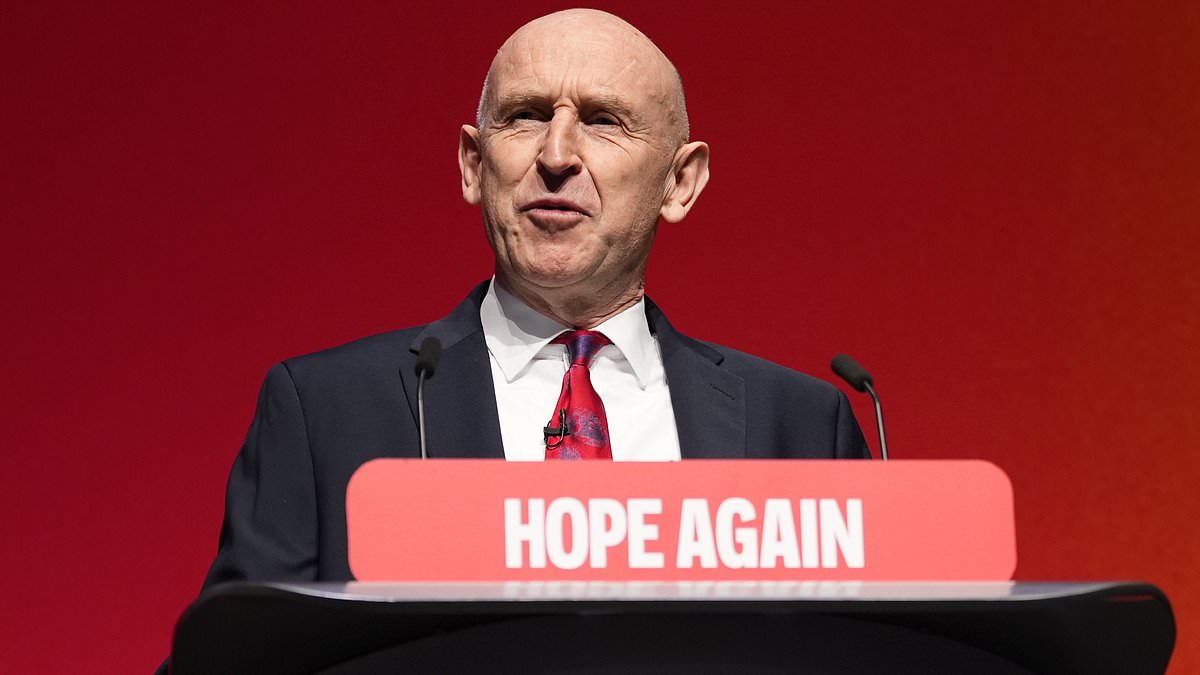
Even by the usual grim standards of party conference speeches, John Healey’s first address as Chancellor to a Labour conference was a pretty dismal affair.Tedious attacks on the Tories, as if Labour had just taken over from them and not been in power for more than two years.That curious mixture of nostalgia and folklore for a long-passed industrial age that still dominates so much Labour discourse. Vacuous talk of ‘fresh hope’, ‘a more resilient country’, ‘a new age of industrialisation’.Plus multiple dollops of hypocrisy.Keir Starmer was praised to the heavens, even though it was Healey’s resignation as defence secretary which put the final kibosh on his premiership.Plaudits too for Rachel Reeves, even though she was unceremoniously sacked to make way for Healey.It was, of course, a party conference speech and the Labour faithful in Liverpool expected some tribal red meat. I get that. But chancellors must also speak to a wider audience: investors, lenders, holders of sterling and British bonds, business executives, entrepreneurs – the people on whom Britain’s prosperity depends.They expect a chancellor to rise above petty party politics, to speak in the best interests of the economy. In a half-hour speech, Healey managed that only twice. Even by the usual grim standards of party conference speeches, John Healey’s first address as Chancellor to a Labour conference was a pretty dismal affair, writes Andrew Neil‘Fiscal discipline underwrites everything we do’, he averred. This was aimed at those who lend us billions, who keep the Government afloat and who fear Labour is hopelessly addicted to extra public spending.It was right that he reassured them. It was just a pity that nobody in the hall applauded when he did so.‘The money New Labour had in the Nineties’, Healey warned, ‘is simply not there’. This was aimed at his party’s soft-Left, which has never come across a spending programme it didn’t like. They heard that in silence too.Labour’s heart is perhaps not quite in it when it comes to fiscal discipline. It’s not even clear Healey’s boss gets it.The only other time he rose above the usual political argy-bargy and point-scoring was when he told his party that, for too many, welfare benefits had become a ‘trap’ and that it was a ‘moral duty’ to get people off welfare and into work.This they did clap – but only after a pause, until they remembered that pre-speech instructions had gone out that this bit should be loudly applauded.Healey is clearly preparing the ground for unpalatable truths to come. He knows that fiscal prudence is being thwarted by an escalating welfare bill. He also knows that, though his party might agree in principle, it has no stomach for the kind of ‘tough love’ welfare reforms needed to tackle it.After all, Starmer’s attempt to cut a mere £5billion from the welfare bill was the beginning of the end for him.What Healey has in store, if anything, remains a mystery. Indeed we learned next to nothing about what will constitute Burnham-Healey’s economic policy.It was not the time, of course, for Healey to reveal his Budget. But his speech was curiously bereft of substance, perhaps because he and Burnham have yet to agree what to do, even though the Budget is only a month away.Healey spoke several times of a ‘new age of industrialisation’, without ever telling us what it means, probably because it’s a meaningless nonsense.The idea Britain can reindustrialise lumbered with the highest industrial energy costs in the world is for the birds.Both Labour and Tories have been complicit in this sorry tale. Their rush to Net Zero, to the exclusion of all other issues, means British industry pays on average £238 per MWh for electricity versus £138 in Germany, £122 in France and £65 in America.British manufacturing companies paid £17billion combined in energy costs in 2024; if they’d been in the US their energy bill would have been £5billion. As long as that’s the case there can be no British industrial renaissance, whatever the politicians promise.It’s not even clear if ‘reindustrialisation’ is the right way to go.Britain is a services superpower. We export more services – legal, financial, consultancy, audio-visual, digital – than any other country in the world, bar America. Since Brexit, service exports have boomed even as the export of goods has struggled somewhat.You’d think it might be an idea to concentrate on what we’re good at, rather than hanker for a lost industrial past. But politicians, especially Labour politicians, are congenitally backward-looking. They’d still rather pose in high-vis vests in factories than visit high-tech offices and laboratories where Britain’s future lies.Healey was desperate to be upbeat. Starmer-Reeves had been so negative about their economic inheritance from the Tories they managed to talk down the economy. Healey was determined not to repeat their mistake. What Healey has in store, if anything, remains a mystery. Indeed we learned next to nothing about what will constitute Burnham-Healey’s economic policyEven so, I was surprised he didn’t prepare us for some tough times ahead. For they’re coming this winter.The Government is struggling to cut its borrowing. This year’s budget deficit might be almost as high as last year’s, which was £130billion.We pay the highest interest charges on our debt of any advanced economy. They’re about to get higher as inflation rises and interest rates follow suit. It already costs us £110billion a year just to service the national debt. That is set to rise.Healey’s scope for borrowing more is close to zero. The bond markets won’t wear it (except at penal rates of interest). His scope for cutting public spending is just as limited. The Labour Party won’t wear it. That leaves tax rises. That’s what’s coming.Given the Labour manifesto ruled out increases in income tax, VAT and national insurance (only for employees, as it turned out), the Treasury is scrambling for smaller tax rises, none of which will raise very much on their own, all of which will be bad for the economy (tax tinkering always is).They will come at a time when the economy, which already suffers under the highest tax burden in peacetime, needs even more taxation like a hole in the head.There is no end in sight for Donald Trump’s war against Iran, so oil and gas prices will remaining elevated, pushing up inflation and interest rates, dampening what economic growth there is and reducing tax revenues.As I write, Trump is preparing to curtail diesel exports in a vain attempt to force down diesel prices in America, which are hurting Republican chances of holding on to the House and the Senate in November’s mid-term elections.Diesel in the UK is already nudging past £2 a litre. It is the essential fuel for farming, construction and road haulage.Over the years we’ve closed more and more oil refineries. So much for ‘reindustrialisation’. We now import 55 per cent of the diesel we need, much of it from America.We have only 42 days worth of diesel in storage, much less than France (219 days), Germany (298 days) and Italy (349 days). So much for ‘resilience’.If Trump proceeds with a ban on diesel exports, the UK economy will be in recession before the year is out.Of this there was nothing from Healey. He was too busy boasting about the miner’s lamp on his shelf and stuffing union pockets with even more dosh in the form of a so-called ‘learning fund’.Labour is good spirits in Liverpool, with a new leader, a lead in the polls and Reform in the dirt. The party should enjoy itself. This is as good as it gets.
ANDREW NEIL: Healey was too busy boasting about his miner's lamp to explain how he'll pay for all that 'hope'
Full Article
Original Source
Read the full article at Dailymail →KhanList aggregates and links to publicly available news content. We do not host full articles from third-party sources. Always verify important information with original sources.