
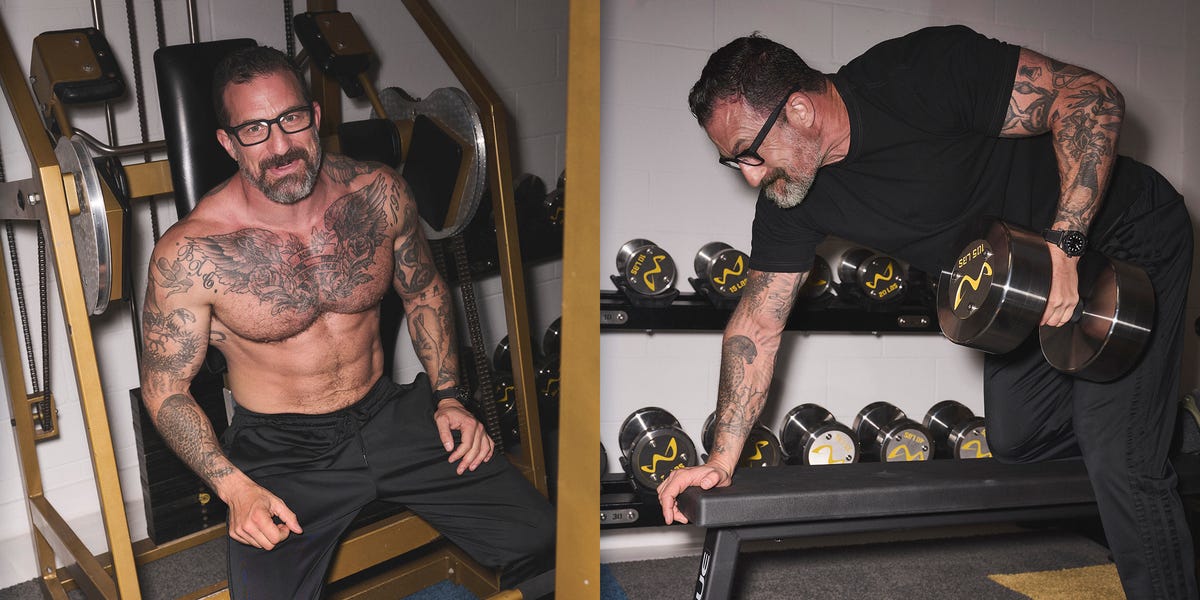
16 min readSPORTING BLACK TRACK pants, a black T-shirt, and Adidas Busenitz skate shoes, Andrew Huberman is prepping for his next set inside his airy and bright gym in Venice Beach, Los Angeles. The room has a mad-fitness-scientist’s playground feel, with new and old equipment jammed together. There are specialist machines like a Pit Shark belt squat and Hammer Strength 4-way neck machine, more conventional gear like a speed bag and an AirDyne bike, as well as a gleaming set of stainless steel, thick-grip, rotational-handle dumbbells made by Watson, the Rolls-Royce of iron. With his Spartan posture and thick beard, Huberman’s giving Moses meets King Leonidas, and he has a mischievous glint in his eyes as he positions his 6'1", 225-pound body into a vintage Nautilus One pullover machine—one of only two in the world—to show me how it works. He pushes the foot lever, which raises the weights, and then he rests his elbows on the bar, puts his feet on the ground, and pulls down. The tall stack of iron rises with a whir as Huberman, 51, launches into all the details about the Nautilus One in the gravelly voice, and with the easy command of science, that fuels his blockbuster podcast, Huberman Lab.This machine, he tells me, was designed by Arthur Jones, the founder of Nautilus and a fitness innovator in the 1970s, and it allows users to target their lats, the wide slabs of muscle that give the back its V-shaped taper, with greater precision than dumbbells or barbells. “The pullover for the back is a great isolation exercise for the lats because only one joint moves,” he says. “It takes the arms completely out of the movement. You can go really heavy and get a great lat contraction without fatiguing your arms. You can go immediately into pullups—but I’m not going to do those today.”Eric Ray DavidsonHuberman with his seven-month-old puppy, Strummer.Almost 35 years ago, as a scrawny 6'1", 150-pound teenager and avid skateboarder, Huberman went to Tower Records near his home in Mountain View, California, to read up on Jones’s workout programs in muscle magazines. He grew up in a close-knit family, but when he was 13, the divorce of his dad, an Argentine physicist and consulting professor at Stanford, and his mom, an American children’s book author, shook him up. Strength training helped him find stability. Earlier this year, for an episode of his podcast, he trained with bodybuilding icon Dorian Yates, a fierce advocate of the pullover machine, and the two muscle-geeked out on the Nautilus One. The reps he’s putting in this morning, with their chain pulley and muscle-head specificity, represent a full-circle moment for Huberman that connects Jones—the person who introduced him to lifting weights so long ago—to Yates, the expert who shapes his training now.With relentless curiosity, Huberman has mixed and matched fitness—and health, and psychology, and biology—knowledge in his own quest to become a better version of himself and build an empire of self-improvement. Huberman Lab, his COVID baby, launched in January 2021 and is now approaching its 500th episode. With 7.85 million followers on YouTube, its audience is at an all-time high, and its format has stayed mostly the same: The host, always clad in a black button-down, converses with an expert, explains the scientific mechanisms behind a behavior, and suggests different tools listeners can use to identify, address, and improve whatever supposedly needs improving.On September 15, he dropped his new book, Protocols: An Operating Manual for the Human Body. More than just show notes from the podcast, it “consolidates the points of intersection” gleaned from Huberman’s interviews with the world’s top experts into “protocols for sleep, fitness, stress, nutrition, light, learning, and personal growth.” He defines a protocol as “an established formula to help you overcome common obstacles, achieve a specific health or performance goal, or generally improve your day-to-day physical or mental state.” They’re specifically not “hacks,” which he deems shortcuts and not “long-term solutions.”Like the podcast, it dives deep and gets granular. At a dense 688 pages, the book is a middle-finger slash bold challenge to our attention-scarce society. It lands at a turbulent time in health culture, with the Make America Healthy Again (MAHA) movement loosening oversight of unproven peptides and understudied psychedelics; the FDA and CDC in constant turmoil; and vaccine and nutrition science becoming increasingly politicized. While his listeners might see Huberman as a sleeved crusader fighting to save science at the Hot Gates of disinformation, critics say his podcast platforms a subtle version of “scienceploitation,” using technical-sounding language to sell questionable wellness products. For his efforts to explain complicated scientific concepts and early-stage research studies to his 7.85 million YouTube subscribers and his 3 million Spotify followers, he has been called a “low-rate Dr. Oz,” “a charlatan,” and “a BS artist [who] dumbs down science to the shallowest popular level possible.” He has also been called “a brilliant neuroscientist” and a “neuroplasticity overlord.” Joe Rogan has called him “a genius.”Still, Huberman’s formula seems to be working. He’s embarking on a book tour, with three live dates, including one at Radio City Music Hall in New York City. If he’s not the first neuroscientist to headline Radio City, he’s certainly the strongest, and he’s the closest thing the wellness world has to a rock star right now. Like any good performer, he gives the crowds something they crave, something deep and primal they’re not getting anywhere else. And whether that’s competence, credibility, or the sense that at least somebody has some answers around here, they get their fix from Huberman.Turns out he has some questions that need answering, too.Eric Ray DavidsonHuberman doing rows and curls.Eric Ray DavidsonWHEN HE LAUNCHED the first episode of Huberman Lab on January 4, 2021, Huberman was 45 years old and a professor of neurobiology and ophthalmology at Stanford University. He previously completed a bachelor’s degree in psychology at UC Santa Barbara in 1998, a master’s in psychology at UC Berkeley in 2000, and then a PhD in neuroscience at UC Davis in 2004. He did postdoctoral work at Stanford before opening his own lab to research vision regeneration at UC San Diego in 2011. He earned that faculty position at Stanford in 2016, where his lab studies brain function, development, and repair. “I studied neuroscience, biology, and psychology for 20-plus years,” he says. “It’s one thing to study these topics. It’s another to work on the brain in a laboratory—to record the electrical activity of neurons and slice up a brain and look at it and talk to clinicians.”His work in the lab led to various stints on friends’ and colleagues’ podcasts, and after a few appearances, he realized he could build his own audience off of his analysis of, say, brain plasticity and stress management. “What was unique about that time, of course, was the pandemic. People were stressed,” he says. “I like to think that I had tools they hadn’t heard of before that could help them get their sleep, their stress, and so on under control.” His tagline—“Welcome to the Huberman Lab podcast, where we discuss science and science-based tools for everyday life”—might not sound compelling, but the captive pandemic audience craved trustworthy health information.Huberman has several theories for why his podcast caught on. Theory one: It was free to listen to, and he wasn’t selling anything. Theory two: His guests were diverse and top caliber. “It was rare among public health communicators to talk about a wide array of things. Now, it’s a bit more common. Like you would get Matt Walker talking about sleep, Angela Duckworth talking about grit, right?”Theory three: There wasn’t really anyone out there who was talking about the underlying mechanisms of things. “Deep down, people want to understand the why behind the tools. The more that they learn that those mechanisms exist in them and everyone, and that the tools work the first time and every time, it really resonates.” It’s partly thanks to Huberman that a more scientific way of talking about our bodies—about cortisol arousal, dopamine receptors, stress adaptation—has become mainstream. “I am well aware that if somebody wants to know the 10 best ways to improve their sleep, they can go on Google or ChatGPT and just print that out,” he says. “Why does that not work? Because the things it lists off aren’t effective. It’s because there’s something about human behavioral changes, there needs to be a buy-in. The buy-in with me is you learn the underlying mechanisms and principles. And once people own those, they are far more likely to do the things on that list, and they can modify them according to their own needs, day-to-day, travel, kids, etcetera.”Eric Ray DavidsonHuberman uses an inversion table to maintain his posture and stay pain-free.When Time ran a feature about how Huberman got America to care about science in the summer of 2023, it cemented his status as an avatar of self-improvement. On TikTok, wives joked that their partners were “Huberman husbands” (evidence: seeking sunlight at dawn, drinking green smoothies, talking about protein), and being “Huberman-pilled” became shorthand for being someone obsessed with their wellness routines. People started recognizing Huberman on the street. “That doesn’t bother me,” he says. “One thing that still makes me happy to hear is when people say, ‘I can’t believe [the podcast] is free.’ We’re giving people stuff that’s really useful.”Jordan Shlain, MD, a physician who runs Private Medical, a concierge health company with six locations across America, says patients arrive in his office and quote Huberman or ask if they should start a certain protocol. “I take it seriously, because it means they’re paying attention to their own health, which is the hardest part of my job to manufacture. People wanted a longer conversation about their bodies than the 15-minute doctor visit was giving them, and they found one [in Huberman]. Physicians should take that personally.”Although Huberman is not an MD, he is in the business of giving health advice. “I don’t consider myself the people’s doctor or psychiatrist or psychologist. I’m a communicator and connector, a connector of people to people and connector of people to ideas,” he says. “What I’m trying to do is create more logical, grounded-in-principle thinkers. I’m trying to set up a situation in the world of health and fitness and scientific understanding where I’m not needed anymore, where the principles are what matter.”Of course, he gets asked a lot about peptides, and he’s cautious: “Everyone’s excited about peptides, but you have to really think, ‘What are the short-term and long-term benefits? What’s the effect you’re trying to get?’ There’s no human evidence that BPC-157 can accelerate healing, but there’s tons of anecdotal evidence and some pretty good animal data, actually. I think there’s a way to do it more safely, and I am for medical freedom. But I’m just not gonna get leveraged by one side or the other. It may infuriate some people, and you end up with fewer friends overall, but probably better friends.”Eric Ray DavidsonHuberman on the vintage Nautilus One pullover machine.DURING THE MEN’S Health shoot, Huberman joked how Internet trolls would comment that the seriously heavy weight he was lifting was fake. (For the record, it wasn’t, and he did multiple reps of single-arm rows with a 105-pound dumbbell.) He recognizes that he is seen as a fitness and health influencer more than a scientist and researcher, and he’s not entirely comfortable under the microscope.Timothy Caulfield, a professor in the Faculty of Law and School of Public Health at the University of Alberta who studies health science policy, is a critic of the wellness industrial complex—specifically, when people use science framing as a strategy to sell supplements or wellness devices that lack strong evidence. He notes that various brands—including AG1, David, Function Health, Roka, and Whoop—sponsor Huberman’s podcast, and he believes the sponsorships create profound conflicts of interest. “When I coined the term ‘scienceploitation,’ it referred to grifters who sell products using science buzzwords like ‘stem cells’ on supplements or ‘microbiome’ on a shampoo bottle to make something feel legitimate,” says Caulfield. “What Huberman does is more subtle, kind of like scienceploitation 2.0, because his entire being is sciencey. As a listener, it becomes difficult to tease out when should I believe you and when are you selling a product.”Huberman notes he lists his sponsors on his website and that he believes in their efficacy based on his personal experience. “Obviously, we have sponsors to make the whole thing continue, but I won’t work with any sponsors I don’t love,” he says. “So I actually feel no shame.” For instance, he says he’s been taking AG1 since 2012, before the podcast started, and uses it himself to get his essential vitamins, minerals, and probiotics. He says he now also takes AGZ, a sleep aid, because “they combined all the things that I suggested they put into a single supplement. It’s got some magnesium. It has some tart cherry, kiwi, a few other things that are known to improve sleep. To be fair, some ingredients have more data on them than others. It works for me. I get great sleep on it.”ERIC_RAY_DAVIDSONHuberman doing dips.During our conversation, the most animated Huberman becomes is when I say the word longevity. He scrunches up his face, like he is in pain. “The longevity space is a circus. The word ‘longevity’ is gonna be right down there with ‘looksmaxxing’ soon. It’s really pathetic,” he says. “I’m sad about it because the goal of living longer is excellent.” He clarifies that there are serious scientists doing important research (Tony Wyss-Coray, PhD, on brain aging; Eric Topol, MD, on genomics; Matt Kaeberlein, PhD, on the biology of aging; David Sinclair, PhD, on reversing aging in eye cells), but the public perception has become silly. “It’s like people come up to me, they go, ‘Did you see this thing?’ And it’s always like the craziest thing. Like, what’s next? Most of the people in the longevity space are to true science and medicine what Bonnie Blue is to true intimacy.”Clearly Huberman doesn’t see himself as being in the longevity space, but the general population often lumps together longevity and wellness, whether Huberman likes it or not. Some critics wonder if all these protocols are too much, or if the nuances of the science are lost on casual listeners, or if some of the studies he references aren’t ready for prime time. “You can listen to an entire episode of Huberman Lab and there won’t be a sentence that’s profoundly inaccurate,” says Caulfield. “There are often caveats, like ‘this was a preliminary study’ or ‘this was a mouse study,’ but the gestalt is ‘Cold plunge. You should do it. This is optimizing!’ ”Optimization is another trigger word for Huberman, and he squeezes his eyes shut and puts his hands on his head when I bring it up. “I think people mistakenly think that my obsession is with supplements, cold plunges, and rigid optimization,” he says. “But part of being a healthy person is being flexible. True optimization is about embracing reality—enforcing some things as best you can but being adaptable. Rise, eat, move, hydrate, sleep: What I’m about is trying to do the little things that cost nothing, take very little time, and that give you an outsized positive effect on the big thing.”Eric Ray DavidsonHuberman using the belt squat machine.The chatter about optimization took on a different meaning when New York Magazine published a cover story on him in March 2024. Multiple people in the article described Huberman as manipulative, deceptive, and unfaithful to partners, and more broadly, the story contrasted his highly disciplined public persona with a chaotic private life. (It also questioned his scientific reasoning and the potential conflict of interest around his supplement recommendations.) The story went viral, with some viewing him as a prime example of toxic masculinity while others wondered what bearing a scientist’s infidelity has on the quality of his scientific advice. Through it all, Huberman continued to post the podcast on its regular schedule, maintaining his work at Stanford and choosing not to talk about the story. “I certainly disagree with a number of things in the story,” he says. “Look, it’s never comfortable when people are saying things and you feel like you would like to correct the narrative. But you really are not in a position to do that because to do that would just amplify the discussion. So I opted to just say nothing.”And rather than turn off listeners, the article actually introduced him to a whole new segment of the audience. “Look, our podcast grew,” he says of the days and weeks after the article’s publication. “I don’t know if I’ve ever said that publicly. Our [audience] grew from that. It was wild. Some people say all press is good press, unless it’s happening to you! But at the same time, I didn’t wanna lean into that because there was another narrative that emerged. There was this kind of folk hero narrative, like, ‘You were dating all these other women.’ I didn’t want that either.” (This particular narrative, popular in the dingier corners of the manosphere, views having multiple partners as apex male behavior.)“I’ve made not the best choices about relationships and partners in the past,” he says today. “I asked myself where I had made poor decisions about people, where I needed to take a look at myself, where I needed to make some changes internally and places where I needed to put my foot down and say, ‘No, that’s not actually true.’ This is the toughest thing about being a public-facing person: You have to have a very clear sense of self. Otherwise, what people say, both positive and negative, can distort your self-perception.”And because he’s Huberman, he found a protocol of sorts to help him navigate his emotions, relying on the guidance of his friend Martha Beck, a Harvard-trained sociologist. Huberman says Beck and her analogy of “the human lighthouse” taught him that it’s critical “to really acknowledge and own the things in you that are challenging.” The analogy goes like this: Imagine a lighthouse that casts a circular light, but if there’s a stain on the lighthouse lens, it casts a shadow. It’s in that shadow that things in life can hurt you. If you realize what those things are, you can wipe them off the lens. “The last thing you wanna do is to try and be seen as perfect. So apparently—and I’m being half-serious—my biggest mistake was not telling people just how imperfect I was enough. I’m perfectly happy going on record—then and now—saying I’m an imperfect person,” he says. “I struggle with all sorts of things. But I strive to be a good person.”Eric Ray DavidsonHUBERMAN HAS SPOKEN (and podcasted) openly about his experiences with talk therapy over the past three decades, but he’s recently started talking more about his exploration of psychedelics. He’s had clinical sessions with MDMA and psilocybin, all under the supervision of a therapist, and he says they’ve been revolutionary in how he remembers his past and lives in the present. “I was able to really think about things from my childhood, things from my life, that I had not been able to face before,” he says. “Everything is amplified with psychedelics, so you really get into your emotions, but then everything opens up. It was like a new vista. Now I have a completely different relationship to the past. I look at it with gratitude. I sure as hell wouldn’t wanna repeat some of that stuff. I managed to throw myself up against the rocks of life many times without needing to. But now I’m living in a peaceful place. I can finally exhale.”Just as he takes other routines seriously, so it is with prayers before bed. “Ever since I was little, I believed in God,” he says. “I just didn’t feel comfortable talking about it.” But in the past three years, he’s confronted “his sneaking suspicion that there was something more.” As a neuroscientist who is interested in self-understanding and trying to parse what it is to be human, this is a thorny area. “I don’t know what form it takes, but maybe this God thing is something to lean into and things will start to make more sense.”He says he realized the way you lean into faith is by having faith. “I learned that in prayer, you’re allowed to have doubts about the existence of God, but you believe anyway. It’s a practice, like working out.” He never prayed “for stuff,” but prayed to wake up with a peaceful mind or clarity around something. And although it didn’t happen overnight, eventually he started having “astounding results.” He says, “You could argue this is all just the human mind convincing itself and looping up back on itself. I can’t rule that out, but the big one for me was when my dad came on my podcast.”The episode with Bernardo Huberman in December 2024 was titled “How to Use Curiosity & Focus to Create a Joyful and Meaningful Life.” “He’s a theoretical physicist, and I said, ‘Would you be willing to explain chaos theory and relativity?’ He said, ‘You know I can and I will, but I have to be really honest with you: One of the most important things you learn as a physicist is that you can’t use the logic of the human mind to understand quantum mechanics. Anyone who says they understand quantum mechanics and they can’t do the math, they don’t understand it.’ When we started talking about God and faith, I said, ‘That’s similar to God: The human mind can’t get from A to B to C in a linear way. In physics, you have the math to rely on. In a relationship with God, you have faith to rely on.’ ”He says he hasn’t missed his nightly prayer in almost three years. “I pray for other people. I pray for clarity around things that are troubling me. Even before a podcast, I pray for the egos to leave the room, for it to be of benefit to people. Then I ask God to open up a bit of a crevice to let something in that’s unaware to either me or the guest, something that’s beyond our conscious awareness.“Sometimes it happens,” he says. “Sometimes it doesn’t.”Lightning RoundExercise protocol?Walk as much as possible every day, strength train three times per week, do cardio three times per week, and do two to four short bouts of mobility and flexibility work.Weekly training split?Long, slow run; legs day; recovery day; chest, back, and neck, a.k.a. “torso” day; 30-minute tempo cardio; 30-minute HIIT-cardio Tabatas on an AirDyne; and arms and shoulders.Gym anthem?The Sentence, by Rancid. The best song ever.What’s the better compliment? “Jacked.” “Ripped.” “Swole.” That you’re all three and not “for your age.”Cardio goal?Crack a sub-7-minute mile again. I ran cross-country in high school, and my best time was 4 minutes 57. But I’m heavier and older now!Burger order?Double cheeseburger. Tomato, lettuce on the side.Meal you’ve mastered?Steak. Growing up the son of an Argentine, I know how to prepare steak properly, indoors or on the grill. I also make an excellent chimichurri. Never had a single response except, “This is the best steak!”Comfort food?I love oatmeal. I guess I lucked out. With cinnamon, cream, and a little maple syrup, if I’m feeling decadent.Fantasy workout partner, alive or dead?Santiago Ramón y Cajal, the father of neuroscience and an avid bodybuilder. Look him up.Last time you cried?Out of happiness? After a recent walk with my puppy Strummer. Yeah, he must have been exhausted like a toddler gets exhausted. He was jumping around, going crazy. And I was laughing so hard, tears streamed down my face. Out of sadness? I talk to my parents often, they’re in their 80s now. I hope they live another 20 years, but I’m bracing myself, there’s this anticipation of pain. Every interaction with them becomes more and more crucial.Eric Ray DavidsonPhotographs: Eric Ray Davidson Visual Director: Sally Berman Video Executive Producer/Director: Dorenna Newton Video Producer: Angel Lenise Pyles Video DP: Ryan MurphyVideo Editor: Kyle OrozovichBen Court is the Executive Editor of Men's Health. He has a decade of experience writing and editing stories about peak performance, as it relates to health, nutrition, fitness, weight loss, and sex and relationships. He enjoys yoga, cycling, running, swimming, lifting, grilling, and napping.
Andrew Huberman 2.0
Full Article
Original Source
Read the full article at Menshealth →KhanList aggregates and links to publicly available news content. We do not host full articles from third-party sources. Always verify important information with original sources.