
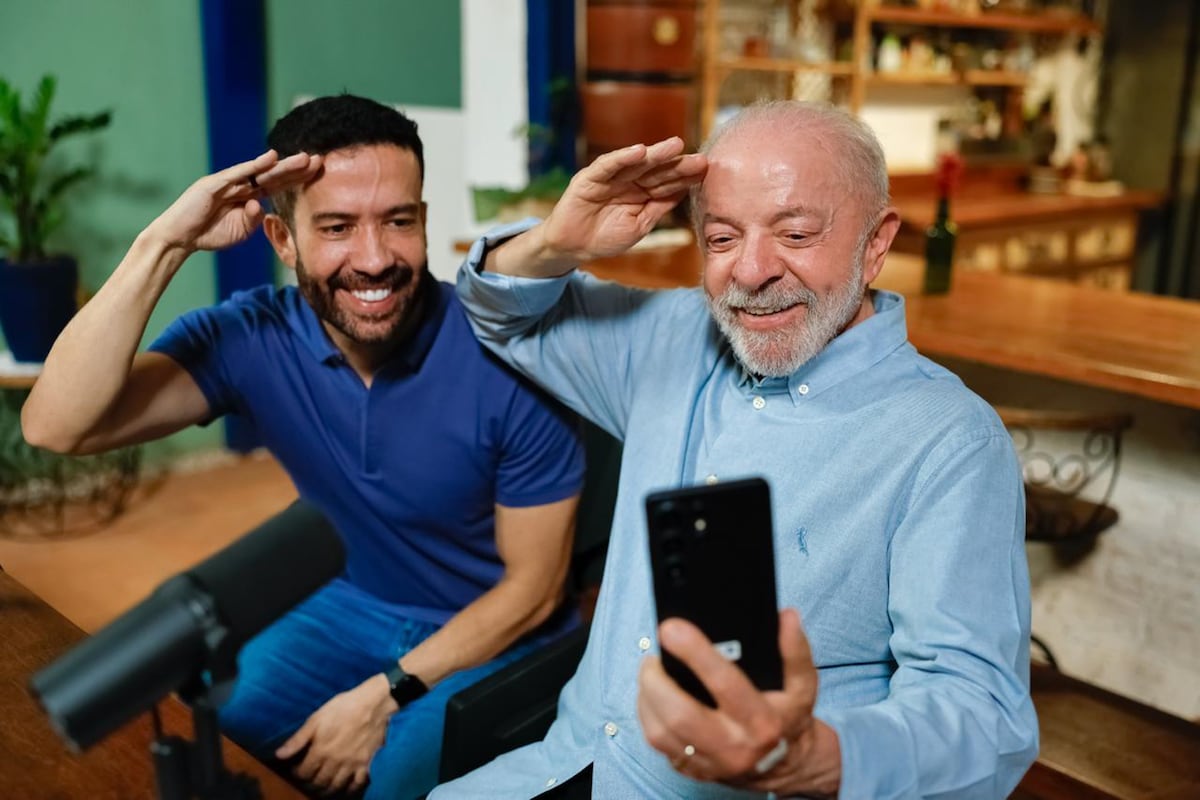
The night Luiz Inácio Lula da Silva won his fourth term, among veteran ministers and old and new allies of the Workers’ Party, there was a man who never left the president’s side and whom almost no one outside Brazil would recognize. He stood out for his big white smile and for being the only one wearing the national team’s yellow jersey. He was André Janones, a lawmaker turned general of a digital army without which Sunday’s historic comeback cannot be understood. A former bus fare collector who had spent three weeks issuing orders via WhatsApp to nearly 11 million Brazilians to tame the algorithm and help the left’s digital communications make, in a few days, a leap they had not achieved in years. “I want to call up the new figure of this campaign, our General Janones,” Lula said from the stage on Avenida Paulista as he celebrated his unexpected victory. “A hug, general.” The crowd replied in chorus: “Janones, warrior of the Brazilian people!”Lula won with 51.7% of valid votes to 48.2%, more than 4.4 million votes ahead of Flávio Bolsonaro, and that was just three weeks after losing the first round by 2.2 million votes. No candidate had pulled off that feat before in Brazil. The president thanked Janones for having raised “the morale of our troops morning, noon and night” and asked him not to demobilize them: “The army cannot disperse.” Euphoric, Lula rallied his supporters: “I doubt that Russia, China or the United States have a victorious army like this country’s army of democracy.”The left’s campaign made some mistakes before the victory. Among them were its digital strategy and its disconnect with younger voters. Something similar happened with the left’s candidacy in Colombia, except that Iván Cepeda was not able to reverse it in time. In Lula’s case, it also emerged that big tech companies such as Meta were suppressing their posts, allegedly for technical problems.“In this runoff I learned the biggest lesson of my life: when a ruler doesn’t know what to do, he asks his people,” Lula said, who has just started using his first mobile phone. “I’m already learning to speak with the general,” he added in reference to Janones. “Now get ready, because I’m not going to speak to you through the media’s interpretation. I’m going to speak to you through Janones’s Army.” The deputy announced: “Now the old man will be here with the phone in his hand, giving direct orders.”Janones’s success lies, among other things, in having reappropriated Bolsonaro supporters’ symbols. From the national team jersey, which for a decade has become the right’s uniform, to the rhetoric. The deputy speaks plainly, even roughly and imperatively, and in martial terms (soldiers, troops, army, missions). He talks like the Bolsonaros, but in service of Lula. His battle cry in the channel was always the same: “People, urgent! Explode!”It is the drumbeat that has accompanied Alexandre Conceição every day for three weeks. He is a government employee and one of those nearly 11 million soldiers who helped boost Lula. He decided to join the WhatsApp channel one day after the first-round debacle, almost as a headlong escape to avoid falling into defeatism. “I only used Instagram to watch recipe videos, and in two days I started to understand how algorithms work. When I realized it, I was awake at dawn doing the homework Janones assigned,” he jokes.The operation is relatively simple: flood the networks with pro-Lula content to the point of bursting the left’s bubble so the content reaches people with a different profile — in this case the most sought-after groups in this election: the undecided and the non-voters. Most “missions” focused on Instagram and X (formerly Twitter). The soldiers were tasked with posting hashtags in support of Lula, sharing videos, giving likes, ensuring record views on YouTube, and so on. There were also clear rules about what not to do: do not interact with Bolsonarista accounts, not even to defend Lula, so as not to give them more visibility.At certain moments in the campaign they carried out coordinated actions, such as a pot-banging protest that swept the country when Bolsonaro gave a television interview, or when millions of Brazilians appeared at nine o’clock on a Saturday morning on Instagram wearing the national team jersey and making Lula’s ‘L’ with their hands. “Not a minute earlier, not a minute later!” Janones warned with his usual vehemence the day before. The goal of the perfect synchronization? For the algorithm to detect that something extraordinary was happening and boost it harder.“The ways people fight for democracy are crazy. In my parents’ time they took to the streets to stand in front of the military. Today everyone is stultified, having to make posts on the internet, but it has been great, it worked,” Alexandre says. He now wants to take a couple of days of digital detox, but he knows Janones will soon call him back.Janones, 42, was born in Ituiutaba, an inland city in Minas Gerais. The son of a domestic worker, he paid for his law studies working as a bus fare collector. He is evangelical and, before entering politics, became known online as a pro bono lawyer for public health patients suing the state to obtain treatments. He was active in the PT for a decade and rose to national fame in 2018, during the truckers’ strike, when he went from 70,000 to one million followers overnight.His “army” was born at the start of the runoff campaign, when Lula’s team was looking for a response to the October 4 defeat. In three weeks he gathered nearly 11 million followers in a WhatsApp channel from which Janones distributed, or rather ordered, daily tasks: sharing videos, creating memes, responding to Bolsonaristas or ignoring posts so as not to give them reach in the algorithm. The Superior Electoral Court suspended the channel twice at Flávio Bolsonaro’s request and it resumed twice.At first, Lula’s own team distrusted him and asked that he not be considered an official part of the campaign. In the end, President Lula was doing live broadcasts with him at dawn. “We are going to win the war. And you will be promoted,” he promised on Saturday during a streaming after the final debate. Janones had been announcing for days that the president would be reelected. “The left hadn’t found its own style and he invented it,” says someone close to the president. “He doesn’t opine much: he passes on information, he doesn’t make theoretical elaborations. His power comes from simplicity.” A verification by fact-checking agency Lupa of 721 messages from the channel found no misinformation about Flávio. In the rival channel, the Tropa do Flávio, which has about two million followers, fact-checkers counted 17 false or distorted posts.The paradox is that the general who mobilized millions barely wins votes for himself. Elected federal deputy in 2018 with 178,660 votes and in 2022 with almost 239,000, on October 4 he renewed his seat with 78,780 votes, 67% fewer. He is not free of controversy either: in 2025 he reached a deal with the Prosecutor’s Office to avoid a trial for keeping part of his aides’ salaries, a practice in Brazil known as rachadinha and of which Flávio Bolsonaro has also been accused. Lula does not seem to mind. He already has a mobile phone, and he already knows whom to text first — the secondary figure who turned a digital army into votes.Sign up for our weekly newsletter to get more English-language news coverage from EL PAÍS USA Edition
André Janones, the WhatsApp ‘general’ who turned the Brazil election around for Lula
Full Article
Original Source
Read the full article at English →KhanList aggregates and links to publicly available news content. We do not host full articles from third-party sources. Always verify important information with original sources.