
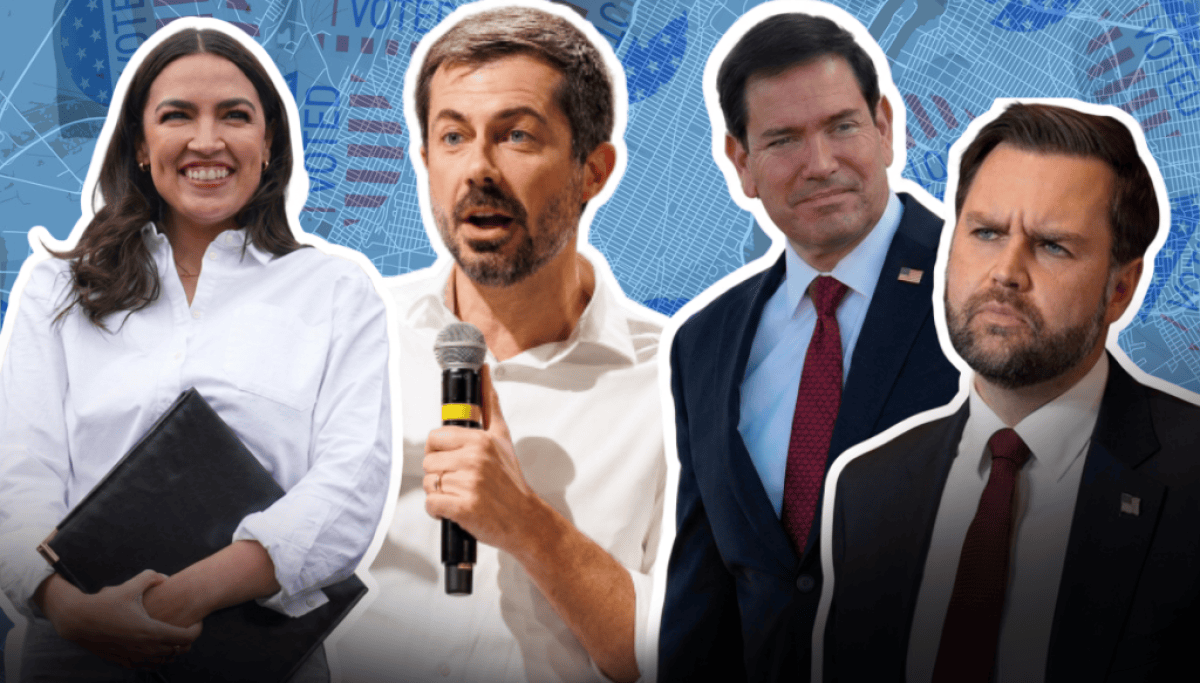
Last week’s election was a rolling catastrophe of historic proportions for the GOP, from which a political recovery could take years. It also marked the unofficial start of the 2028 presidential race, which will heat up in earnest next year.Republicans are licking their wounds, engaging in recriminations over the midterm repudiation, and wondering aloud whether the party can rebound quickly enough to be nationally competitive in the next cycle. Democrats are licking their chops, eyeing the very real possibility of substantial congressional majorities plus the presidency starting in 2029 — a combination that could produce disorienting policy and structural changes.One prominent strategist has said his party’s presidential field will feature a cavalcade of aspirants. Former Barack Obama campaign chief Jim Messina has heard from “over two dozen” candidates who are eyeing 2028 bids. He believes the process will kick off very soon, anticipating that various Democrats will begin to “announce exploratory committees next week or the next couple of weeks, probably after Thanksgiving.” Figures from across the center-left spectrum are emboldened by the 2026 outcomes, which demonstrated that within a toxic anti-Republican overall climate, even strikingly “progressive” and extreme candidates are viable all across the map. If the national environment two years from now resembles anything close to what we witnessed last week, virtually anyone with a “D” next to his or her name could realistically win the White House.The litmus test for this proposition, in the minds of many progressives, was the Michigan Senate race. “If Abdul [el Sayed] can win in Michigan, anybody can win anywhere,” declared Rep. Alexandria Ocasio-Cortez, the New York congresswoman and leftist “Squad” leader who is widely speculated to be mulling a presidential run. She added an extra “anywhere,” for emphasis. Tuesday’s results buttress her point, and perhaps her own personal calculus, too.On the Republican side, shell-shocked partisans are pointing fingers and raising voices over the causes and scope of the wreckage.Vice President JD Vance published a much-discussed memo on social media, laying out his version of a postmortem analysis. He placed blame for sweeping GOP losses on a number of factors, but ultimately identified the Iran conflict as the ultimate culprit. “The reason we lost is the war,” he wrote in his post.Critics pushed back, noting that Republicans’ polling position and the president’s approval ratings were already in poor shape at the onset of the military campaign, accusing Vance of ignoring the impact of tariffs and related post-“Liberation Day” chaos on the electorate’s mood. Others questioned Vance’s claim, attributed to an unnamed data guru, that one of the top four reasons Trump voters flipped to Democrats was the belief that America must alter its relationship with Israel. (Exit polls showed the heavily blue-tinted electorate was evenly split over Israel, which was not a major vote-moving issue overall. Among the half of the electorate that said America’s government is too supportive of the Jewish state — the other half said the US position is sufficiently supportive, or should be more supportive — less than 20% were self-identified Republicans).Voters’ overriding concerns, per exit polling, were the cost of living and corruption. Democrats cleaned up among voters focused on these issues, lopsidedly winning over those who said they didn’t trust either major party. (Democrats have not suddenly become beloved by the American people, the data shows, but voters were determined to send a punishing message to ruling Republicans).The “affordability” question was clearly impacted by the Trump administration’s tariff policies — and specifically, I’d argue, the widespread perception that the tariffs were implemented in a tumultuous and capricious manner, including the gratuitous targeting of allies. Voters may have been open to limited action on tariffs, but the way the policy was shoddily rolled out led many Americans to conclude the administration was driven by misplaced and counterproductive priorities on the No. 1 reason Trump had been re-elected in the first place: inflation and making life more affordable. The president’s approval numbers tumbled immediately following “Liberation Day,” and never recovered.His approval ratings also tracked closely with the per-gallon price of gasoline, which serves as an omnipresent billboard for affordability. This metric was undoubtedly affected by the U.S. military action against Iran’s regime. It is debatable at best to claim that last week’s anti-Republican wave was caused by the war. It is indisputable, however, that the conflict inflamed a serious and underlying political vulnerability for the party in power. High fuel costs helped doom Republican campaigns across the country, and those costs were driven higher by the war. That is a fact. Iran’s regime temporarily succeeded in exploiting the Strait of Hormuz choke point to manipulate oil prices around the globe. It’s worth noting that regime leaders publicly celebrated our election results, having effectively endorsed the opposition party in a pre-election screed.Another rumored 2028 contender is Secretary of State and national security adviser Marco Rubio. Unlike Vance, Rubio is robustly defending the president’s decisions vis-à-vis Iran. During a post-election gathering at Mar-a-Lago, flanked by the president, Rubio praised Trump’s choices.“The most important thing the president can do for our country is to keep it safe,” he said, adding that Trump “was elected to do the hard things…it would have been very easy to do what multiple presidents before him have done, which is ignore the Iran thing, leave it for the next guy, put it aside, and don’t worry about it. That would have been the easiest thing to do. But this president didn’t do that,” he continued. “We cannot live in a world in which the most radical, terroristic regime on the planet possesses a weapon of mass destruction. And we had president after president ignore it and allow it to linger, but this president wasn’t elected to ignore it, and he wasn’t elected to allow threats to linger.”Rubio has rejected any talk of 2028, and recently swatted down rumors that he is preparing to exit the administration, perhaps to pursue a second White House run. Rubio has previously stated that he’d rule out such a campaign in the forthcoming cycle if Vance throws his hat in the ring.Relatedly, reports are also buzzing about Vance allies privately warning against a 2028 run, citing dreary prospects for a GOP victory. Meanwhile, Florida Gov. Ron DeSantis has come out swinging on social media and in a flurry of interviews, diagnosing his party’s ailments.DeSantis largely receded from the national limelight after a failed 2024 presidential bid, but has now re-emerged as his term-limited tenure in Tallahassee comes to a close. Florida offered a faint silver lining for Republicans last week, as the statewide ticket survived the blue tsunami that crashed nearly everywhere else, dragging under Republican candidates in similarly red, and even deeper crimson, states. DeSantis is arguing this was no accident, making a case for his leadership and judgment. With an emphasis on delivering conservative policy results and winning elections, DeSantis is fighting to help shape the congealing post-2026 narrative.Unlike Vance and Rubio, he is at a distance from Trumpworld, which may prove an asset moving forward, especially if public sentiment toward the administration does not improve (a sustained drumbeat of positive economic news, particularly on fuel prices, could move the needle on that front).TRUMP’S BASE GOES BLUEMany Americans are putting the midterms in the rearview mirror and gearing up for the fast-approaching holiday season, which often offers a political hiatus. But within the political realm, Democrats are plotting their agenda for the next two years, ahead of an extremely high-stakes rumble in 2028. Presidential fields are already taking shape on both sides, mostly out of view. Movement is underway behind the scenes, much of which will soon come into public view. With one side reeling and the other side ebullient, a new and highly consequential political season will soon be upon us.Prepare for a very bumpy ride.
And they’re off: 2028 jockeying already underway
Full Article
Original Source
Read the full article at Washingtonexaminer →KhanList aggregates and links to publicly available news content. We do not host full articles from third-party sources. Always verify important information with original sources.