
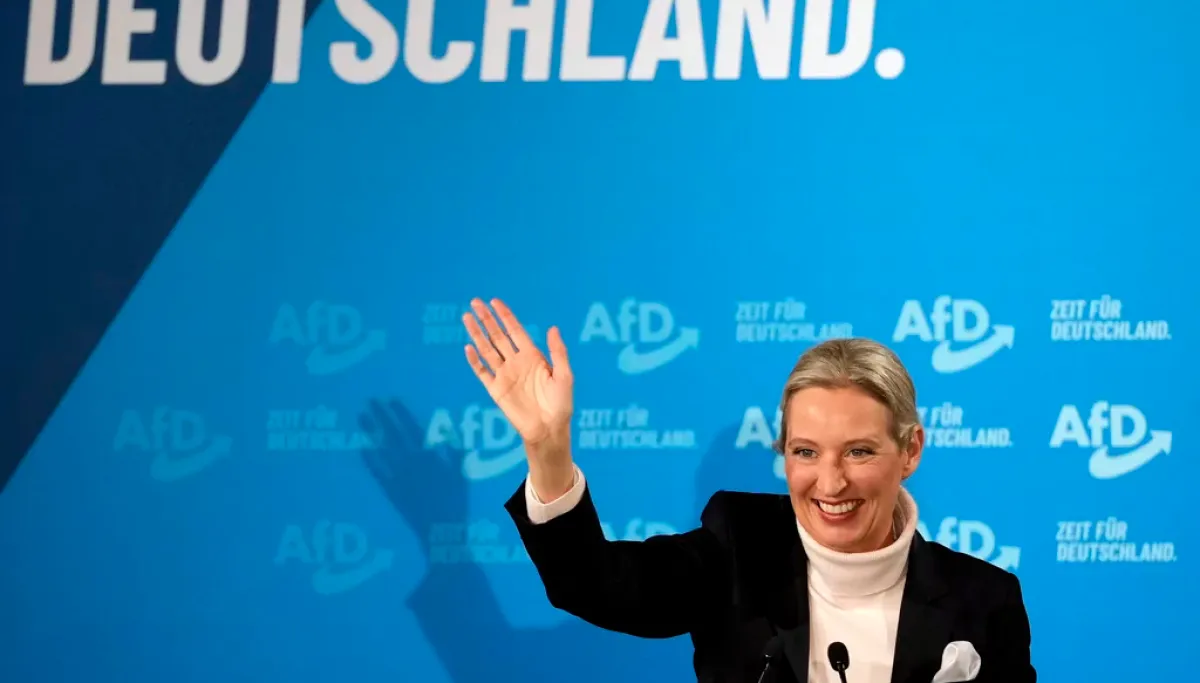
The British diplomat and novelist, Harold Nicholson, tossed off an essay in 1929 containing a short riff on the three great capitals of Europe. “London is an old lady in black lace and diamonds who guards her secrets with dignity,” while “Paris is the woman in the prime of life to whom one would only tell those secrets that one desires to be repeated.” London, an old lady, the City of Lights, a woman, “But Berlin is a girl in a pullover without much powder on her face,” and not much concerned with secrets. “One walks with her among the lights and in the shadows. And after an hour or so one is hand-in-hand.”A good chance that Berlin girl marched on the Left in the heady days of the Weimar Republic. So, too today, a century later. She now goes by the clear and forthright name The Left party (Die Linke). She won a smashing victory last Sunday. Berliners delivered her 25% of the vote in its state election against a fragmented opposition: Center-right Christian Democrats 19 %, hard-right Alternative for Germany 16%, Greens 14%, and center-left Social Democrats 12%. CALL THEM ‘NAZIS’ ALL YOU WANT: THE NEW GERMAN RIGHT IS WINNING THE ARGUMENTWho she might walk hand in hand with to form a coalition state government remains to be seen. A likely possibility is a three-party coalition with the Greens and the SPD. The Left party’s leader, Elif Eralp, a 45-year-old lawyer of Turkish origin, is also the top contender to become mayor of Germany’s capital city (which is also a state for electoral and other purposes). Eralp’s immigrant background helped her party’s chance of winning the election. Almost half of Berlin’s 3.9 million residents have an immigrant background. This includes an extremely large Turkish community. Eralp’s heritage, along with her status as a social media star and her cosmopolitan edginess, catapulted her to a powerful victory. As the Financial Times reported: “She and other leading party figures have cultivated a recognizable style: sharp fringes, tattoos, hoop earrings and red lipstick.”And still more for Americans into the German groove. Drawing comparisons to New York Mayor Zohran Mamdani is irresistible. Eralp welcomes this. “If a left-winger can win in New York, it can happen in Berlin,” she announced last November after Mamdani captured the mayor’s office. The two radical leaders keep in touch. “We’ve exchanged a lot of ideas,” she said. Like Mamdani, Eralp’s most potent idea concerns housing. A key plank in the party platform is a frontal assault on large real estate developers in the city. The Left party, which grew out of the socialist party in the former East Germany or German Democratic Republic, seeks to bring capitalist landlords under the control of government power not only by way of rent control, but also by going for the classic Marxist brass ring: expropriation. In this case, liquidating any company that owns more than 3,000 flats. This is an iffy power play since the city’s less radical previous administration tried a similar move in 2020 and the following year a federal court overruled the proposal (Teutonic judicial originalism?)Still, with a chronic housing shortage a top concern among Berliners, especially young people who are more likely to swing to extremes on the Right or the Left, Eralp’s ringing Mamdani’s “affordability” bell is a political no-brainer. In Berlin, 85% of households are renters, and rents have nearly doubled since 2014. An expensive decade for shelter against the storm. What, then, is to be done with the capitalist real estate developers if The Left party’s expropriation gambit takes place? What Lenin proposed for the bourgeoisie in a communist society comes to mind: They will be “cleaning latrines.” For those on the Left waiting to pass out sponges, latex gloves, and Lysol spray to the plutocrat cleaning crew, these are glorious days. Along with the latrines, perhaps spruce up the beautiful, high-Renaissance-style red-brick facade of Berlin’s city hall, called Red Town Hall. As Eralp said on the campaign trail, “The Red Town Hall must finally turn truly red.” Despite Eralp’s elation, Die Linke’s nemesis, the party furthest to the right, the AfD, came in third with 16% of the vote, almost double what it received in the previous election two years ago. On the same day as the election in Berlin, in another state election, the AfD shot its wad across a big chunk of north-east Germany. In Mecklenburg-Western Pomerania, the AfD won overwhelmingly with 38% of the vote, more than doubling its share from the previous election in 2021. The SDP came in a close second with 35%, followed by the Greens and The Left, both of which snagged about 6% each. More stunning than the AfD’s win was the devastating wipeout of the CDU in Mecklenburg-Western Pomerania, bringing in only 4.9%, just shy of the 5% threshold required for representation in the state parliament. A first and new low for the CDU of Wagnerian proportions. In three state elections over the past two weeks, the CDU has given new meaning to the word “kaput.” The party’s share of the vote in Berlin at 19% was down from 28% in 2023. In the first of the three elections in Saxony-Anhalt, the CDU received only 17%, down from 37% in 2021. In that state in eastern Germany, the AfD made its best showing, winning 44% of the vote. With two out of three election victories behind it, the AfD’s momentum will likely continue. However, not so much for its anti-immigration, anti-elitist, and pro-Russia get-that-natural-gas policies as people think. “The AfD is winning by default,” argues Russell A. Berman in the Swiss magazine, Die Weltwoche. A longtime analyst of German politics and culture, Berman is a professor at Stanford University and a senior fellow at the Hoover Institution. Three differing ways of defining what the AfD is all about have arisen as it has gained appeal, Berman suggests. First, the spokespersons and AfD party leaders call themselves nationalist and conservative rather than far right. Second, AfD’s political opponents “unambiguously denounce the party as Nazi, fascist, racist, and an outright threat to democracy.”Of greater interest is a third force, “the voices of the people who may actually cast their votes for the AfD.” Setting aside Berman’s 50-plus years of scholarship on Germany, he picked up a sense of what ordinary Germans were thinking about their government on a train trip through central Germany a few weeks before the first of the three elections. In casual conversations with his fellow passengers, “I did not hear much direct enthusiasm about the AfD. Instead, there appears to be a willingness to give the AfD a chance because it is seen as a plausible alternative to the established parties.” In his conversations on the train, even the most contentious issue on the German political landscape remained in the background. “Remarkably, most of my informants did not mention concerns about immigration at all until I prompted them.” Viewed from this train hurtling across Germany, the twin elections in Berlin and Mecklenburg-Western Pomerania, despite their different outcomes, carry the same meaning. The political center represented by the CDU and the SPD is getting squeezed from both the left and the right, not so much to topple established institutions, but to heed the poet’s call: “Don’t stand in the doorway. Don’t block up the hall.”A LESBIAN GOLDMAN SACHS BANKER WITH AN IMMIGRANT PARTNER — AND THEY CALL HER GERMANY’S ‘NEO-NAZI’ LEADERThe train passengers who spoke with Berman “basically explained the widespread AfD support as a matter of Wir sind das Volk — we are the people — the slogan of the anti-communist demonstrations that forced the end of the GDR regime. During the decades of the GDR, the government had consistently ignored the people. Now they see the new regime, the ‘Berlin Republic,’ as similarly ignoring them.” If this frustration, mixed with hope for a new direction, continues over the next few years, it will favor the Right no matter how much it gets trashed by the Left.Bob Armstrong is a contributing writer to Thursday Review, an online magazine, and the author of a memoir, No Exit from Vietnam, Pen & Sword Books.
And just like that, Germany’s establishment went kaput
Full Article
Original Source
Read the full article at Washingtonexaminer →KhanList aggregates and links to publicly available news content. We do not host full articles from third-party sources. Always verify important information with original sources.