
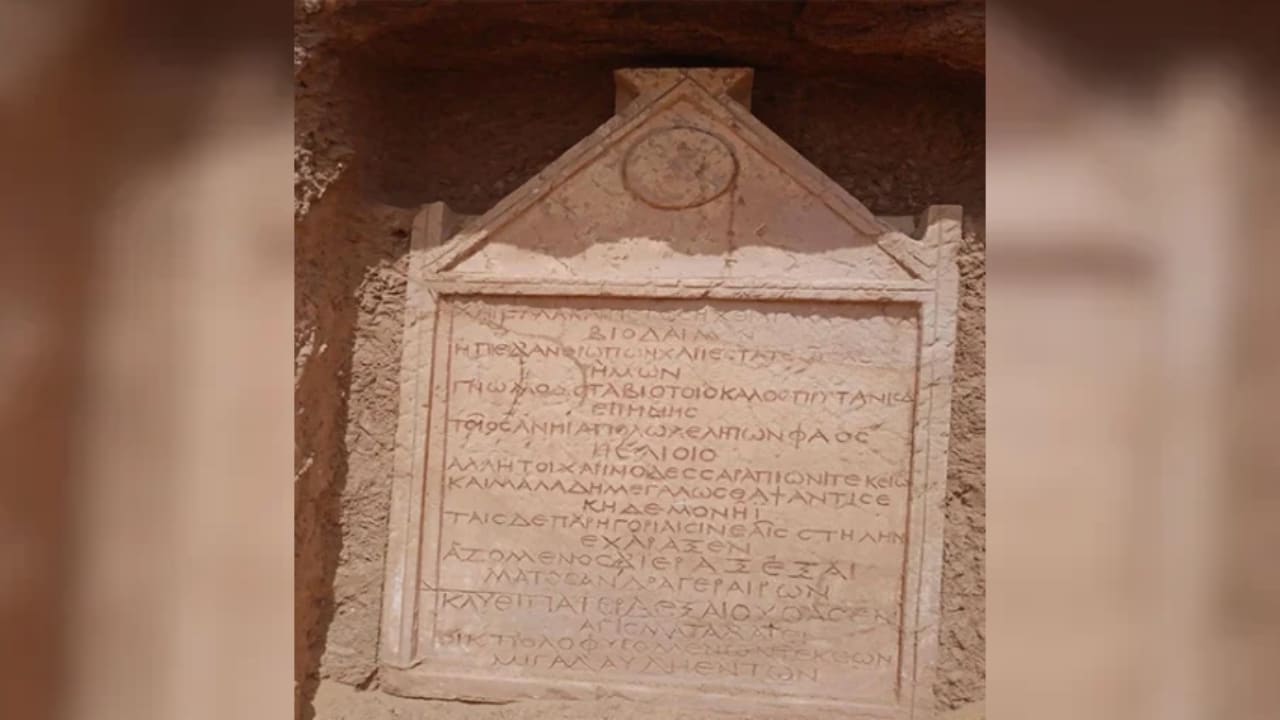
Its 19-lines of ancient Greek text is written in red ink, dedicated to a person named "Pesikhtis," who, according to preliminary study, may have held the position of judge.Follow us on GoogleEgyptian funerary stele written in ancient Greek recently found during excavations at the Dakhla Oasis, Egypt, October 2, 2026.(photo credit: EGYPTIAN TOURISM AND ANTIQUITIES MINISTRY)OCTOBER 4, 2026 02:55An ancient Greek funeral elegy stele was found within a pyramid-shaped mud-brick tomb in the Bir al-Shaghala archaeological site in the Dakhla Oasis, Egypt’s Tourism and Antiquities Ministry announced in late August.The tomb, which dates back to Egypt’s Roman period, was built for the burial of a man and his wife.A 14-step staircase leads down into the tomb’s main entrance, made of sandstone and decorated with hieroglyphic inscriptions and writings, including protective funerary spells and other phrases.The stone entrance is a unique to the Bir al-Shaghala necropolis, noted Mohamed Abdel Badie, Head of the Egyptian Antiquities Sector at the Supreme Council of Antiquities.It is crowned by an Egyptian cornice decorated with a winged sun disk and two cobras, followed by an architectural element in the form of a bundle of reeds.Entrance to ancient Eygptian tomb found in Egypt's Dakhla Oasis, October 2, 2026. (credit: EGYPTIAN TOURISM AND ANTIQUITIES MINISTRY)The entrance’s upper lintel also bears a funerary scene previously unseen at the necropolis, depicting the seventh hour of the Book of Amduat, one of the ancient Egyptian books of the afterlife.Inscriptions on both sides of the lintel include texts and scenes related to the tomb's owners. Additionally, the entrance was found sealed by a stone slab carved with the image of an Osirian form surrounded by a group of spells.The entrance then leads into a mud-brick hall with a partially-collapsed vaulted ceiling, with two burial chambers branching off it to the right.Funerary stele found affixed to tomb's wallArchaeologists found the funerary stele affixed to the tomb’s southern wall. It is rectangular in shape and is topped with a gabled stone centered on the relief of a sun-disk.Its 19-lines of ancient Greek text is written in red ink, dedicated to a person named "Pesikhtis," who, according to preliminary study, may have held the position of judge.The elegy dates back to the late third and early fourth centuries BCE, and serves as evidence of a literary and cultural life in the region during the Roman period.In addition to the stele, archaeologists also uncovered a sandstone offering table and purification basin, several pottery vessels, and a bronze coin with the portrait of the Roman Emperor Constantine within the tomb.Director general of New Valley Antiquities Mohamed Ibrahim noted that there is evidence of the tomb having been reused at a later point, as the remains of mud-brick chapel and funerary shrine were found above the entrance.The importance of the discovery lies in the tomb’s architecture, inscriptions, and funerary texts, explained Secretary-General of the Supreme Council of AntiquitiesHisham El-Leithy, providing important information about the funerary practices and life during the Roman period.Egyptian Tourism and Antiquities Minister Sherif Fathy echoed the sentiment, noting that the oases sites hold “important evidence… of the succession of civilizations Egypt has witnessed through the ages.”Follow us on Google
Ancient Greek elegy dedicated to judge found in ancient Egyptian tomb sealed with protection spells
Full Article
Original Source
Read the full article at Jpost →KhanList aggregates and links to publicly available news content. We do not host full articles from third-party sources. Always verify important information with original sources.