
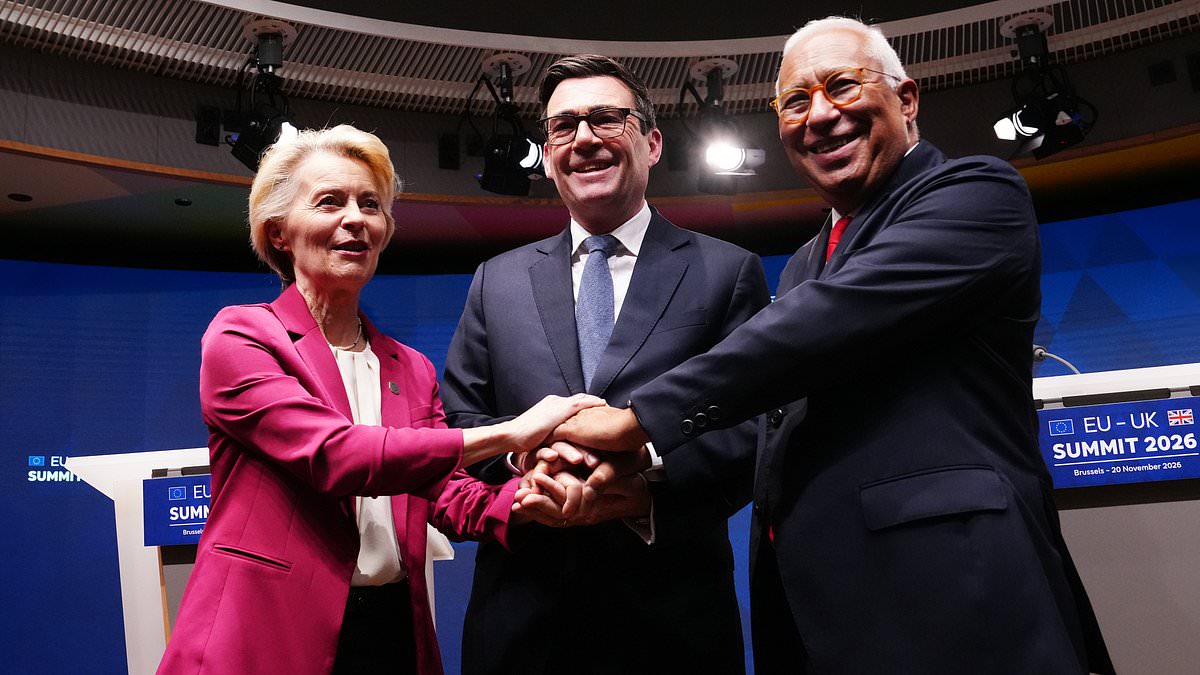
Andy Burnham brought half the Cabinet to Brussels today to celebrate his Brexit surrender deal.The beaming PM was joined by Ed Miliband, John Healey and others as he met European Commission president Ursula Von Der Leyen this morning.They were in the European capital to sign off an agreement that hauled Britain into closer alignment with the bloc it voted to leave a decade ago.With more than a gentle nod to domestic problems, he and his team have been to spin the deal as a way of helping hard-pressed Brits who face major cost of living challenges.The legislation that will be required to turn it into UK law is unofficially being touted as a 'cutting costs bill' and the PM this morning told business leaders in Brussels would add up to 0.5 per cent to the UK's GDP.He also suggested it could be a panacea for the blight of youth unemployment and struggles for younger adults, saying: 'Gen Z, millennial kids, I think they arguably were the biggest losers from the changes of a decade ago.'But it has prompted a major pushback from Brexiteer critics who say the UK is getting a very poor deal and that it is not worth unpicking past battles over sovereignty. But what exactly is in it?European Council President Antonio Costa, Britain's Prime Minister Andy Burnham and European Commission President Ursula von der Leyen He was joined by Ed Miliband, John Healey and others to sign off an agreement that hauled Britain into closer alignment with the bloc it voted to leave a decade agoOpening the UK's border to 'young' EU workers and studentsThe most contentious part of the deal surrounds making it easier for EU students and young workers to come to Britain in larger numbers and more cheaply.The UK has made concessions on a 'youth experience scheme' that allows people aged 31 and under live, work or study in the UK and EU.Britain initially wanted to limit it to around 50,000 people going either way each year but has agreed to an EU demand for 100,000 work visas a year and raising the age limit from 30 to 31. The visas last three years, meaning that there will be a maximum of 300,000 EU citizens in the UK under the scheme at any one time/ But demands from Brussels to cut the fees faced by students from member states studying in the UK to the same level as domestic undergraduates could block the deal coming into effect.It would mean a cut from fees of up to £38,000 a year to £9,970 – something the UK has resisted because of the financial impact it would have on universities. Subsidising the difference would cost UK taxpayers up to £485million a year.While an over-arching deal has been signed, a six-month deadline has been put on talks to reach a deal on fees, with the prospect that other elements of the agreement might not be implemented until a solution is found.An EU official said: 'We have given ourselves a deadline of six months to solve this issue, we have been in talks with the UK.'I think our position has been clear that this is an issue that needs to be addressed. Since Brexit the level of students from both sides studying on the other side has decreased, notably EU students in the UK.'We think this is something that makes our relationship poorer and we want to address this.'So have given us six months to solve this. As for the other agreements we hope they will come into force quickly but we have been negotiating these in parallel and we think that they should also come into force in a balanced way. So this is our expectation and … we think this will be met.'But Mr Burnham said there was 'no confusion' over the status of the deal.'There are firm dates for the implementation of the changes to the different policy areas in the deal and there will be further discussions coming out of it as referenced in the text, around various issues, of which tuition fees is one,' he added.Universities UK, which represents 124 universities, said a change to fee status would raise questions about autonomy, devolution and financial sustainability of institutions.The Russell Group, an association of 24 'research-intensive' universities, said reduced fees for EU students would lead to 'unintended consequences'.Hollie Chandler, director of strategic policy, said: 'Our education and research links with the EU are incredibly important and EU students make a valuable contribution to our universities.'However, any reduction in EU student fees would put pressure on UK student places and take more money out of UK higher education, without necessarily achieving the ambition of growing opportunities for EU students to study in the UK.'It is clear from the statement today that the UK Government and the EU are aware of these risks, and have agreed to take the time to fully consider the unintended consequences before taking any final decisions.'Conservative leader Kemi Badenoch meanwhile warned the youth experience scheme risked making the competition for jobs fiercer.She told reporters on a visit in Essex: 'I just don't think this deal is fair – I don't think it's fair because it's going to increase energy bills, I don't think it's fair because it means that more young people are coming here to compete with our young people who are struggling to get jobs.'Cross-border deal on food and agriculture The food and agriculture deal, aimed at ending post-Brexit export checks, would see Britain align with the EU on trade rules on sanitary and phytosanitary (SPS) goods, such as food and plants from March 2028.This would help speed up border checks at ports like Dover and also in Northern Ireland. Because Northern Ireland remains aligned with EU SPS rules under the Windsor Framework, agri-products can move across the Irish border without routine controls.The post-Brexit arrangements in the Northern Ireland Protocol, however, mean consignments of live animals, animal products, plant products, high-risk foods, and wood packaging material from Great Britain to Northern Ireland face documentary, identity and physical checks.The Conservatives accused the Government of preparing to 'sell out' British farmers by becoming a rule taker.Shadow environment secretary Victoria Atkins said: 'They are forcing farmers to follow rules over which we have no say, no vote, and no veto, that benefit highly subsidised foreign farmers, and taxpayers are going to end up paying for the privilege.'Reform UK leader Nigel Farage accused Mr Burnham of 'betrayal'. He acknowledged that for food exporters a deal on agricultural standards will make things 'a little bit easier', but said it comes at the cost of giving up control over regulation.The Reform leader told BBC Radio 4's Today: 'The Labour Party was elected saying they would not rejoin the single market. Well, today we're rejoining a chunk of it.'Getting cut into EU's 'Made In Europe' trade planA key British demand for closer relations is that the EU grant it special status under the bloc's 'Made in Europe' rules, notably for cars. The EU's scheme would require companies to include a certain percentage of European-made components as a condition of accessing EU subsidies or selling to EU governments and agencies.The main goal is to help manufacturers in sectors including electric vehicles and batteries compete against cheap Chinese imports, but it would also exclude products made in the UK.While the plan is currently incomplete, the EU has indicated it is willing to let the UK, but only on condition that Britain align with its policies.The draft joint statement had featured conflicting lines from Britain and the EU about the extent of coordination.The final agreed wording said that, in sectors where cooperation had been agreed, Britain would 'ensure outcomes consistent with relevant EU measures' to protect sectors and guard against circumvention.This seems to allude to a Franco-German proposal that EU public money could be spent on British cars, through public procurement or subsidies, if Britain agreed to dynamic alignment with EU trade protection measures.That could mean Britain adopting measures the EU has taken to restrict imports of Chinese-built hybrid and battery-electric vehicles, which London has so far been reluctant to do.Mr Burnham today said the deal alleviated the UK concerns, saying: 'We are facing the undercutting of European and British industry from overseas exports, and we should face it together.'And that is what the text talks about. So, our experts, European experts in the same room dealing with these challenges together. That is progress, I would say, not a fig leaf.'
Anatomy of a Brexit surrender: Burnham swaps 'free movement' for 300,000 'young' Europeans and obeying EU rules for smoother cross-border trade
Full Article
Original Source
Read the full article at Dailymail →KhanList aggregates and links to publicly available news content. We do not host full articles from third-party sources. Always verify important information with original sources.