
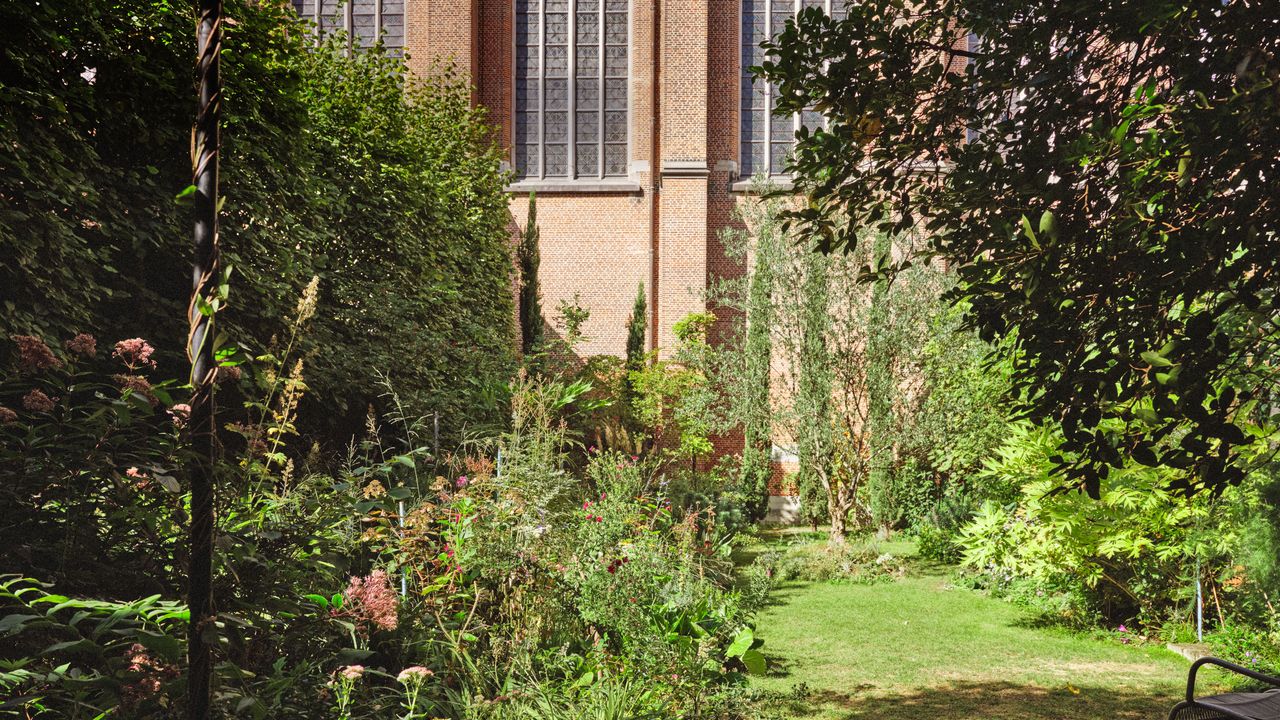
On a quiet side street, Dutch landscape Ronald van der Hilst architect and designer tends to a richly layered, historic church gardenTo achieve a feeling of abundance, landscape architect and designer Ronald van der Hilst planted beds with multiple individual species rather than big groups of one kind. The walls of Antwerp’s Sint-Joriskerk (St. George’s Church) rise in the background.For Ronald van der Hilst—the Dutch landscape architect and designer based in Antwerp—one garden in particular celebrates his calling. It just so happens that he lives in a renovated 19th-century coachman’s house across the street.The site is a hidden space known as Hortus Conclusus, after the Latin for enclosed garden. Historically, such spaces were often features of religious buildings around the world including monasteries and convents, keeping animals out and fresh water, herbs, vegetables, and flowers safely inside. This one belongs to St. George’s Church (Sint-Joriskerk) on Mechelseplein, a quiet street around the corner from a lively square in the heart of Antwerp.Van der Hilst’s involvement was planted in 2018. As their neighbor, the clergy approached him that year with what he calls a “godsend of an opportunity” to take over the care of the garden—no longer used by the congregation, and by then more burden than blessing. He conditioned his involvement on being granted some degree of freedom to really make it his own, was given carte blanche, and began writing a story that blooms all year.Vines provide shade alongside a path. A Tuber vase by van der Hilst for Mobach Keramiek “This garden means the world to me: It grounds me to this specific place, making me feel as though I have finally achieved a sense of completeness,” he says. “It gives me immense satisfaction to see how I have managed to bring a place in the city back to life, turning it into a true oasis within the desert of the urban context.”Van der Hilst has been a passionate gardener since childhood. “I simply need hands-on contact with plants and the soil—to witness what the seasons bring and be connected to what lives and decays.” He kept a personal garden outside Antwerp for several years before beginning Hortus Conclusus.Running parallel to the street and occupying some 4,800 square feet, the garden is an immersive, seasonal experience, and what stands out most is the layering of its features, both artistic and historic. A single olive tree stands at the center as a symbol of peace and longevity. Tall cypresses border the perimeter wall, embodying the connection between earth and heaven, van der Hilst says, referring to the enclosed garden described in the Song of Songs. There is a small water basin symbolizing the source of life, and a continuous path that echoes monastic walks of contemplation.Van der Hilst on a walkway Van der Hilst’s planning results in beds filled with a maximum of different plants, textures, colors, and flowers throughout the year. The garden is enclosed on all four sides; here, flora nestles right up to a wall. But these themes are only one layer of the density that makes the garden his. He has cultivated some 500 plant species, along with 5,000 tulips and another 2,000 bulbous flowering plants. There are no ordered beds, no real symmetry. To achieve his vision of an abundant garden of paradise, he has planted most specimens individually rather than in collections, a way of showing nature’s diverse richness. “Through this individual planting,” he says, “I can maximize the variety of species, textures, colors, flowering periods, and foliage contrasts, while simultaneously fitting my use of the garden as a plant lab.”Every visitor encounters something different. “I strive—and succeed—to have flowers in the garden every single day of the year, thereby giving it an aesthetic appeal even in winter,” he says. Transience, eternity, and perspective have been prized in tales of garden-making since Eden: To seal a garden off from the world is, in fact, to open it vertically toward the endless sky.A lush bed with the south wall of the garden in the background La Tulipe Noire, a bronze sculpture by van der Hilst A Murano glass tulip vase designed by van der Hilst and made by Seguso Although van der Hilst is known as an expert in tulip history and is famous for his cultivation of rare bulbs, this garden remains discreet. “It’s the first garden I’ve designed that I can occasionally open to the public.” Hortus Conclusus may be visited by appointment, discovered by word of mouth, or encountered during open garden days, drawing hundreds—sometimes thousands—of visitors a season. The paradox of it, private and public, hidden yet accessible, reflects something essential about Antwerp, a city whose richness lives largely behind closed doors. Seek it out and the rewards may include a cup of tea brewed with homegrown herbs, served in porcelain van der Hilst made himself.Though he has called Antwerp home since the early 1990s, van der Hilst grew up in Bennekom, in the Netherlands. Near his childhood home, he recalls, “there was a place in the nearby woods that always left a magical and fascinating impression on me—a clearing where someone maintained a vegetable garden. I never saw the person, but it had something surreal about it: a garden right in the middle of nature, a world unto itself.” Not unlike Hortus Conclusus.This story appears in the November issue. Never miss a story when you subscribe to AD.Not a subscriber? Join AD for print and digital access now.Sign up for our daily newsletter to get the best of design in your inbox.Read MoreAxel Vervoordt Transforms a 1980s Chalet Into a Serene Mountain Retreat That Feels as Though It Has Always ExistedUsing centuries-old woodwork and ancient stone, the AD100 designer balances art and architecture to achieve peak zen in the Swiss AlpsThe Best Stoneware Dinnerware Worth Building a Table AroundIncluding pottery made by a Brooklyn studio and a CB2 set that costs less than dinner outA 750-Square-Foot Home Gets a Fresh and Fun Look, Thanks to Colorful Floors and a Pink BathroomA compact attic apartment is transformed into a lively Monza, Italy, home where bold colors and unique furnishings come together naturallyArtist Sunshine Thacker Built Her Upstate New York Dream House Brimming With Color, Memory, and EmotionIn a shaded clearing in the Hudson Valley, the ceramist realized her lifelong vision of homeBy Amir Capogrossi BadreddineStained glass gets a secular spin as designers and homeowners opt for colorful, handmade panes that deliver us from dull decor. Hallelujah!The 11 Most Beautiful Flower-Inspired Buildings Across the Globe—and One Is in the United StatesFrom temples in India to high-rises in Qatar, buildings that resemble blooms turn petals into functional formsIn This Midcentury Home the Terrazzo Floor Creates a Color Palette That Explores Femininity, Nature, and SoftnessAD100 firms Geremia Design and Terremotto worked with Marsden Architecture to restore the glass-walled, postwar Joseph Eichler house for recent empty nestersTo Save a 1903 Home, This Architect Employed an Out-There Solution: A House Within a HouseThe red brick Victorian in Dallas was nearly beyond repair when architect Russell Buchanan devised a radical design to restore the historic propertyIn This Elegant Paris Pied-à-Terre the Interiors Are Inspired by a 1960s Novel and Model Betty Catroux“There’s a passage where the protagonist says how much she loves the silence, the warmth, and the freedom of the night," designer Giampiero Tagliaferri saysThis Hudson Valley Home Bridges Brooklyn Vibes and Barn TraditionsRising star Brent Buck crafts a 4,400-square-foot family retreat that melds with the rolling landscape
An Walled Paradise in Antwerp That Blooms Year-Round
Full Article
Original Source
Read the full article at Architecturaldigest →KhanList aggregates and links to publicly available news content. We do not host full articles from third-party sources. Always verify important information with original sources.