
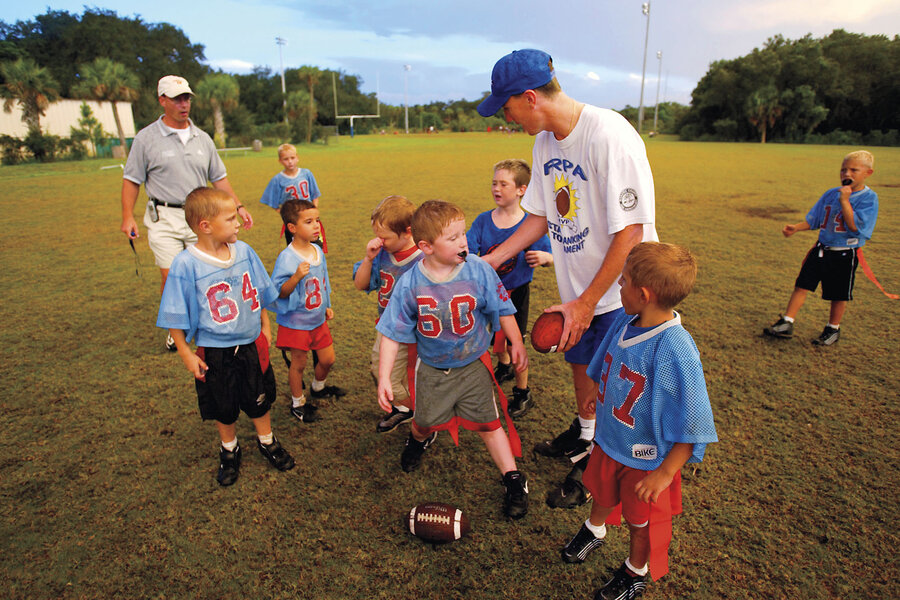
Crouched furtively behind a bush while peering at a middle school flag football practice about 40 yards away, I must have looked like a rival team’s scout. Or just a creep. In truth, that afternoon marked my son’s first practice in 10 seasons that I wasn’t coaching myself. I was in this ridiculous spying position ostensibly to see how it was going, but I didn’t want him to know.I volunteered to coach my first rec center teams mainly to insulate my kids and others from difficult adults. My daughter’s first soccer coach put her at goalie without instruction and then, after she allowed five goals in about two minutes, treated her with a sort of personal disdain; she was in preschool at the time. My son had an experience in peewee football with a guy who cussed and shoved and questioned the size of his players’ 6-year-old hearts.This admittedly small sample size convinced me – self-gratuitously, to be sure – that if I didn’t become involved, then sports might be ruined for my kids before they could even learn the difference between left and right. And I believed that playing for a team was more valuable than just about anything else a child could do. So I threw my hat in the ring for basketball and learned almost immediately that volunteer youth-sports coaching resembles John Grisham’s “The Firm”: Once they get you, they don’t let you leave. The fact that the director of our local rec center, a salty and raspy man known to generations of young athletes in East Los Angeles as Big Cheese, lives directly behind us did not help. He sat on his front porch between his walking cane and a scary, feral cat he’d named Shade, and would holler over the fence whenever he needed a coach.Basketball, baseball, track, football: I said yes to whatever he needed, any age group and gender. Over the last 12 years, I’ve led over 60 youth sports teams in the dusty gyms and gopher-ridden fields of the Los Angeles Parks & Rec landscape, and I’ve seen a generation come of age.Our players weren’t generally the gifted athletes, the prematurely tall or well-resourced kids whose families could give themselves over to the private travel-team circuits. For the most part, they were uncoordinated and often there for free childcare. And yet with some modest reinforcement, they made friends and became less entitled, more assured. They also consistently carried themselves with poise in the face of the despicable adult behavior that youth sports can draw out sometimes. Within those small moments – at turns hilarious, exasperating, and poignant – I felt a visceral hope for young people. Soon, I found myself procrastinating at work and passing up most weekend plans to teach rudimentary drills to other people’s children, even though when it came to leading a team, I was a stammering pushover. A first grader once raised his hand in the middle of my pre-practice pep talk and asked earnestly, Are you ever going to stop talking so we can play?Periodically over these years, I would proclaim that my retirement was imminent. My kids would laugh and say, Yeah, sure Dad, because they knew that wasn’t going to happen. And then it did happen. After too many missed events and family dinners, I started saying no to Big Cheese. The life rhythm that had carried me well into middle age simply phased out – no championship, no ceremony, no entreaties to stay on.Which was how last week, I scuttled forward in the brush through spiderwebs and pollen gunk to sneak a glimpse of my son’s new team. Now, for years I’ve been confounded by adults who stay to watch practice – primarily because the players who pay more attention to their parents than to teammates are usually the unhappiest ones. So, in addition to being a hovering father, I was also a ludicrous hypocrite, gummed up in a whorl of nostalgia, heartache, and obsolescence.Clearly, my son and his new teammates were having a fantastic time. The new coach was knowledgeable and respectful. But I still lingered. As my thighs and back tightened, I gave up on the flimsy premise of being there as a protective act, because what I was actually searching for was some signal that my kid missed having me coaching his team, and missed poring over diagrams and losing ourselves in what was possible each season – that he missed what I was going to miss.On the field, he didn’t appear to be in the midst of any emotional transition. He was playing football with new friends. I knew this was a positive sign, but I felt stabbed anyway. Afterward in the car, when I asked how practice was, he answered,It was chill. A few weeks have passed since that afternoon. Like most other team parents, I’ve taken to dropping him off at the park at the allotted time and working elsewhere. A nonnegligible part of my mind or spirit remains there on the field, rambling about strategy – but a little less each week. Deepen your worldviewwith Monitor Highlights.Politics with respectGet political stories with respectful analysis.There‘s a world of new ideas in everyBooks newsletter.There‘s more to life, enrich yours withCulture & Learning weekly.Follow humanity‘s discoveries withScience & Nature stories in your inbox.Gain a spiritual perspectivefrom the stories in your inbox.Want to understand the deeper impact of critical events? Learn the Monitor‘s insight.Already a subscriber? Log in to hide ads. In the meantime, it’s common for me to run into young people I’ve coached around Los Angeles – in grocery stores, movie theaters, parks. Some will light up and holler, Coach Jeff! And others might look blankly back when I wave, totally clueless as to who I am.■ Jeff Hobbs, a bestselling author, teaches writing at Yale University. Bring news welcomed in any home into your home45% off$110/year → $60/yearJournalism that gets above the fray and brings perspectives you won't get anywhere else.Already a subscriber? Sign in
An ungraceful exit
Full Article
Original Source
Read the full article at Csmonitor →KhanList aggregates and links to publicly available news content. We do not host full articles from third-party sources. Always verify important information with original sources.