
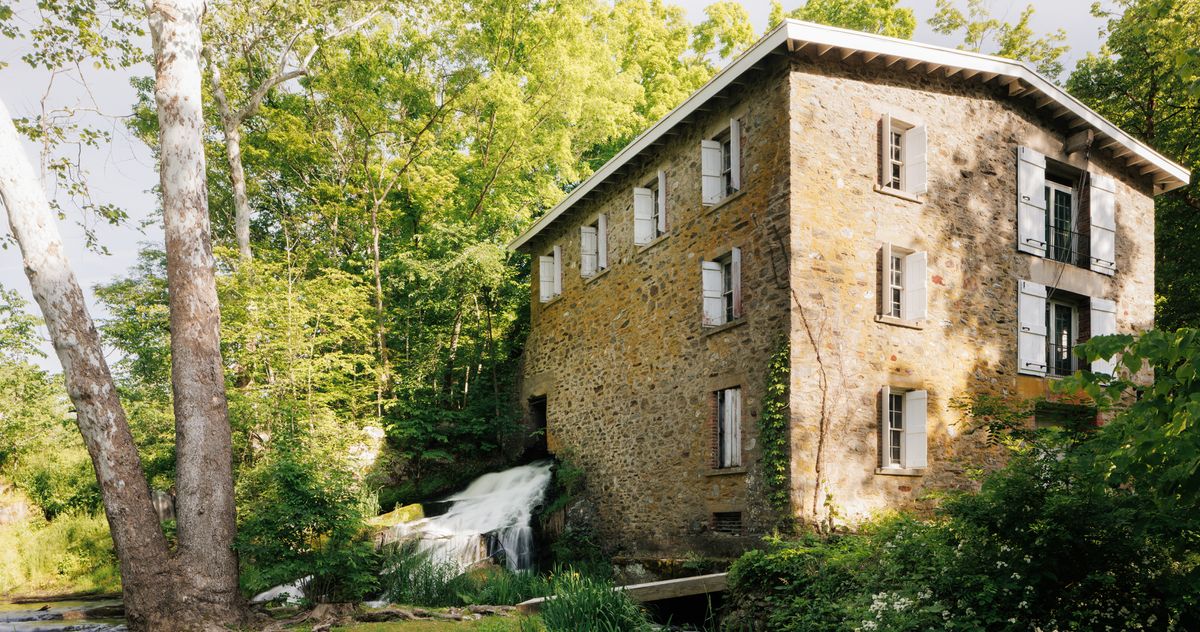
An Old Mill Transformed by a Family of Designers By , an Emmy Award–winning Curbed writer who has reported on New York City for four years A 1913 cider mill, built from the stones of a predecessor dating to the 1740s, was transformed into a home in the 1960s. Photo: Gabriel Zimmer Thirty minutes’ drive northeast of Poughkeepsie, just outside the village of Millbrook, Highway 82 rolls past a waterfall that seems to gush from a darkened doorway under an old stone house. With its sheer walls and plain wood shutters, it looks a bit like a Provençal farmhouse. But this is a 1913 cider mill built with the stones of a much older mill from the 1740s and is now on the National Register of Historic Places. The village that grew around it is gone, its ruins under the tree roots. And by the time a pair of West Village hippies drove up here in 1966, the cider mill’s floors were rotting and its windows were knocked out. The 1913 turbine is still in place. Photo: Gabriel Zimmer Don Salvato was ready to take on a project. He had graduated from Pratt with a degree in architecture and got a job at a big firm designing hospitals. He had worked construction, even helping Willem de Kooning build his studio on the East End. His wife, Antonia Salvato, a Dutch transplant, had an eye for design. Neither of them knew how much work lay ahead, and Don was a perfectionist, scribing each new board to fit as snugly as a puzzle piece against the irregular stone walls. Where the staircase hits the second floor, he built cutouts that peer down over the living area so heat can rise and sound can travel. In the living area on the first floor, his built-ins include slats to hide a sound system and deep storage for firewood. In their daughter’s bedroom, he added a tiny triangular desk and a sleeping loft. The deck off the back of the second floor isn’t cookie-cutter either: It hugs the ruins of an old wall with open windows framing the forest. The ruins of the earlier 1730s mill create a rectangular wall around a site he filled in with gravel — a conversation starter, and a spot to dance under the trees at overflowing parties. The ruins of the earliest mill are just off the back deck. Don Salvato built a fountain at the center. Photo: Gabriel Zimmer Around 1971, the family moved in full time, adjusting to the nearby rush of water. “By night, I’d go to sleep and wake up to that sound, but the rest of the time was saws and hammers,” said their daughter, Ariana, who arrived there as a toddler and watched her parents take on more and more projects — buying up properties around them, including a cottage across the creek, and fussing over the old turbine with a plan to eventually get it up and running. Calls came in regularly from friends who spotted salvage, such as old laboratory cabinets that ended up in the kitchen holding Antonia’s collection of Dutch vases. A hot Saturday night was a date at the county auction bidding for antiques. But the Salvatos divorced in 1986, and Antonia eventually turned her energy to Millbrook, buying up old buildings to restore, including the town’s newspaper office. Don, meanwhile, kept the mill and added walls to partition off more rooms, turning the place into a casual inn. He got into painting — big gestural abstractions, maybe a little like de Kooning’s — and built himself a two-story studio that looks like a modern chapel with salvaged roundels. Then, in 1998, he died suddenly. Antonia and Don Salvato. From left: Photo: Courtesy of Ariana SalvatoPhoto: Courtesy of Ariana Salvato Antonia and Don Salvato. From top: Photo: Courtesy of Ariana SalvatoPhoto: Courtesy of Ariana Salvato The art studio, which Don added in the 1990s. The roundels might have come from a nearby chapel that was torn down around the same time. Photo: Melvin Brinson Jr Ariana was 29 and overwhelmed. She was living in the East Village, working as a prop stylist, and had just opened a new bar with her husband on Houston Street — a fashion hot spot modeled like a 1960s jet, called Idlewild. But she couldn’t bear to sell her father’s project. Instead, she put in a series of tenants who did maintenance in exchange for a deal on rent. There was always something to take care of given the age of the buildings and the dampening mist sent up by the waterfall. On top of that, nature was always invading, and the property spread over 12 acres. But taking on this work herself started to make more sense over the years, and in 2009, she drove back. A 1940s cottage on the property was owned by the family of Joseph De Natale, who sold the mill to the Salvatos in 1966. Photo: Gabriel Zimmer Details: Price: $5.25 million Specs: Main house has three bedrooms and two and a half bathrooms; cottage has two bedrooms and one bathroom Extras: Twelve acres of grounds with a creek, a waterfall, a pond, and an auxiliary art studio. Ten-minute driving radius: the Salt Point Market & Cafe, Ruby Hill Farm, Wing’s Castle Listed by: Lindsay Allen, Upstate Down Ariana started taking down some of the walls her father had added over the decades, turning the home back into the one she had grown up in. Every day revealed a design decision she had not noticed at the time — like the back panel of a built-in bookcase that opens up to make it easier to clean the chimney. She eventually spiffed up the old cottage, too, moving there full time, and started renting out the mill as a vacation retreat and advertising her father’s stylish house to her network of friends in fashion and film. Models posed against the stone walls for shoots in Elle and W. The playwright Neil LaBute visited, then directed a feature there: Monstrous, the story of a filmmaker who “struggles to write her next script while negotiating successive visits to her isolated home,” according to the description for a recent screening. In the early days of COVID, Robert Hammond, the co-founder of the High Line, came across the rental listing and had a sense that it might appeal to his husband, Dan Barasch, who had just put out a book about the use of ruins in architecture. They ended up renting for more than two years, and Barasch is now working on a children’s book based on their experience there with their son. “You felt you were living in a ruin, but the architect was also really adept at inserting his own stamp,” said Hammond. “It was always misty because there was a giant waterfall tumbling through it, so you felt like you were in a cloud or had escaped somewhere. It was its own microclimate.” The creek feeds a small pond. Photo: Gabriel Zimmer Swimming in the stream below the waterfall. Photo: Courtesy of Ariana Salvato Ariana is now planning to move into a barn behind her mother’s home in Millbrook, where she won’t have to attend to the needs of tenants or the issues associated with maintaining a sprawling estate. Still, selling the mill feels emotional, as though she is also selling off her parents’ legacy as designers. “Yes, it’s a property, but it’s also the history of my family,” she said. “I’ve done the best I could to hold on to all the pieces.” One side of the home faces a bright lawn. Photo: Gabriel Zimmer The other side looks over water. Photo: Gabriel Zimmer A channel through the side of the house on the lowest level once ran over a turbine that the Salvatos tried to bring back online. A new owner could attempt to take the home off the grid, says Ariana, who has met with consultants to do the project herself. Photo: Gabriel Zimmer The ruins of the old mill are up the hill and directly off the upper story. Photo: Gabriel Zimmer/Miki Takashima Doors on the left of the main living area lead to the entrance and kitchen. Photo: Gabriel Zimmer The Salvatos painted this iron beam orange. It’s original to the house, as are the stone walls, but most of the wood has been replaced. Photo: Gabriel Zimmer/Miki Takashima Don designed built-in shelves and cabinets (far right) that also hide speakers and save a spot for firewood. Photo: Gabriel Zimmer The kitchen, with Don’s abstractions on the walls and a built-in breakfast nook. The cabinets (lower left) were salvaged from a laboratory. Photo: Gabriel Zimmer Upstairs are four bedrooms and a sitting area with a stove that leads out to a deck. Photo: Gabriel Zimmer The sitting area. Photo: Gabriel Zimmer Don added cutouts to the walls and put a window into one bedroom, creating a sense of connection. Photo: Gabriel Zimmer An upstairs bedroom. Photo: Gabriel Zimmer Ariana’s childhood room. Photo: Gabriel Zimmer The primary suite has a Juliet balcony and its own stove. Photo: Gabriel Zimmer The primary has built-ins and an en suite bathroom (left). Photo: Gabriel Zimmer The primary bathroom. Photo: Gabriel Zimmer The cottage is a short walk from the main house in the mill. The Salvatos purchased it, along with other neighboring properties, to create a 12-acre spread. Photo: Gabriel Zimmer The opposite side of the cottage has a wide deck. Photo: Gabriel Zimmer The living room of the cottage. The fireplace is at least old and may be original. Photo: Gabriel Zimmer Don’s paintings hang on the cottage walls. Photo: Gabriel Zimmer The Salvatos kept the original farmhouse sinks and added a Paul Secon pendant lamp. Photo: Gabriel Zimmer The cottage dining room. Photo: Gabriel Zimmer The cottage has one bathroom, with a clawfoot tub and an original sink. Photo: Gabriel Zimmer The cottage has two bedrooms, both on the upper floor with pitched ceilings. Photo: Gabriel Zimmer The art studio is a quirky folly that Don built in the 1990s. Photo: Melvin Brinson Jr Don added balconies and connected a second story with a spiral stair. Photo: Melvin Brinson Jr A pathway off the studio leads to a smaller workspace. Photo: Gabriel Zimmer An outbuilding provides space for contemplation or maybe a future sauna. Photo: Melvin Brinson Jr An Old Mill Transformed by a Family of Designers Your product is saved! You’ll receive emails when your saved products go on sale. Manage preferences.
An Old Mill Transformed by a Family of Designers
Full Article
Original Source
Read the full article at Curbed →KhanList aggregates and links to publicly available news content. We do not host full articles from third-party sources. Always verify important information with original sources.