
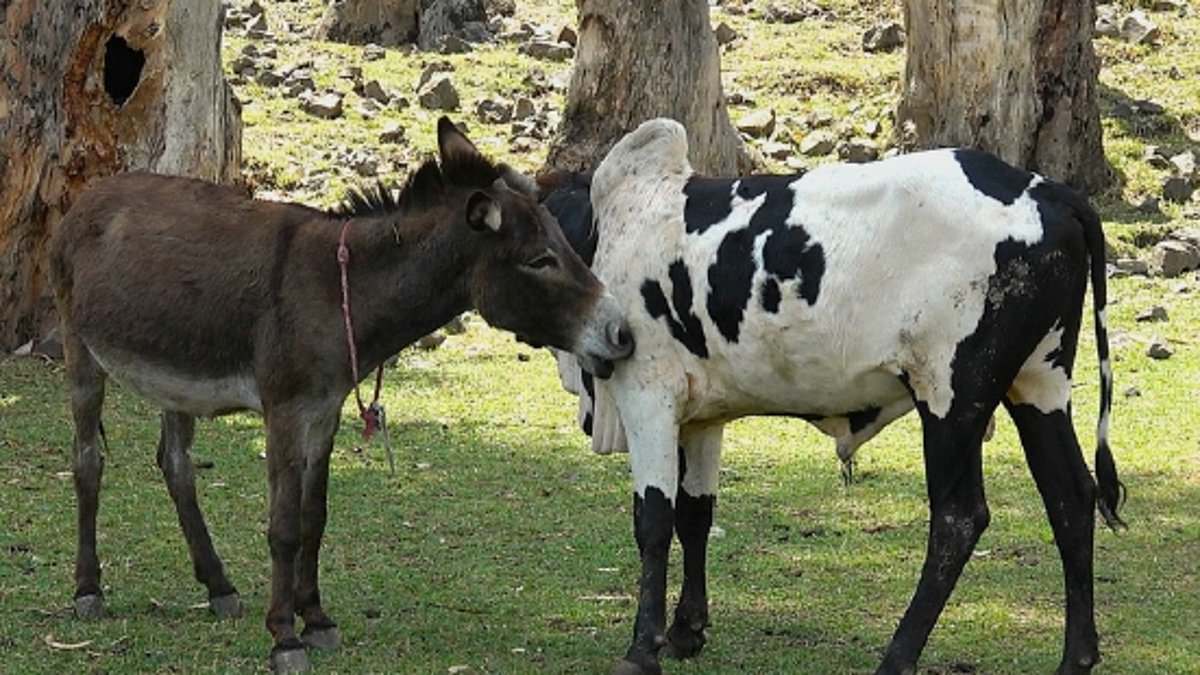
Scientists have discovered an 'unusual sexual bond' between a bull and a male donkey, with the animals repeatedly choosing each other – despite having plenty of females around them. The unusual partnership involves a bull called Achille and a male donkey called Patroclo, who both live on an Ethiopian plateau. Scientists from the University of Pisa first spotted a sexual interaction between the two animals while they were in the field conducting another study. Subsequent observations showed that the two males repeatedly chose each other, even though they belonged to different owners and only saw one another during time in the pasture.'The sexual interactions between Achille, the bull, and Patroclo, the male donkey, were not isolated events,' said Elisabetta Palagi, an author of the study.'What really caught our attention was that these interactions were embedded in a very selective and consistent social relationship between the two individuals.' Scientists have discovered an 'unusual sexual bond' between a bull and a male donkey, with the animals repeatedly choosing each other – despite having plenty of females to choose fromDuring the first interaction, the team observed Achille mounting Patroclo. Normally, this kind of behaviour would result in an animal trying to kick or act defensively. However, this wasn't the case, with Patroclo happily accepting Achille's advances. 'They repeatedly chose to stay close to each other and engaged in many different affiliative behaviors, such as licking, rubbing, and nuzzling, alongside the repeated mounting behavior,' explained study author André da Cruz.'Importantly, this was happening in a social environment where both animals had access to other potential partners, including individuals of both sexes and of their own species.'This wasn't a one–off encounter. In total, the team saw 51 mountings between the animals from March 6 to March 19.During other romps, Patroclo would present his hindquarters to Achille, and nipped him. On two occassions, Achille did mount another male donkey. However, that animal showed 'clear avoidance behaviours', including flattened ears and threatening expressions. During the first interaction, the team observed Achille mounting Patroclo. Normally, this kind of behaviour would result in an animal trying to kick or act defensively. However, this wasn't the case, with Patroclo happily accepting Achille's advancesMartina Francesconi, lead author of the study, said: 'We believe the key finding is not simply that a bull mounted a male donkey.'It is that this unusual sexual behavior was part of a broader, selective social relationship. 'Our observations suggest that it cannot be easily explained simply by a lack of alternative mating opportunities, although we cannot say from this study exactly what function these sexual interactions may have had.'The researchers now hope to carry out further studies to understand the relationship dynamic further. 'For us, a major question for future research is what mechanisms, and possibly what benefits, might underlie these interactions,' Ms Palagi says. 'Are they mainly related to social bonding? Could they play a role in maintaining relationships or reducing tension? Or do they emerge from a combination of social and sexual motivations? 'We think that comparative research across species with different social systems could help us distinguish between these possibilities.''More broadly, we would like to better understand how social relationships shape sexual behavior and how behavioral flexibility allows animals to navigate complex social environments.'We see this study as a starting point for asking these broader questions.'HOMOSEXUALITY IN ANIMALSHomosexuality in nature has been observed in as many as 1,500 animal species, humans included.There has yet to be an accepted explanation based on neurological, chemical or behavioural factors to explain why some animals are homosexual and some are heterosexual. Some scientists say it may be due to exposure to testosterone levels in the womb, although this remains a hotly debated topic which has yet to be proved. In a book titled: 'Homosexual Behaviour in Animals: An Evolutionary Perspective', the author, UCL professor Dr Volker Sommer, writes: 'Within a select number of species, homosexual activity is widespread and occurs at levels that approach or sometimes even surpass heterosexual activity.'Homosexual behaviour has been observed in many animals, including macaques, dwarf chimpanzees, lions, giraffes, dolphins, orcas and humans. Some studies claim homosexuality may be as common as being found in up to 95 percent of all animal species. There are two principal schools of thought when it comes to the prevalence of homosexuality in nature. One theory states that homosexuality in animals doesn't need an explanation, with animals being homosexual just as naturally as they are heterosexual. It appears irrational for it to survive as a trait as it hinders the ability to procreate directly, but many speculate it allows individuals to ensure their genetic material is passed down the generations indirectly as they are able to look after members of their family with offspring. For example, helping nurture the offspring of a sister. Similar behaviour dedicated to the 'greater good' of a large group have been seen in various species. For example, in familial wolf packs only one pair of animals breeds – the alpha and the beta. The other animals ensure the protection, feeding and nurturing of the litter.This allows their genetic material to pass indirectly to the next generation through their sister, brother, mother etc or whatever the relationship may be. The same school of thought applies to animals which have exceeded their reproductive age. For example, female elephants which are now too old to have offspring. They still play a crucial role in the protection of the young – the matriarch leads the group to spots of food, water and chases off would-be predators.These actions ensure the survival of the young and vulnerable members of her family, again helping ensure her genetic material is passed down through the generations indirectly. A similar concept can be applied to homosexuality, some experts claim. Without the ability to reproduce directly, they are able to expend energy looking after the offspring of their family members. Another theory states that homosexual behaviours aid in the successful passing on of genes in the long term as young animals 'practise' mating techniques and ways of attracting a member of the opposite sex.Rates of homosexuality in different species continues to be unknown, as ongoing research finds more nuances to homosexuality in nature. It continues to be found in more species but the level of homosexuality in individual species is not well enough studied to be able to determine if homosexuality is becoming increasingly common.
An interspecies gay love story: Scientists discover an 'unusual sexual bond' between a bull and a male donkey
Full Article
Original Source
Read the full article at Dailymail →KhanList aggregates and links to publicly available news content. We do not host full articles from third-party sources. Always verify important information with original sources.