
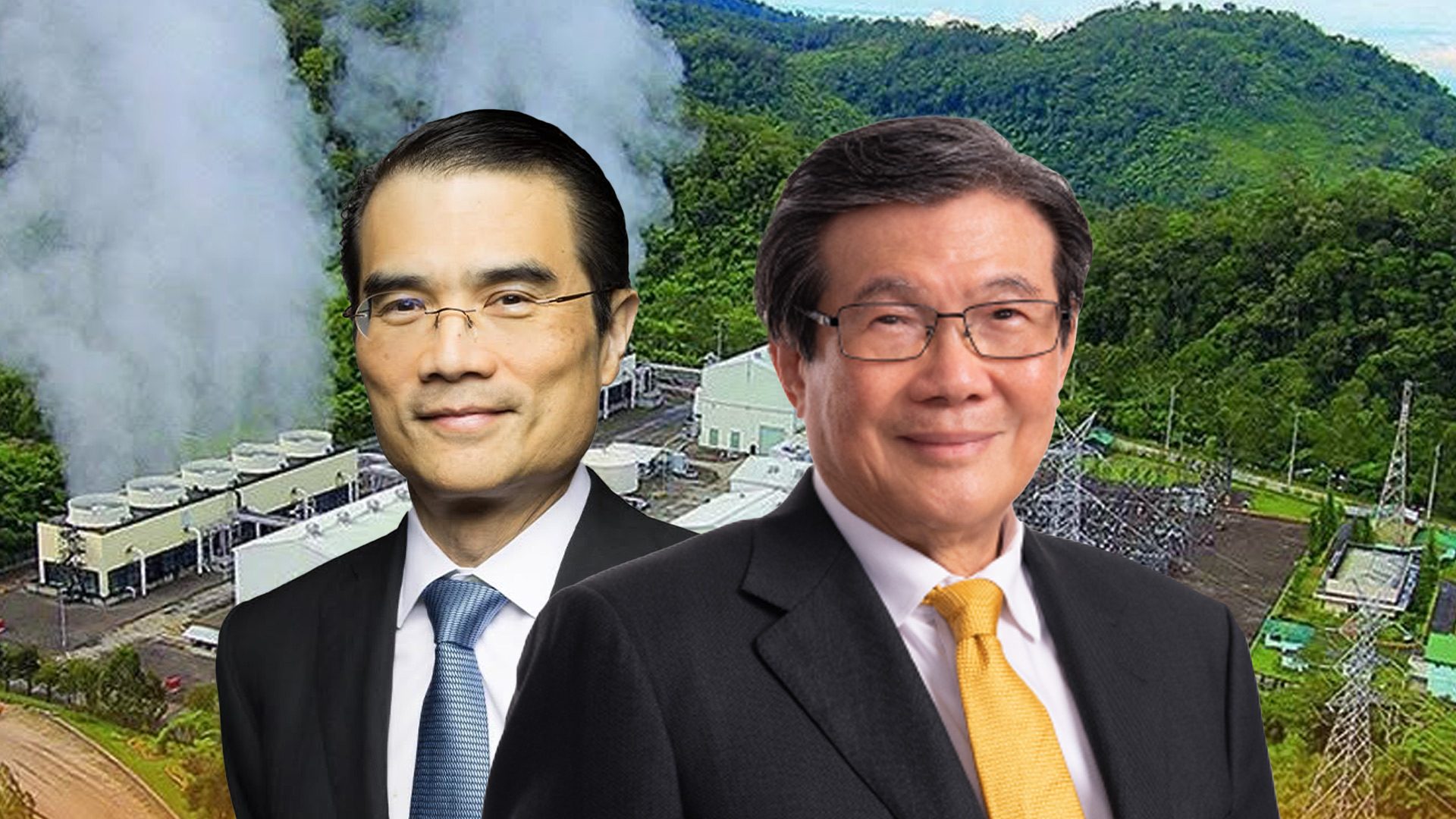
First of two parts Barito Renewables’ unsolicited bid for Energy Development Corporation arrives while the Strait of Hormuz is closed, oil prices are volatile, and the Lopez cousins are fighting over who controls the family’s energy empire. Whose stake would the Indonesian tycoon actually buy? On Wednesday, July 15, First Gen Corporation confirmed to the Philippine Stock Exchange what a Bloomberg report had already pushed into the market: Indonesia’s PT Barito Renewables Energy Tbk had made an unsolicited, indicative, and non-binding offer to acquire Energy Development Corporation (EDC) at an equity value of about US$5 billion. First Gen told the exchange that there have been no discussions between the parties, that no agreements have been signed, and that no financial advisers have been hired for any transaction. Equity value, in plain terms, is the price tag on the company’s ownership. It is what Barito is signaling all of EDC’s shares put together are worth, on top of the company’s debts, which a buyer would also carry and which is why Indonesian reports have put the total cost of the deal at about US$7 billion. If a sale were ever negotiated and closed, the amount that actually changes hands would depend on the final price, and who receives it would depend on which shareholders sell. That question — which shareholders — turns out to be the sharpest one in this story. Because EDC is a private company with exactly two blocs at the table, the answer determines whether Barito’s billions would ever touch the Lopez family war at all. Whose stake would the Indonesian buy? EDC has been delisted from the stock exchange since 2018, and its ownership has since narrowed to two groups. The controlling bloc is First Gen, which holds a 65% voting interest in EDC, most of it through Red Vulcan Holdings, the acquisition vehicle from the 2007 privatization. The other bloc is Philippines Renewable Energy Holdings Corporation (PREHC), a vehicle of Australia’s Macquarie and Singapore’s sovereign wealth fund GIC, which entered through a US$1.3 billion tender offer in 2017 and holds 34.9% of the votes. Votes, however, are not the same as money, and this is where EDC’s structure produces its most counterintuitive fact. First Gen keeps control through voting preferred shares that carry ballots but little economic weight, so its actual economic interest in EDC, the share of profits and of any sale price, is 45.8% according to First Gen’s own information statement filed with the exchange in April. The rest of the economics, roughly 54%, belongs to the Macquarie-GIC side. The foreigners already own most of EDC’s value. The Lopezes own the steering wheel. Run Barito’s number through that split and the stakes become concrete. At P61.70 to the dollar (as of July 15, 2026), the peso level reached as the Strait of Hormuz crisis pushed oil prices and import bills higher, a US$5-billion equity value converts to more than P300 billion ($5 billion x P61.70). First Gen’s 45.8% economic share of that would be roughly P140 billion. The Macquarie-GIC share would be roughly P170 billion. This opens a scenario the family-feud framing tends to miss. Barito could pursue the whole company, but it could also start, or settle, with the stake that is likeliest to be for sale: PREHC’s Infrastructure funds like Macquarie’s and sovereign investors like GIC buy assets with an exit horizon, and the consortium is now 9 years into a position in an unlisted company with no public market to sell into. A purchase of the PREHC stake alone would be a change of hands among foreigners. Not a peso of it would flow to First Gen, to First Philippine Holdings, to Lopez Holdings, to Lopez Inc., or to any of the Filipino and institutional shareholders along that chain. It would, however, replace a financial investor at EDC’s table with a strategic rival that operates Indonesia’s largest geothermal company, sitting across from the Lopezes inside their own crown jewel. The distinction also clarifies who is not in this transaction. KKR, the American private equity firm, is often mentioned in the same breath as EDC’s foreign investors, but KKR does not own EDC shares. Its vehicle, Valorous Asia Holdings, owns 19.9% of the economics and 14% of the votes of First Gen, one level up. The same applies to the state pension funds SSS and GSIS and to the ordinary investors who together hold the roughly 30% of First Gen not owned by First Philippine Holdings. None of them would sell anything in an EDC deal. They benefit only if First Gen itself sells its EDC stake and the value shows up in First Gen’s coffers, its dividends, or its share price. Whether it would show up there, rather than being absorbed into the next round of projects, is a fight this story comes back to. Who decides, and where the feud comes in Let’s start with the mechanics. Red Vulcan is a special-purpose company created in 2007 to bid for the government’s EDC stake. It is wholly owned by First Gen through another holding company, Prime Terracota. Red Vulcan has no operations of its own, so in practice it follows instructions of First Gen’s board, where Federico “Piki” Lopez is chairman and chief executive. But the decision would not stop at the board because of what EDC now is to First Gen. After the 2025 sale of 60% of the natural gas business to Enrique Razon Jr.’s Prime Infrastructure, EDC and its plants make up roughly 9 of every 10 megawatts that First Gen operates. Under the Revised Corporation Code, a sale of all or substantially all of a corporation’s assets requires ratification by shareholders representing two-thirds of the outstanding capital stock, and it is difficult to describe a divestment of EDC as anything less than substantially all of what First Gen has become. That would put the question to First Gen’s shareholders, where First Philippine Holdings holds 67.84% of the common shares and all of the voting preferred shares, enough to carry or kill the vote on its own, with KKR, SSS, GSIS, and the public watching their single biggest asset decided by the majority owner’s ballot. And FPH’s ballot is exactly where the family war reaches the transaction. FPH answers to Lopez Holdings, and Lopez Holdings is 54.74% owned by Lopez Inc., the private company at the apex of the family structure where Eugenio “Gabby” Lopez III and the majority cousins, holding roughly 71%, moved to remove Piki as president before he secured an injunction and, more recently, a withdrawal of the removal resolution that he has called a possible first step toward peace. Climb the staircase from the corporate box to the family boardroom and the answer to who decides comes out layered: First Gen’s board proposes, First Gen’s shareholders ratify, FPH casts the deciding ballot, and whoever controls the top of the chain ultimately instructs how that ballot is cast. The cousins fighting over Lopez Inc. are, at the end of the staircase, fighting over the pen that signs away EDC – or refuses to. The majority bloc has spent months accusing cousin Piki of withholding timely information about big-ticket gas and hydro deals, complaints that culminated on July 9 in the exchange publishing penalties against First Gen for disclosure violations tied to the Prime Infra transactions (See story below). Six days later, on July 15, it was not a cousin’s complaint but a news wire report that forced the next disclosure, and this time the market learned about the offer within days rather than months. For a company sanctioned for telling investors too little too late, the speed was its own kind of statement. What P300-billion does to a family war The arithmetic explains the context. In November 2007, the government sold its 60% stake in what was then PNOC-EDC to Red Vulcan for P58.5 billion, a price that valued the entire company at close to P100 billion (P58.5 billion divided by 60% share it bought). Barito’s indicative number values the same company at more than 3x that, in nominal terms, before any negotiation has begun. For months the Lopez fight has been about governance, board seats, and whether ABS-CBN deserves fresh family capital. A live outside valuation converts those abstractions into pesos: whoever controls the chain of companies above EDC controls the decision over an asset the market now knows is worth hundreds of billions of pesos. For Piki Lopez, the offer cuts both ways. It validates the platform he and the Lopez energy side have spent years modernizing and folding into a clean-energy narrative. But it also tests his claim to disciplined stewardship, because a bid of this size asks whether the goal is to keep compounding value inside the group or to unlock and distribute it. First Gen president, Francis Giles Puno, told shareholders at the May 28, 2026 annual meeting that First Gen had trimmed its stake in the Prime Infra pumped-storage hydro projects from 40% to 33% “to ensure prudence in its capital allocation process,” so that the company would have the liquidity to fund all its projects. A company rationing capital that carefully would, after an EDC sale, have more cash than at any point in its history, and the question would flip from which-projects-can-we-afford to what-is-all-this-money-for. Asked at the same annual stockholders’ meeting whether the gas sale proceeds meant a special dividend, Puno pointed to policy rather than promise: 30% of the prior year’s recurring net income, subject to capital spending, growth plans, and debt service, with special dividends open to revisiting. A sale at Barito’s valuation of more than P300 billion would hand First Gen about P140 billion for its 45.8% economic share, and a windfall of that scale would test that answer in ways the P48.8 billion-worth gas sale never did, and the cousins at Lopez Inc., for whom the flow of money up the holding chain is precisely what the war is about, would likely be the loudest voices in the room. A company rationing capital that carefully would, after an EDC sale, have more cash than at any point in its history, and the question would flip from which-projects-can-we-afford to what-is-all-this-money-for. “ The company on the table What Barito wants is the country’s largest geothermal producer and one of the largest geothermal companies in the world: 16 power stations with a combined installed capacity of 1,302.78 megawatts, plus roughly 300 megawatts of wind, hydro, and solar led by the Burgos wind farm in Ilocos Norte and the Pantabangan-Masiway hydro complex in Nueva Ecija. The geothermal fields sit on the archipelago’s volcanic spine, in remote uplands where rainwater seeping into fractured volcanic rock is heated by magma into reservoirs of superheated water and steam, brought up through wells one to about 3 kilometers deep to spin turbines. Steam cannot be shipped the way coal or gas can, so the plants stand where the resource is: the 637.2-megawatt Tongonan complex above Ormoc and Kananga in Leyte, now slated for a P100-billion expansion to 967.2 megawatts; the Southern Negros field above Dumaguete and Valencia, capable of over 222.5 megawatts and undergoing its own P25-billion renewal; the 197.27-megawatt Bacon-Manito complex straddling Sorsogon and Albay; and the roughly 106-megawatt Mt. Apo complex in Kidapawan, North Cotabato. What that fleet delivers is baseload power, the heart of EDC’s value. Baseload is the floor of the country’s electricity demand, the consumption that never switches off and is as present at 3 am as at noon, and baseload plants run continuously to hold that floor. Solar generates only while the sun is up, and wind only while the weather cooperates, but the Earth’s heat does not set and does not die down, which makes geothermal the only renewable that supplies the grid around the clock. EDC accounts for roughly 6 of every 10 installed geothermal megawatts in a country that ranks 3rd in the world in geothermal power, after the United States and Indonesia. Acquiring EDC would more than double Barito’s geothermal capacity in a single stroke and combine Southeast Asia’s two largest geothermal companies under one owner.” The identity of the buyer explains the ambition. Barito Renewables is the holding company of Star Energy Geothermal, Indonesia’s largest geothermal producer, with 886 megawatts across three fields in West Java. Its controlling shareholder, Prajogo Pangestu, built an empire from timber into petrochemicals and energy, carries a Forbes-estimated net worth of about US$15.4 billion, and has been expanding across the region, from Indonesian wind ventures with the Ayala-led ACEN to refinery and fuel retail assets in Singapore. Acquiring EDC would more than double Barito’s geothermal capacity in a single stroke and combine Southeast Asia’s two largest geothermal companies under one owner. Platforms like this almost never come to market, because each productive field represents decades of geological risk, wells costing hundreds of millions of pesos apiece that can come up dry, and accumulated knowledge of how living reservoirs behave. A buyer is not purchasing power plants so much as reservoir data, operating teams, permits, community relationships, and the industrial memory of keeping steam flowing for over 50 years. Born of one oil crisis, priced in another EDC exists because of a previous oil shock. In October 1973, Arab members of OPEC embargoed countries seen as supporting Israel in the Yom Kippur War, crude prices roughly quadrupled, and the Philippines, which imported nearly all of its oil, faced rationing, brownouts, and a balance-of-payments squeeze that turned energy into a national security problem. In November 1973, the Marcos government created the Philippine National Oil Company (PNOC) and, under it, the Energy Development Corporation (EDC) in March 1976, the state’s arm for drilling into the country’s volcanic belts so that some portion of the grid would run on heat no Arab embargo could touch. By 1983, the young company had commissioned its first plants at Tongonan and Palinpinon. That geothermal backbone it built still carries the grid today. A company created as the state’s answer to fuel insecurity, then later privatized and transferred into Filipino hands, could see its drilling pace, expansion priorities, and the economic life of critical reservoirs decided in a Jakarta boardroom, in the middle of an oil crisis, with Philippine regulators keeping formal oversight and losing the informal leverage that comes with local ownership.” Fifty years later the country is living through the sequel. Since the United States and Israel launched an air war against Iran on February 28, Iran has declared the Strait of Hormuz closed, choking a waterway that in peacetime carries about a fifth of the world’s seaborne oil and liquefied natural gas, in what the International Energy Agency has called the largest supply disruption in the history of the global oil market. For the Philippines, still an oil importer, the consequences arrived at the pump and in the exchange rate, with the peso falling to record lows near P61.70, the very rate that turns Barito’s offer into more than P300 billion ($5 billion x P61.70). The crisis cuts in two directions at once: it makes EDC’s indigenous, around-the-clock output more strategically valuable to the country than at any time since the company was founded, and it makes the offer harder to dismiss, because the same shock that raises geothermal’s strategic worth raises its commercial price. The law permits foreigners to own indigenous or homegrown energy sources. Since the power industry’s 2001 restructuring under EPIRA, foreign capital has been allowed to own controlling stakes in generation companies, and EDC already has Macquarie and GIC holding most of its economics. But there is a difference between foreign funds holding a minority position behind a Filipino operator and a foreign strategic operator holding the platform itself. A company created as the state’s answer to fuel insecurity, then later privatized and transferred into Filipino hands, could see its drilling pace, expansion priorities, and the economic life of critical reservoirs decided in a Jakarta boardroom, in the middle of an oil crisis, with Philippine regulators keeping formal oversight and losing the informal leverage that comes with local ownership. Only an offer, and already a test The Barito approach remains unsolicited, indicative, and non-binding, and First Gen’s disclosure forecloses nothing while promising nothing. A deal may never even happen. PREHC may sell alone, or no one may sell at all. But the offer has already done its work. It has put a number on the crown jewel, exposed how little of EDC’s economics the family actually holds behind its commanding votes, and reminded everyone on the staircase from Red Vulcan to Lopez Inc. that the next great Lopez decision may not be about board seats or a broadcast network, but about whether the asset the family gave up Meralco to keep is now the asset it can least afford to lose, or the one it cannot afford not to sell. EDC was born as a public answer to an external energy shock. Its future, at least for now, will be decided in private. – Rappler.com Sources: • First Gen Definitive Information Statement, April 30, 2026. This is the source of every ownership figure in this story. Its Security Ownership section says: FPH owns 67.84% of First Gen’s common shares and 100% of its voting preferred shares, and Valorous Asia Holdings’ (the KKR vehicle) 715.9 million common shares equal to 19.9% economic and 14.1% voting interest. In notes to the financial statements, under the discussion of the Parent Company’s control over EDC, First Gen’s 45.8% economic and 65% voting interest in EDC, of which 44% economic and 63.9% voting are held through Red Vulcan, as well as PREHC’s 34.9% of EDC’s outstanding voting stock. These numbers are stated as of December 31, 2025 and reiterated as of March 31, 2026 in First Gen’s first-quarter 17-Q report. Lopez Holdings Form 17-A for 2025, filed on April 16, 2026: Lopez Inc.’s 54.74% ownership of Lopez Holdings (Security Ownership section) and the narrative history of the 2017 PREHC tender offer and the 2018 EDC delisting (notes to the financial statements). First Gen disclosure to the PSE, July 15, 2026: confirmation of the Barito offer, the US$5-billion equity value, and the statements that no discussions, agreements, or adviser engagements exist. First Gen clarification to the PSE, May 29, 2026: the Wawa and Pakil projects, the GEA-3 contracts, and the expected P16 billion in average annual dividends from 2031 to 2050. After gas selldown, EDC represented roughly fourfifths of First Gen’s remaining portfolio. First Gen’s FY 2025 and Q12026 filings show total MW by platform; while exact 90% is an approximation, EDC clearly dominates the renewable portfolio postgas sale. The Revised Corporation Code does require twothirds shareholder approval for sales of all or substantially all assets. PNOC and PhilStar confirm Red Vulcan’s winning P58.5 billion bid. At that time, 60% at P58.5 billion implies 100% ≈ P97.5 billion. Comparing P97.5 billion to today’s P308 billion indicative value (US$5 billion x 61.7) is 3.1589x, or simple a bit over 3x in nominal pesos. https://www.philstar.com/headlines/2007/11/22/28886/lopez-group-wins-60-stake-pnoc-edc and PNOC 2007 annual report https://www.pnoc.com.ph/wp-content/uploads/2024/11/2007-Annual-Reports.pdf , and the P58.5 billion payment https://www.philstar.com/business/2007/11/30/30496/lopez-group-hands-over-p585-b-payment-60-pnoc-edc First Gen 2026 annual stockholders’ meeting transcript and presentation, May 28, 2026: the Puno quotes on capital prudence and dividend policy, the portfolio figures, and Piki Lopez’s remarks on the family rift. PSE Publication of Penalties, July 9, 2026: the disclosure sanctions. Forbes.com, January 13 June 5 and July 15, 2026: the Barito offer report, Star Energy’s 886 megawatts, Prajogo Pangestu’s net worth, and the Tongonan and Southern Negros investment programs. Bangko Sentral reference rate, July 15, 2026: ₱61.70 per US dollar. Lala Rimando wrote about Philippine business, and managed newsrooms, including Newsbreak, ABS-CBN, Rappler, and Forbes, for over 25 years. She’s now based in La Union, taking care of her mom with dementia, and working on the multimedia biography of the late John Gokongwei. Below are other stories on the Lopez cousins’ feud: Debt, discipline, and daring: Inside the Lopez Group’s high-risk bets The Lopezes, presidents, and the cost of dissent Lopez vs Lopez: The secrecy fight behind the Razon power deals How to make yourself very expensive to fire: The Lopez cousins’ war First Gen sat on a P23.5-billion Lopez clause for 60 days, then the family went to war Ceasefire on paper, war in the courts: Why the Lopez feud is far from over The business case of the Lopez-Razon gas and hydro deals [ANALYSIS] The Lopez ceasefire lasted only 26 days, then came the P50 billion math
An Indonesian billionaire wants EDC: The $5-B offer raising the stakes in the Lopez feud
Full Article
Original Source
Read the full article at Rappler →KhanList aggregates and links to publicly available news content. We do not host full articles from third-party sources. Always verify important information with original sources.