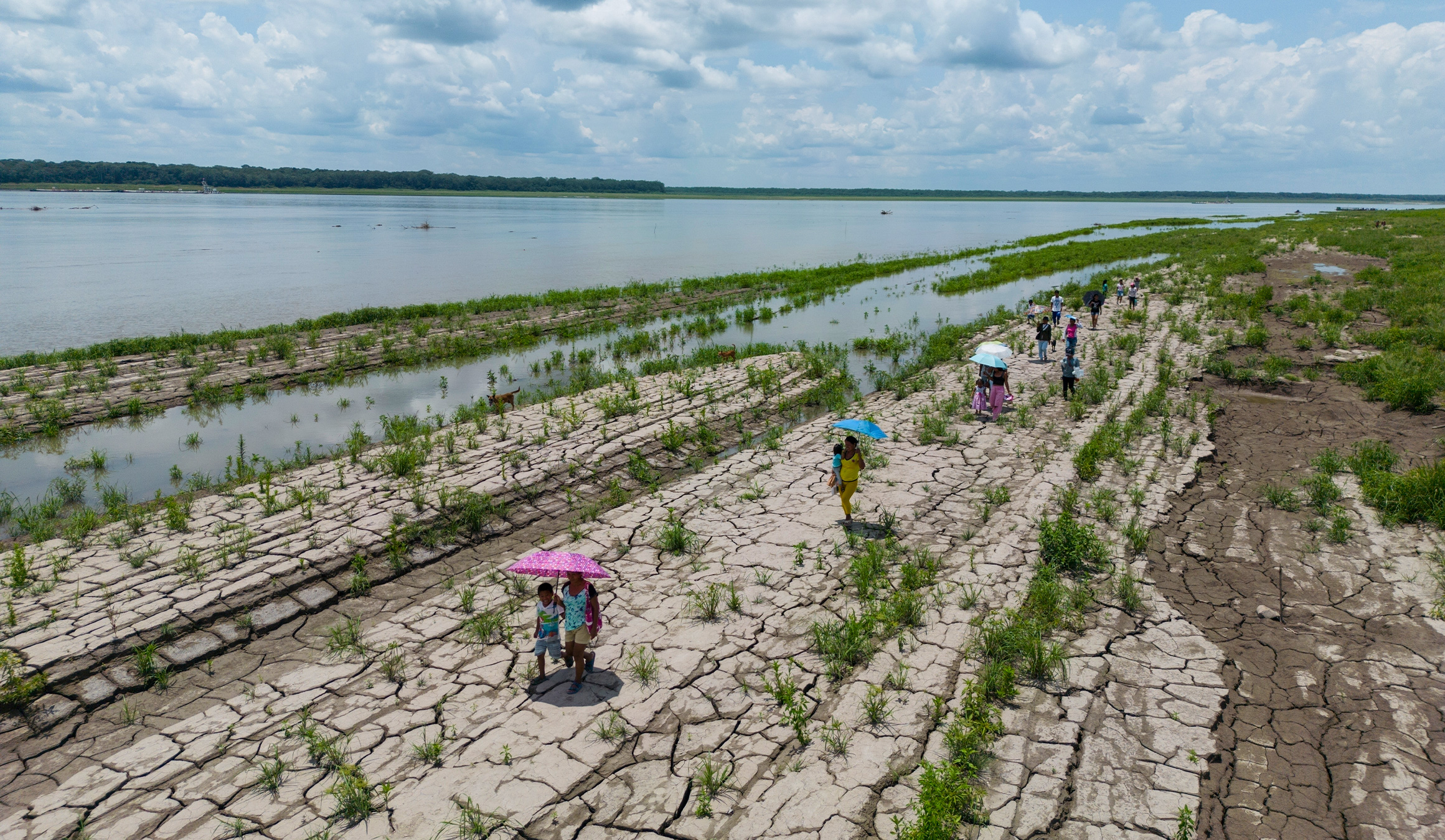
Mongabay interviewed Marino Peña, a prominent Indigenous leader from Colombia’s Putumayo region, to hear his take on the incoming government’s plans and how it might affect Indigenous communities and forests in Colombia.Abelardo de la Espriella, from the far-right Defenders of the Homeland party, won Colombia’s runoff election on June 11 and will be inaugurated on Aug. 7.De la Espriella says he will expand fossil fuel production and mining across the country and has promised to tackle violence using greater force and militarization.In this interview with Mongabay, Peña explains that the atmosphere on the ground is tense, in part because de la Espriella’s policies might exacerbate existing conflicts linked to a controversial copper mine in the region. In just a few weeks, Colombia will have a new leader. Right-wing candidate Abelardo de la Espriella won Colombia’s runoff election on June 11 with 49.6% of the vote, securing a razor-thin victory over the left-wing candidate Ivan Cepeda, who received 48.7%. De la Espriella has promised to expand fossil fuel production and mining in the country, leaving the future of conservation in the Colombian Amazon, the fossil fuel phaseout commitments made by current President Gustavo Petro’s administration and the rights of Indigenous peoples and other traditional communities open to question. Ahead of de la Espriella’s inauguration on Aug. 7, Mongabay interviewed Marino Peña, an Indigenous Inga leader and president of the Indigenous Zonal Organization of Putumayo (OZIP), to get his take on how the incoming president’s policies might impact communities in the department of Putumayo, in southwestern Colombia. De la Espriella has also promised to reduce the state budget to a minimum and tackle violence using greater force and militarization. For communities in Putumayo, the implications of these promises hold weight. Colombia’s Putumayo region, which has historically been a drug production and trafficking hotspot, is “one of the deadliest regions in Colombia for social leaders.” Illegal mining by armed groups has also grown exponentially in recent years, fueling conflicts, violence, mercury contamination and accelerated deforestation. Due to their critical role as vocal defenders of their territories and of environmental and Indigenous rights, social leaders have frequently found themselves in the crossfire between armed groups and the state. In addition, armed actors often target leaders to enforce criminal control, an issue that is exacerbated by slow or limited security guarantees in conflict-affected regions like Putumayo. According to data compiled by the Institute for Development and Peace Studies (INDEPAZ), two out of the 29 Indigenous leaders assassinated in 2025 were in Putumayo. Marino Peña and other leaders of the Siona Indigenous people from Puerto Asís, a Colombian municipality in the Putumayo department. Image courtesy of Marino Peña. In the Upper Putumayo region, Peña told Mongabay that a large-scale copper mine has added to the tense situation on the ground. The mine, promoted by the Canadian mining company Copper Giant Resources Corp. (previously Libero Copper), sparked protests Mocoa, the third-largest city in the Colombian Amazon, and many Indigenous communities fear the social and environmental implications for one of the most fragile ecosystems on the planet. This interview was translated from Spanish and edited for clarity. Mongabay: Abelardo de la Espriella from the far-right Defenders of the Homeland party won Colombia’s runoff election on June 11. What has the atmosphere been like among Indigenous peoples and local communities since the elections? Marino Peña: There’s a somewhat tense situation in the communities because, well, I also want to emphasize that Indigenous peoples have never been left-wing or right-wing. We have defended life, and that has been our constant, ongoing struggle for centuries. Today, we are concerned. This is precisely because of this somewhat tense situation in our territories. The [incoming] government has been very direct with its threats, saying it will gut anyone who contradicts or opposes its aims. His aims directly threaten what we have always done, which is to intervene in Pachamama [Mother Earth in the Quechua language], the land that provides for us, that has ensured the cultural survival of our peoples. That is our concern because finally, after a struggle, in 2018, we succeeded in having the Amazon rainforest declared a subject of rights through a court ruling. We, as caretakers, in the case of the Inga as Wuasikamas (Guardians of the Earth), have dedicated ourselves precisely to making those land rights effective, specifically in the Amazon. When the [incoming government] intervenes, as they say they will, this poses a direct threat to those of us who continue to defend [our territories] in a determined and firm manner. Because it is the only way we can transmit or leave to present and future generations a place that is pleasant and can guarantee life as it guarantees it for us. Right-wing candidate Abelardo de la Espriella won Colombia’s runoff election on June 11. Image by Abelardo de la Espriella via Wikimedia Commons (Public domain). Mongabay: One of his promises is a large fiscal adjustment that reduces the size of the state, which may cut into government spending. How might this impact the conservation of Indigenous territories and Colombia’s National Natural Parks, as well as security across regions like Putumayo? Marino Peña: It’s also important to highlight that we Indigenous peoples haven’t depended on economic resources to do what we do. We do it out of conviction and because that’s what we’ve learned from our grandparents — to ensure that our space, the land, provides for us as it has for millennia without any intervention. This is something that is constantly instilled in us, and we live our lives according to it. For this reason, a budget decrease might affect the bureaucracy surrounding it, such as the Corpoamazonia [the Corporation for Sustainable Development of the Southern Amazon] here in the Amazon region, which supposedly plays a conservation role. But the conclusion is that they ultimately align themselves with economic power and the interests of businesspeople and their investments. We will continue to grow with conviction, and we will continue to grow in organization because it’s the only way we will strengthen ourselves to continue defending what is ours. Regarding international cooperation, we might have some hope for support, but from the national government, we’ve always faced restrictions, specifically in the Amazon. However, today we have an advantage: The [current] national government recognized eight Indigenous territories, the so-called ETIs. These territories will have the same resources as municipalities for their operation, with the same guarantees as other municipalities in Colombia. This will allow these territories, which cover a considerable area, to move forward with planning, developing the communities’ life plans and strengthening conservation efforts with the budget that the government will have to allocate to them. But those of us who don’t have this designation will continue to operate within the possibilities we’ve created, through our own will. Members of the Indigenous Zonal Organization of Putumayo (OZIP) and the Organization of Indigenous Peoples of the Colombian Amazon (OPIAC) carry out a tour of Indigenous territories in Colombia’s Putumayo department. Image courtesy of Marino Peña. Mongabay: It was the current administration, led by Gustavo Petro, that signed that agreement. Do you think the new government will carry it through to implementation? Marino Peña: More than an agreement, there’s already an approved law. It’s assumed that it has to be followed. Repealing it will also take time. This might be part of their plan to undo all the progress made under this government, but it will most likely take time. These communities aren’t exactly benefiting from anything extra; it’s simply a right because these ethnic groups are located in the territories of remote, rural Colombia. The Colombia that has been forever abandoned on the periphery, which spans practically half of Colombia. For this reason, I believe that these resources won’t amount to much money because the population isn’t significant in these territories. Indigenous peoples are a minority. I don’t think it’s a resource that will significantly affect the national budget. Perhaps it will be significant for the interests of investors, for those who want to intervene in these territories, perhaps to extract oil and minerals. In that sense, they may place limitations, but the world has recognized that our conservation work allows that lung [the Amazon] to continue breathing. Mongabay: Has the new administration interacted at all with the Indigenous communities of Putumayo during its campaign, and what has this relationship been like so far? Could the remote communities you mention, which live in areas that have historically been abandoned by the state, find themselves facing greater insecurity due to the reduction in state budgets and state presence? Marino Peña: It has a psychological effect; history has shown us that violence has always been perpetrated against Indigenous peoples. This has been the case for millennia. I believe that resilience, and above all, our capacity today to come together as peoples, to unite in defense of this vital element, which is the land, will unite us with greater strength. Perhaps even with greater determination, we will make ourselves heard as Amazonians. What has been happening is that those who have become visible in Colombia, such as our [Indigenous] Nasa (or Paez) comrades, because of their location, have had the opportunity to exert pressure on the government by blocking the Pan-American Highway in Cauca. We don’t have anything to block, perhaps, to generate that kind of pressure. But I believe that the Constitution and the regulations that implement it, as well as international agreements, will ensure that this government, despite having the power to do whatever it pleases, will take a moment to make the necessary adjustments to this [military] intervention it intends to carry out. From left back, Ecuador’s Vice President Maria Jose Pinto, Brazil’s President Luiz Inacio Lula da Silva, Colombia’s President Gustavo Petro, and Bolivia’s then President Luis Arce Catacora meet with Indigenous leaders during a summit of leaders of the Amazon Cooperation Treaty Organization in Bogotá, Colombia, Aug. 22, 2025. Image by AP Photo/Fernando Vergara. It has ultimately been demonstrated that it didn’t win by a large margin. It was a very small margin. However, what has been demonstrated is that over 12 million Colombians believe that the preservation and development of the country is not achieved through military intervention, not by force, but through dialogue and opportunities. Mongabay: De la Espriella’s environmental program mentions streamlining environmental permits and expanding mining. The current minister of mining has also said she wants copper to be “the new star of the mining sector.” What might this mean for the Indigenous people in Putumayo, where the Canadian multinational mining company called Copper Giant Resources Corp. (previously Libero Cobre) are currently exploring for copper and molybdenum? Marino Peña: This situation presents us, as an Indigenous movement, with an interesting challenge. One we must overcome through the established mechanisms of self-governance. What has been happening is that we are, in a way, victims of the education our brethren receive. While it’s true that technical skills are necessary for our communities. In many cases, this technical capacity has transformed the way Indigenous peoples think and act. Money, the economic aspect, plays a significant role, to the point that today we are perhaps viewing and planning everything from a financial perspective. But money is a great suppressor of willpower, and that’s why dependency is generated. To the point that if we don’t have money, we can’t do what we want to do. How did we function before? We functioned with mingas [an ancestral tradition of communal labor], with mutual support. With the community’s willingness to support one another, to practice solidarity. That was the norm. Today, this way of acting and thinking has been somewhat disrupted, as economic resources have been presented as the means of escaping poverty. In many cases, some communities have indirectly accepted the operation of this mining company, because it generates employment. According to them, it generates wealth. Amidst these contradictions, we have been debating and discussing, but ultimately, the majority of the towns or their communities will prevail. We have 238 communities in the department of Putumayo. Of those 238, five communities are leaning towards accepting the operation of this mining company. We have been engaging in dialogue with them. The majority opposes this company’s involvement in this process. What’s coming is strength to contain this action, and very surely, just like in those times when violence and news of violence will be seen on our screens, we will always be ready and firm in defense of our territory, in defense of our water. We cannot allow a concept, a new way of thinking that contradicts our worldview, to put us on the brink, perhaps ruining the life we have, this guarantee of life we have, because they offer us a few coins. That’s not going to happen, and we will be here, from wherever we are, leading or helping in this task of making ourselves heard as a people, because what we want is water, not copper. Marino Peña, an Indigenous Inga leader and president of the Indigenous Zonal Organization of Putumayo (OZIP). Image courtesy of Marino Peña. Mongabay: Indigenous communities consider the land under the location of the proposed mine as sacred. Can you explain what this means and its importance? Marino Peña: For us, it’s very important. In the concept held by the majority of [Indigenous] society, living beings and inanimate beings occupy the space. For us, from a spiritual perspective, we believe that every being has life, and every being that occupies a space here has a reason for being. It’s there because it fulfills a function. Many, though, have a different concept, and that’s where the controversy and the different points of view come in. It’s scientifically proven that those inanimate beings, which are interpreted as not having life, do indeed have it because if you reduce matter to its most elemental, smallest component, it’s reduced to an atom. Science tells us that an atom is charged with electrons and protons. Therefore, there is life there. In that same way that we [human beings] add to spiritual life, we have masters. Masters are beings that lead different forms of life. They occupy those spaces. We have the Master of Water — that being who is vigilant, ensuring that what is vital doesn’t reach the point of disappearing, or that we don’t suffer from its lack. We have many, many guardians in those spaces, those who care for the gold, those who care for the minerals; they are there. So, for us, it is sacred. It is sacred because it is a very important point related to life; these are the sources of our water, and water has a direct relationship with life. Removing the mountains, removing these spaces, creates disorder because the land, nature, is already in order. Generating this type of intervention creates disorder, and there are consequences. For example, we will likely have the effect of contamination from that [mining] intervention. The tributaries will soon be contaminated and will flow into other tributaries, which will ultimately end up contaminating those of us who consume them. Our space is sacred; there’s wealth there. But to summarize what I want to say, the company tells us we’re poor because we’re sitting on a bed of gold, and then they say that if we extract that wealth, we can generate or somehow overcome poverty. But they don’t mention that 90% of it is usually taken by the investors. Perhaps the same thing happens with the other line of thinking, like the left or socialists, in the sense that they say we are also people and that we should have the resources we have and distribute them equally, which sounds good. But we must also take a stand, and that is: The mountains should not be destroyed because they are full of minerals, like gold and great wealth. This is the position of our Indigenous peoples. The sacred has a direct relationship with our lives, with the lives of those of us who are here, but also with the lives of others who inhabit this planet. Banner image: Indigenous people walk through a part of the Amazon River that shows signs of drought in Santa Sofia, on the outskirts of Leticia, Colombia, 2024. Image by AP Photo/Ivan Valencia. Oil ‘does not guarantee stability’: Colombia’s environment minister on energy transition Citation: Samper, J. A., & Krause, T. (2024). “We fight to the end”: On the violence against social leaders and territorial defenders during the post-peace agreement period and its political ecological implications in the Putumayo, Colombia. World Development, 177, 106559. doi:10.1016/j.worlddev.2024.106559 Credits Topics
An Indigenous take on Colombia’s new gov’t: Interview with a Putumayo Indigenous leader
Full Article
Original Source
Read the full article at News →KhanList aggregates and links to publicly available news content. We do not host full articles from third-party sources. Always verify important information with original sources.