
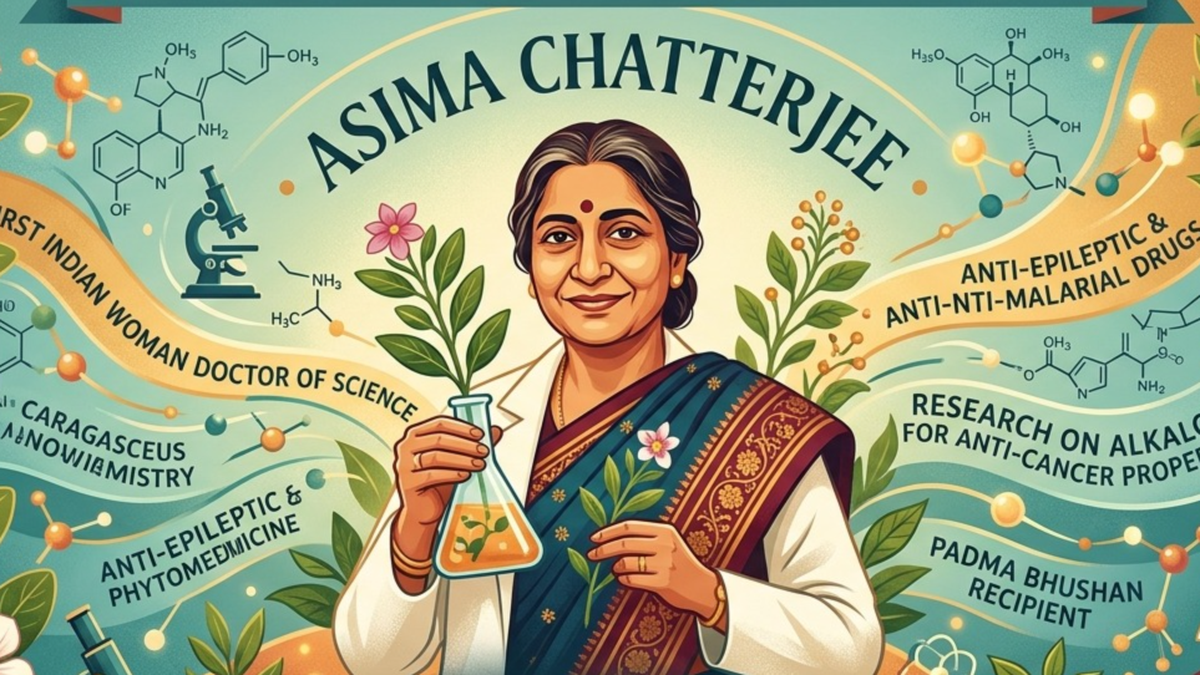
Asima Chatterjee was the first woman to receive the Shanti Swarup Bhatnagar Prize in Chemical Sciences, in 1961 | Photo Credit: Photo Credit: Image generated with the help of AI Did you know that an Indian woman scientist had a notable role to play in the development of anti-epileptic drugs and anti-malarial drugs? That the same woman also told us most of what we needed to know about the medicinal plants in the subcontinent?By the standards of her time, unlike other women scientists, Asima Chatterjee did get recognition for her research while she was alive, but it cannot be said that she received the adulation and celebration that her male peers did. That doesn’t make Asima Chatterjee any less tall a figure in the history of Indian science, and the nation must be grateful for her pioneering work in organic chemistry and the sub category of phytomedicine – using plant extracts to treat various conditions, even prevent them.109 years ago, Asima Chatterjee was born, on September 23. Her love affair with chemistry began at a young age and she went on to pursue this, with a Bacherlor’s degree and a masters in the subject. At a time when few women were able to take up higher education, she went on to complete her Doctor of Science degree in pre-independent India, specialising in phytochemistry. History records her as the first Indian woman to be awarded a Doctor of Science by any Indian university. She went on to gain expertise in research methodology at the University of Wisconsin, Madison and the California Institute of Technology, working with international experts in the field before returning to India.She took a great interest in a sector that sought to harness the natural plant biodiversty of India and phytochemistry skills to develop newer compounds and drugs that could be used to treat people. Today plant-based extracts form key elements of critical drugs. Plant-derived drugs range from pure compounds extracted from herbs to complex botanical extracts approved as prescription medications. Chatterjee sank herself into the development of clinically useful drugs from indigenous plants – striking success with isolating the chemical constituents of Marsdenia tinctoria – which led to the formulation of the anti-epileptic drug later marketed as Ayush- 56.Chatterjee also made huge breakthroughs in developing anti-malarial drugs derived from plant extracts. But the greatest achievement that she is credited with is her extensive research on the chemistry of alkaloids found in Caranthus roseus, or the Madagascar periwinkle, which contributed leaps to the understanding of compounds with anti-cancer properties. No less important is the foundation she laid for modern pharmaceutical chemistry, utilising physical and chemical methods to to determine the complex molecular structures of numerous organic compounds, and recording her methodology meticulously.Beyond her pioneering work in the lab, Chatterjee was also an ace institution builder and educationist. During her academic career, she served as a professor of chemistry at the University of Calcutta at a time of intense gender barriers in academia, and was later appointed as the Khaira Professor of Chemistry, a prestigious chair in the varsity.Her work in science was recognised with a Padma Bhushan in 1975, Chatterjee creating a record here too, being the first woman scientist to achieve this honour. She was the first female scientist to be elected as the General President of the Indian Science Congress Association and was also a Fellow of the Indian National Science Academy. No wonder then that she was the first female recipient of the Shanti Swarup Bhatnagar Prize in Chemical Sciences (1961), India’s top science award, introduced in 1958. She was also awarded the prestigious CV Raman Award and PC Ray Award.Today, as the debate rages about bringing scientific vigour and scientifically validating traditional systems of medicine in the country, Chatterjee was a beacon even in this area, her work bridged the gap between traditional Ayurvedic knowledge and modern rigorous chemical analysis, to benefit humanity. LegacyBut Asima Chatterjee’s achievements cannot be confined to just the scientific arena, her immense achievement must also be counted at a time when formidable gender barriers stood in the way of female achievements, breaking the glass ceiling and making it possible, even inspiring, generations of women scientists to make their bold foray into the sciences. Being that rare Indian women scientist who got substantial recognition during their lifetime, in the scientific world, and yet she was largely missing from mainstream narratives, and global histories of science.But today, we say her name, properly celebrate her legacy. Asima Chatterjee, exceptional chemist, phytochemist and extraordinary pioneering scientist who opened the portals the world of science for generations of women. Say her name, say Asima Chatterjee. Published - September 20, 2026 10:11 pm IST
An Indian woman phytochemist without parallel
Full Article
Original Source
Read the full article at Thehindu →KhanList aggregates and links to publicly available news content. We do not host full articles from third-party sources. Always verify important information with original sources.