
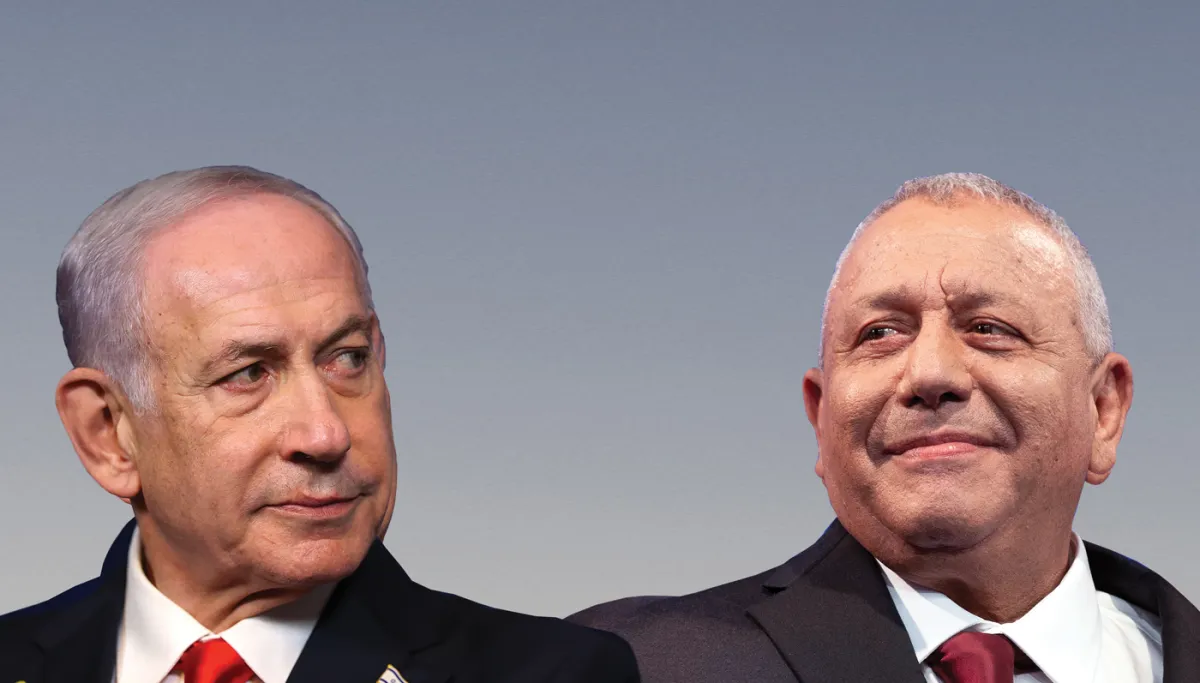
The mixed decision the country’s voters rendered in the first national elections since Hamas’s Oct. 7, 2023, invasion provides only the latest illustration of this undeniable fact.Prime Minister Benjamin Netanyahu’s ruling Likud Party lost one-sixth of its seats as of this writing, and his current coalition fell shy of a majority, as his allies among the Haredim, or ultra-Orthodox parties, and two key right-wing parties, Religious Zionism and Otzma Yehudit, disappointed at the ballot box. At the same time, however, the opposition, led by former Israeli military Gadi Eisenkot’s Yashar party, also came up short, despite high hopes. Eisenkot landed fewer seats than Netanyahu, and his bloc collectively won fewer mandates than the prime minister’s.Meanwhile, the Arab parties secured a record number of seats and are likely to complicate both blocs’ efforts to form a government.Israeli Prime Minister Benjamin Netanyahu, left, and opposition leader Gadi Eisenkot. (Washington Examiner Illustration; Joe Raedle/Getty; Noam Galai/Getty) How did this split decision come to be? And what happens now? With another round of the fight with Iran looming, will the major parties form a unity government? Will one bloc secure enough defections from the other to build a coalition? Will a minority government take power? Or will Israelis head back to the polls in six months?Before engaging these consequential questions, it’s helpful to understand how Israel’s complicated electoral system operates.Israel’s Byzantine electoral system The Knesset, Israel’s parliament, comprises 120 members, thus requiring a majority of 61 seats to govern. Voters in the Jewish state select a party slate rather than individual candidates, and seats are allocated to parties proportionately to the share of the national vote they receive. However, only parties surpassing the threshold of 3.25% of the total vote earn seats — factions that fall short of that mark have their votes thrown out altogether.Yet, even among the parties securing Knesset seats, arriving at a 61-mandate majority is no mean feat. In fact, at no point in the country’s history has any party achieved that magic number — in 1969, the Labor Party won 49 seats, still the all-time high for a single party — and, accordingly, would-be governing factions must cobble together a coalition of other like-minded parties.Traditionally, Israel’s president, a largely ceremonial role, bestows the initial opportunity to assemble a government on the prime ministerial candidate he believes is most likely to succeed. This generally, but not exclusively, means the leader of the party winning the most seats gets the first crack at the often Herculean task, but the president occasionally chooses the second-highest vote-winning party if that faction can more plausibly build a 61-seat majority. Either way, upon receiving the baton, the party leader has 28 days to complete the mission, after which the president may reassign the responsibility to the runner-up. If several rounds of this exercise fail, then new elections are in the cards — between 2019 and 2022, Israel held five elections, only the last of which was conclusive enough to avoid further contests.Canvassing stations on Oct. 27 in Israel. (Michael M. Rosen) The current Knesset, which took office in 2022 and served out its full four-year term, featured 64 coalition members, led by Likud’s 32 seats, 18 mandates for the Haredi parties, and 14 slots for the right-wing factions, led by Bezalel Smotrich’s Religious Zionist Party and Itamar Ben-Gvir’s Otzma Yehudit. The opposition was led by Yair Lapid’s Yesh Atid party, which garnered 24 seats and folded itself into a different party in Oct. 27’s elections; Benny Gantz’s Blue and White faction, which won 12 mandates but dropped out of the recent campaign; Avigdor Lieberman’s Yisrael Beiteinu movement, which held six seats; the four-seat Labor Party; and the Arab factions, which won 10 mandates between them.But Netanyahu and his fairly stable coalition presided over the horrors of Oct. 7, which dealt a heavy blow to his electoral prospects early on. Recent revelations about specific warnings the prime minister reportedly received from Emirati and Egyptian sources prior to the attack further damaged his credibility. He also steadfastly refused to convene a state commission of inquiry to delve deeply and impartially into the country’s systematic failure to anticipate the Hamas invasion. In addition, his controversial attempts to fundamentally reform the country’s judicial system in early 2023 enraged and energized opponents. It didn’t help that Netanyahu had occupied the prime minister’s office for 19 years, including 16 of the last 17 — Israel has no term limits. And while he won significant tactical victories against Hamas in Gaza, Hezbollah in Lebanon, and the mullahs in Iran, the prime minister’s relationships with Western leaders largely soured, as Israel’s support on the world stage declined significantly.Yet what riled the public most intensely were his mostly unsuccessful efforts to exempt the vast majority of Haredim from military service. With hundreds of soldiers dead and thousands wounded since Oct. 7, and tens of thousands of middle-aged Israelis — most with young families, all with regular jobs — serving hundreds of days of reserve duty, everyday voters chafed at the prospect of 15% of their fellow countrymen sitting out the grueling conflict in the comfort of their homes. When a right-wing government supposedly supportive of the military bowed to the wishes of the Haredi minority, many Israelis had simply had enough. Tens of thousands of Israelis living abroad flew home for the election — there is no absentee or mail voting in Israel — and one that I spoke with was positively champing at the bit to evict Netanyahu from office. What’s worse, because the exemption legislation mostly failed, Haredim themselves expressed frustration with Likud and threatened to avoid the ballot box.Canvassing stations on Oct. 27 in Israel. (Michael M. Rosen) Still, as time wore on, the Netanyahu coalition held together and steadily recovered in the polls. The prime minister leaned hard into the argument that Yashar and the rest of the opposition were a bunch of leftists who would partner with the Arab parties to doom the country. Only one party in the so-called change bloc actually represented the Left — the Democrats, a merger of the center-left Labor, Israel’s oldest party, and the further-left Meretz party, led by the retired Gen. Yair Golan, who personally fought on Oct. 7 — and the remaining center-right parties in the opposition vowed not to bring Arab factions into the coalition. Netanyahu also shared an AI image of a mushroom cloud over Tel Aviv, arguing an Iranian nuclear attack would be the logical outcome of his ouster; trumpeted the endorsement of President Donald Trump, one of whose staffers characterized the prime minister as desperate; and threatened to fire the military chief of staff, whom he had previously hand-picked. The aggressive campaigning seemed to work: By the time the final opinion surveys were published on Oct. 22, Likud and Yashar drew mostly equal, as did the pro-Netanyahu and change blocs.So what actually happened on Oct. 27?The results Election Day in Israel is a national holiday with all schools and workplaces shuttered. For a country that treats Sundays like ordinary work and school days, Election Day arrives as something of a civic celebration, where the pace of life slows and Israelis catch up with family, friends, and neighbors. And, of course, a national day off prompts citizens of the Jewish state to vote in very high numbers: the Jewish state routinely ranks highly in OECD surveys of voter turnout.This year, electoral participation surged even more than usual. More than 77% of eligible Israelis cast ballots, the highest percentage in 25 years. Turnout was especially high in Arab cities, a trend attributed by many to the hostility that Ben-Gvir, the far-right national security minister, exhibited toward Israeli Arabs and his failure to stem spiraling criminal activity in the Arab sector. Then, too, participation rates were lower in Haredi redoubts such as Bnei Brak and certain Jerusalem neighborhoods, perhaps a result of the disillusionment the ultra-Orthodox felt with Likud over its failure to enact their desired widespread military exemption.As the results began to pour in, it quickly became apparent that neither side would enjoy an easy path to 61. At press time, with more than 90% of precincts reporting, Likud had secured 27 mandates, five fewer than in the current government. The Haredim shed four votes, while the right-wing parties held serve. Altogether, the Netanyahu bloc held 53 seats, eight short of the magic number and a 16% decline from the previous contest.The change bloc also received disappointing results. Yashar locked up 21 seats, and its allies, including former prime ministers Naftali Bennett’s and Lapid’s Together alliance, Lieberman’s Yisrael Beitenu, and Golan’s Democrats, won only another 27 collectively, bringing the opposition’s total to 48. Given the energy and intensity of the bloc’s efforts to unseat Netanyahu, and the sense that high turnout benefits parties not in power, the outcome was a bitter pill to swallow. In the words of Amit Segal, a leading Israeli center-right commentator, “Bibi hasn’t won, but the opposition has lost.”Netanyahu won in precincts that surprised some, including towns hardest hit on and after Oct. 7. For instance, voters in Sderot, a traditional Likud stronghold that abuts the Gaza border and suffered heavy casualties from Hamas, went 39% for the prime minister. And Kiryat Shmona, another Netanyahu power center near the northern border with Lebanon that absorbed thousands of Hezbollah rockets and whose mayor denounced the prime minister for insufficient support, sent almost half of its votes to Likud. Anecdotally, the majority of the young soldiers I spoke with, including my own children’s friends, many of whom experienced months of grueling combat in Gaza, Lebanon, and Syria, expressed support for the right-wing parties. While I disagree with their choices, I respect the fact that they’re made out of principle and against their own interests, as continued failure to enlist the Haredim only spells more time on the battlefield for our fighters.Among the biggest winners were the Arab parties, who secured an unprecedented 19 seats at last count. Previously, the high-water mark for Arab factions was 15, which they won in 2020. Israeli Arabs compose about 20% of the country’s population, so their electoral numbers still fall shy of their share of the populace, but cities from Rahat to Nazareth rejoiced at the result, which also firmly rejected the apartheid canard promoted by the progressive Left in Europe and elsewhere. Joint List head Yousef Jabareen told Israeli news outlets that his movement intends to “leverage our political power to advance the values we believe in” and is prepared to “pave the way for ousting the government of Netanyahu, Ben-Gvir, and Smotrich, and send them home.”In addition, several new high-profile parties fell short of the electoral threshold, thereby effectively squandering their supporters’ votes. The Reservists faction dedicated itself to securing the rights and benefits of long-serving soldiers and to ensuring a broad draft law that encompasses the Haredim. The party vowed to work with either the Netanyahu bloc or the change group but ultimately won only about 2.67% of the vote, which likely was drawn from both blocs.Meanwhile, the People of Israel party characterized itself as a right-wing party that would partner with Likud but would insist on a draft law that would render an alliance with the Haredim difficult if not impossible to imagine. Netanyahu and Smotrich exerted tremendous pressure on the party’s leader, Ofer Winter, in an effort to force him to drop out, but Winter, a brigadier general, held steady. In the end, though, his party secured a scant 1.6% of the vote, thus wasting close to two possible right-wing seats.What, then, are the paths forward for a divided government?What’s next? Albert Einstein may not have actually defined insanity as “doing the same thing over and over again and expecting different results,” but the indecisive results of Oct. 27’s election may drive the Israeli electorate insane by forcing it to conduct new elections.Repeat balloting, likely in April 2027, would be the first of three principal scenarios, none of which is especially promising for the parties or for the country. For the opposition, if mustering 48 votes is the best they could do despite tremendous emotional and financial investment in the recent campaign, it’s difficult to imagine they could improve their electoral showing next year, barring some major development impugning Netanyahu’s ability to govern. In addition, his coalition can be expected to quash small right-wing parties such as Winter’s, who played a partial spoiler this time around. And the Arab factions would be hard-pressed to replicate their all-time record harvest of mandates.The coalition may also prefer not to call new elections because the prime minister’s interim powers as a caretaker leader are limited by Israeli law. As Israeli analyst Haviv Rettig Gur points out, Netanyahu would indeed be able to participate in military action against Iran and other enemies, including alongside the United States, and the possible renewal of hostilities after the Nov. 3 midterm elections in the U.S. looms large. But nothing as ambitious as judicial reform or military exemptions for Haredim can be enacted during the interelection period.A second option would involve some form of unity government, in which Netanyahu would invite Yashar, and possibly the Bennett-Lapid and Lieberman factions, into a broad government that would exclude the far Left, the far Right, the Haredim, and the Arab parties. Such a constellation would command an almost impregnable 66 votes and would enjoy wide support across the Israeli political spectrum. This hypothetical coalition could enact significant legislation, including a consensus commission of inquiry into Oct. 7, widely acceptable judicial reform plans, and a gradual and reasonable strategy to enlist Haredim.Alas, such an alignment of the stars appears unlikely. Eisenkot and his allies spent the campaign vowing not to partner with Netanyahu, whom they believe to be inherently untrustworthy and unfit to continue governing. Even if Netanyahu promised to rotate out of office midway through the term and hand the reins to Eisenkot, the latter would be unlikely to accept the former’s offer, given that Netanyahu reneged on a similar promise to Gantz earlier this decade. For this part, the prime minister harbors suspicions about even his closest allies, and partnering with erstwhile adversaries will compel him to sleep with one eye open.If the prime minister can’t build a coalition, then a third option remains: Eisenkot hammering together a government with the support of the Arab parties, possibly totaling 67 seats. Indeed, Golan of the Democrats urged exactly this arrangement, exhorting the change bloc to partner with all of the Arab factions and oust the Likud and its allies from power. “We have a majority,” Golan wrote on X. “We have responsibility. And we have an opportunity to form a government of change in partnership with Israel’s Arab citizens. A government that will serve all Israeli citizens. Now we need courage. It takes leadership. It takes stopping the fear and starting to act.”But partnering with the Arab parties is easier said than done. Those factions divide into two: Ra’am, a moderate Islamist party — yes, such a thing exists — whose courageous leader, Mansour Abbas, candidly acknowledged Israel as a Jewish and democratic state and named a Jewish Israeli, Yoav Segalowitz, as his second-in-command, although even Abbas has been reluctant to label Hamas a terrorist organization. Ra’am formed a part of the coalition in 2021-22 during a brief interregnum in Netanyahu’s tenure and, by most accounts, acquitted itself professionally and patriotically. Adding Ra’am’s seven seats to the change bloc’s total of 48 would help, and Abbas has voiced his willingness to join the effort, but it would still wind up short of the magic number by six. (All these numbers are as the Washington Examiner goes to press.)The other faction, however, known as the Joint List, expressly opposes Israel’s existence as a Jewish state and has been even more mealy-mouthed when it comes to Hamas. It didn’t help that the victory party at the Joint List headquarters reportedly resonated with the singing of the Palestinian national anthem. It’s almost impossible to imagine any Zionist party allying itself reliably with the Joint List, and every change bloc party, save the Democrats, has explicitly ruled it out.Still, Eisenkot has floated the idea of governing as a minority, with Ra’am in the coalition, and with the Joint List simply abstaining from voting. This would provide the change bloc with a slim 55-53 plurality, but it would depend entirely on the goodwill of the Joint List continuing not to vote against its endeavors — a surefire recipe for instability.FOUR THINGS TO KNOW ABOUT THE ISRAELI ELECTIONSo what’ll it be? Over the coming weeks, we will find out, as the region continues to simmer and as fighting may return to the Gulf and to Israel and its bordering states. The downside of liberal democracy is the mess it makes: inconclusive elections, factional infighting, and inherent instability. But its virtues include the vigorous airing of disparate voices and, even after multiple rounds of voting, the formation of a government expressing the popular will. Israel proudly boasts the only remotely functioning liberal democracy in the Middle East, and it’s important to keep that in mind amid the turmoil.On Election Day, our family cast our ballots in our neighborhood precinct near the local high school. We chatted with friends and neighbors as we waited in long lines to vote. And less than 100 feet away, we were greeted by a life-size photo memorializing Sgt. 1st Class Sivan Weil, a 20-year-old graduate of the high school and elite combat soldier who fell in battle in Gaza in early 2024. Like all Israelis, we voted in the shadow of Weil and his heroism, mindful that his and others’ supreme sacrifice secured our freedoms. May his memory be a blessing, may a stable government coalesce, and may Israeli society, led by worthy statesmen, continue to heal and strengthen.Michael M. Rosen is an attorney and writer in Israel, a nonresident senior fellow at the American Enterprise Institute, and author of Like Silicon From Clay: What Ancient Jewish Wisdom Can Teach Us About AI.
An inconclusive outcome to Israel’s first election since the Oct. 7 invasion
Full Article
Original Source
Read the full article at Washingtonexaminer →KhanList aggregates and links to publicly available news content. We do not host full articles from third-party sources. Always verify important information with original sources.