
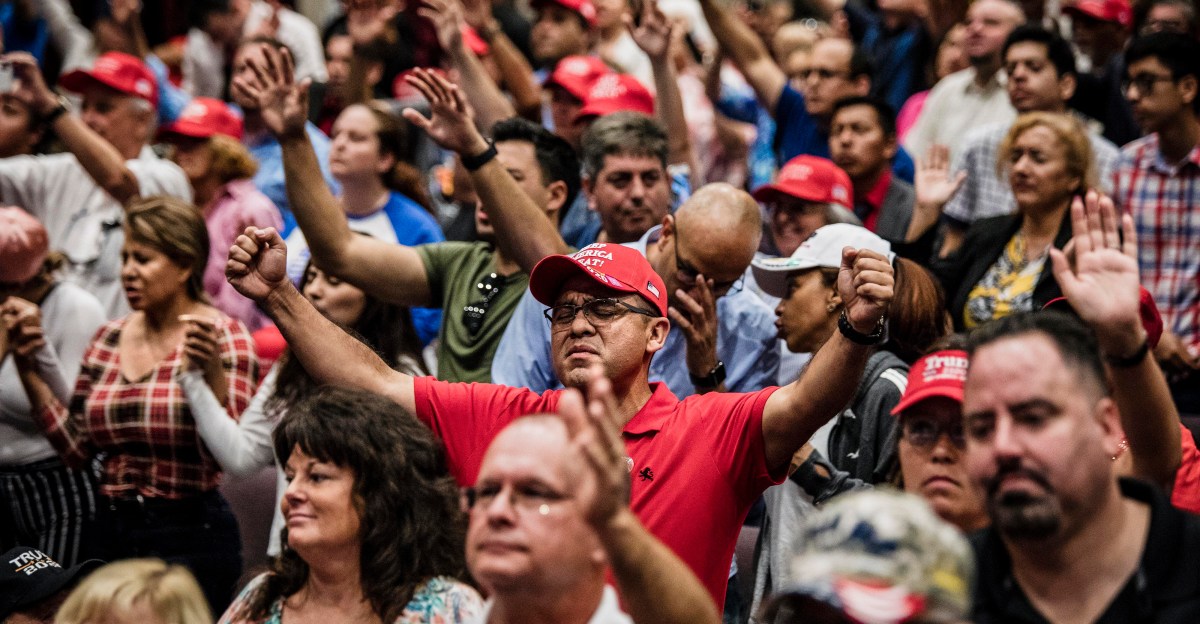
When the Donald Trump era is over — however that ends — I feel comfortable saying that at least one thing will be certain: He’ll still have the overwhelming support of evangelical Christians in the United States.Even today, with the president’s popularity at near-record lows, you’d be hard-pressed to find a religious denomination or ethnic group more supportive of Trump and his MAGA movement than American evangelicals, something that’s been true in polling and election results over the last decade. And that’s all lent itself to the perception in popular media, elite spaces, and the greater non-evangelical world of Christians that this movement is full of bigoted, Trump-worshipping hypocrites.Yet Bonnie Kristian, a deputy editor at Christianity Today and a fellow at the foreign policy think tank Defense Priorities, says that perspective gets it all wrong. It’s a caricature those outside the evangelical movement have made the mistake of accepting as truth, and in the process, they conflate the loud, Trump-supporting, white evangelical voting bloc with the entire evangelical faith tradition.The result is a “monstering” of normal people who hold deep and earnest beliefs about having a personal relationship with Jesus Christ, the importance of the Bible, and spreading the gospel. They may vote for Trump, and they typically favor Republicans, but Kristian argues the reason they vote that way is often more complex than supporting every policy, or even most policies, associated with those candidates. She also points to fascinating research that shows that when Southern evangelicals leave the church, they become more cynical and individualistic, not less — which itself poses concerns for democracy’s future.“This is a movement of tens of millions of people. You can’t have any collection of people that size and not have some unsavory stuff in there,” Kristian told me recently. “But I do really want to emphasize that [what gets caricatured in media coverage] is not typical evangelicalism.”She expands on all this in a new book out this week — In Defense of Evangelicalism — in which she rebuts five popular attacks levied against the evangelical movement in the US: that it is insincere, advances evil, is hypocritical, imposes itself on others, and seeks political control. It’s an impressive intellectual undertaking, and an informative education for those of us who grew up outside of the evangelical tradition. (As a Catholic from Los Angeles, I hadn’t had much exposure to the theological roots and spiritual convictions of the prototypical evangelical.) Kristian helped me better understand all this, and evangelicalism’s place in 2026.Our conversation has been edited for length and clarity.I’m sure our Vox audience thinks of the guys with “big beards and big podcasts,” or Trump-supporting white voters when they think about “evangelicals.” Who were you thinking about when writing this defense? Who are the evangelicals you are trying to defend?The best way to put it is I’m thinking about a normal, typical evangelical church.One of the interesting things that I found as I was researching the book is you’ll see the same characters recur in coverage of evangelicals doing crazy stuff. There’s one pastor in Tennessee, Greg Locke, who shows up in story after story and book after book. I listed something like two dozen media outlets in which he’s been featured. He does sound pretty extreme, but there’s a reason reporters go back to a guy like that, and it’s because most evangelicals are not like that.If you just walked into a normal evangelical church on any given Sunday, you won’t find anything of that nature. This isn’t just my impression — though certainly being at Christianity Today, I do have a bird’s-eye view of this movement, and I did do in-person reporting and talk to ordinary evangelicals for this book.But this is also something that you can see in survey data. Pew especially has done good research on this, asking both pastors and congregants: “Do you want politics in your churches?” Overwhelmingly, people are saying, “No, that’s not what we’re here for.”People might also have misguided ideas about themselves when they speak to pollsters. And so the other fascinating thing is many churches put sermons online now, and we’re able to do large-scale assessments of what is actually being said in these sermons. And there you find the same thing: Overwhelmingly, evangelical pastors are not preaching political sermons in the way that folks who have absorbed that caricature of evangelicalism, or who have focused on those crazy outlying figures, suspect is the case.It is hard to argue that these more extreme voices aren’t influential, or that they aren’t taking up an exorbitant amount of attention online thanks to our algorithms.I mean, obviously those people exist and I don’t like it, but I have to say they are part of evangelicalism. But this is a movement of tens of millions of people. You can’t have any collection of people that size and not have some unsavory stuff in there. But I do really want to emphasize that that is not typical evangelicalism.Even among evangelicals who are squarely on the political right, evangelicals who do support Donald Trump, even evangelicals who want — maybe not the Trump-level aggression and brutality of immigration enforcement — but who want a stricter immigration enforcement than we saw with Joe Biden…even among those people, it is not uncommon to find really tangible care for immigrants in their own communities.For instance, I interviewed a retired pastor who is local to me here in Pittsburgh. He voted for Donald Trump. He also works for an immigration advocacy center. They help people through the legal process at free and really reduced rates to get them access to lawyers.Or one of my writers at Christianity Today did a story on a pastor down in West Texas who liked Trump’s first-term border policies, and he provides tangible care for illegal migrants. He gets them jobs, he helps them find housing, he helps them with food and clothes.Even in those cases where the political differences are real between the average evangelical and perhaps the average Vox reader, that doesn’t mean that that average evangelical is one of these big beards and big podcast guys, just spewing hate. Very often they’re tangibly helping in their communities.Taking a step back, what is the state of evangelicalism in 2026? What’s your diagnosis of this movement? Has anything changed since you wrote the book? Is it still a robust movement, or has anything changed?That’s a broad question, so in broad strokes, things are not terribly different between when I was writing in late 2025 and now. It’s only been a year.In terms of [longer-term] changes, I would also point to a few things. When many people think about evangelicals, thinking back to the ’90s, they might think about the evolution and creation debates. But these days, actually for most evangelicals, they’re not young-Earth creationists anymore.Or many times conversations around evangelicals are framed around, well, will they let women be pastors? Today, the majority of evangelicals say that’s fine. So there are changes and there’s continuity.There’s also intense growth zones of this movement in the Global South. They’re in Latin America, they’re in Asia, they’re especially strong in Africa.Why take on this defense of evangelicalism now? Evangelical identification seems to be on the decline, like religiosity in general. Is this an attempt to intervene in that?I first started talking about this with my editor early last year and I had some trepidation. I work in journalism. I follow politics. I know how people talk about evangelicals in the discourse. And so I went into this with eyes open. Frankly, what would people think of me if I wrote this book?I read this book by an evangelical theologian named J.I. Packer, and as he was writing, he would casually drop in “because I’m an evangelical.” He did this over and over throughout the book, and I was noticing in myself this strange reaction where I asked myself, why is he so happy about it? Isn’t it a little bit distasteful that Packer is out here just perfectly content to be an evangelical and talking about it? And then I really had to ask myself, “Why am I reacting that way?” I am part of an evangelical church. I work at an evangelical magazine.Why is this my response? Why do I think he should be ashamed?And I hadn’t left evangelicalism, so what’s going on here? I worked through that question and realized that as much as evangelicalism has many wrongs in its history and in its present — I don’t want to paper over that — there are also real goods here, and I’m not ashamed of the tradition and the people in it. I value those goods, and these are my people.There are a lot of evangelicals who feel that same dissonance, and I wanted to help them think through that same thing and say, “No, there’s goodness here,” and we can say so and not be embarrassed of it.As far as the idea of evangelicalism trending down here, it’s seeing, if anything, less of a decline than other religious traditions in America. The last I looked at the numbers, evangelicalism and Catholicism are the two big ones and holding steadier than, certainly, mainline Protestantism.But overall, the story of the century, frankly, is the rapid decline in religiosity and connection to religious institutions in general, and evangelicalism’s not immune to that.Turning to the political realm, and how the term has become associated with a negative light, has it been healthy for the movement to be associated so strongly with Trump and the GOP?Squarely the answer is no. It’s not been healthy. It’s not been advantageous.I say that in particular about Trump, but I would also say that about any political alignment. It is not our purpose as Christians, as evangelicals, to advance any political party or politician. That’s not what we’re doing here. So, not healthy.That said, I have spent — and I haven’t changed my mind on this, I don’t think Donald Trump should be president, I think he’s a terrible president — but I’ve spent many years now writing about evangelicals and Trump, and often very critically, and I stand by all of that. However, I also think that in the discourse there can be some conflation of what very famous evangelicals who should — and I think do — know better say and do about Donald Trump, and what the ordinary voter is doing. These are different levels of moral and political responsibility and flattening them is not helpful to interacting with our neighbors.Early on in the Trump era, people talked about the reluctant Trump voter, and there was a theory that the evangelical voter was that kind of voter. That’s not what I’m positing. That might have existed, but we’re over a decade into this now, and that’s not really a viable explanation at this stage. But there is what I would describe as an “obligation voter” who is found among evangelicals.It works like this: Like many other Americans, many evangelicals think you have a duty to vote. That’s point one.Point two is that, also like many other Americans, many evangelicals are only interested in voting for a viable major-party candidate, because they know how this works.Point three, they’re pro-life. We know where the Democratic Party is on this issue. When you add those three things together, you end up with a Republican vote for president, whether it is Donald Trump, or any Republican.We see, basically, statistically identical rates of white evangelicals voting for Republican nominees throughout this century — every single one. It’s right around 8 in 10.Now, that is not how I decide to vote. I reject the idea that I have a duty to participate in a system where the only viable options are ethically intolerable to me, but that is intelligible and it’s, I think, morally defensible and it’s not outlandish and it’s not a statement of extremism.But evangelicals have to vote. We are sensible about who can win and we have this bedrock conviction and that’s where people end up.Sure, there are people who have much wilder ideas. There are people who are voting for Trump because they love Trump — that exists. But I think obligation voter theory is a more accurate and understandable description of the position many ordinary evangelicals are in.What aspects of the movement still need change or reform? What problems remain, particularly on race, or on, as you say, “matching words to deeds”? And how do you communicate that to such a vast movement?It’s complicated. On the one hand, there has been meaningful change on issues of race within evangelicalism in America in my lifetime that I have witnessed that is measurable, a real thing.It’s also fair to say that in the last few years, there’s been some stagnation or even some backwards movement on that. The overall trajectory is we are still going in the right direction there, but it can be a messy trajectory. There’s more to be done there.But there’s also not a one-size-fits-all solution, especially for a movement of this size. Just think in terms of local demographics: there are churches who in 2020 wanted to dive right into a curriculum of racial reconciliation and now seem to have lost interest; that backsliding might have happened for really indefensible and gross reasons, but it also might be that they live in a state like South Dakota, which is like 2.5 percent Black, and realistically they don’t have a way to meaningfully diversify their congregation because it’s just white people who live there.That’s the reality of some of our states and especially rural areas.I tried, and hopefully was careful, to distinguish between cases where a critique is fairly applied specifically to evangelicals and in many cases where progress has already been made and should be recognized alongside the critique.Like which ones?A good one here might be conversations around Christian nationalism. And this is one where I can’t give away all the details because so much of what I’m looking at there has to do with what I think is really bad data that has suggested that Christian nationalism, in the really horrifying way that we understand it, is far more common than it actually is.But to make this distinction, yes, actual Christian nationalism does exist. There are people who will even claim that title. And some of them are Catholics, and some of them, though, are evangelicals. But it’s also the case that sometimes the label Christian nationalism gets applied any time a pretty conservative evangelical is trying to engage in politics, trying to vote for what she thinks is right.That’s just how democracy works! The idea that evangelicals are trying to impose our beliefs on our neighbors when we’re voting for what we believe to be moral — that’s literally what we’re invited to do. We’re supposed to vote for what we think would be best. It’s not Christian nationalism.Maybe we’re wrong, maybe our ideas are bad, but it doesn’t deserve that very exciting label.How did you wrestle with developments in 2025 and 2026, particularly when it comes to mass deportations and stronger immigration enforcement? I’m thinking in particular of the Public Religion Research Institute’s analysis of how white evangelical Protestants seem to have the most restrictive views on immigration, and are more likely than other religious groups to endorse tougher or more dangerous enforcement policies, like razor wire or camps.Those numbers are real in many cases. I might have some quibbles with how the questions are asked, but I think obviously there are patterns here. Those are very much not my politics, and I am very comfortable saying I think evangelicals who are in favor of that kind of brutal immigration enforcement are wrong.I understand why many people outside of evangelicalism may think, well, evangelicalism itself is the problem. But a point of fact: we have research that makes very clear that when, in particular white Southern evangelicals, the kind of folks who are going to be showing up in that PRRI research you named, when they leave the church, they do not become more caring for immigrants. They do not become more gentle in their politics. On the contrary, they go in the other direction.Evangelicalism very measurably is making evangelicals better. It is making them care more for their neighbors. It is making them more invested in their communities. And so just monstering this movement is not even a solution.How do you think evangelical leaders and institutions should be engaging with electoral politics and political activism in the future, and in a post-Trump era? Is there room for collaboration or dialogue between Democrats and evangelicals?It’s so hard to say what the post-Trump era is going to be like.I am very skeptical of church involvement in politics where people are lobbying for things in their formal capacity or their organizational capacity. At the same time, I look back at the history of the civil rights movement and obviously it was enormously important that Martin Luther King, for instance, was Reverend Martin Luther King.That does give me pause in my inclinations to just say we should stay out of it. We should be thinking about things on an issue-by-issue basis and not aligning ourselves with parties or politicians.Obviously there are always going to be policy differences among Christians generally on those alignments — among evangelicals particularly. We have the same doctrine and we read the same scripture and people in good faith can come to different conclusions about what that means for policy. But generally speaking, if we are sincerely trying to bring our faith to bear in our politics, if we were to operate on that issue-by-issue basis, we’re going to tend to see a diversity of coalitions and partners.
An evangelical explains what people get wrong about her faith
Full Article
Original Source
Read the full article at Vox →KhanList aggregates and links to publicly available news content. We do not host full articles from third-party sources. Always verify important information with original sources.