
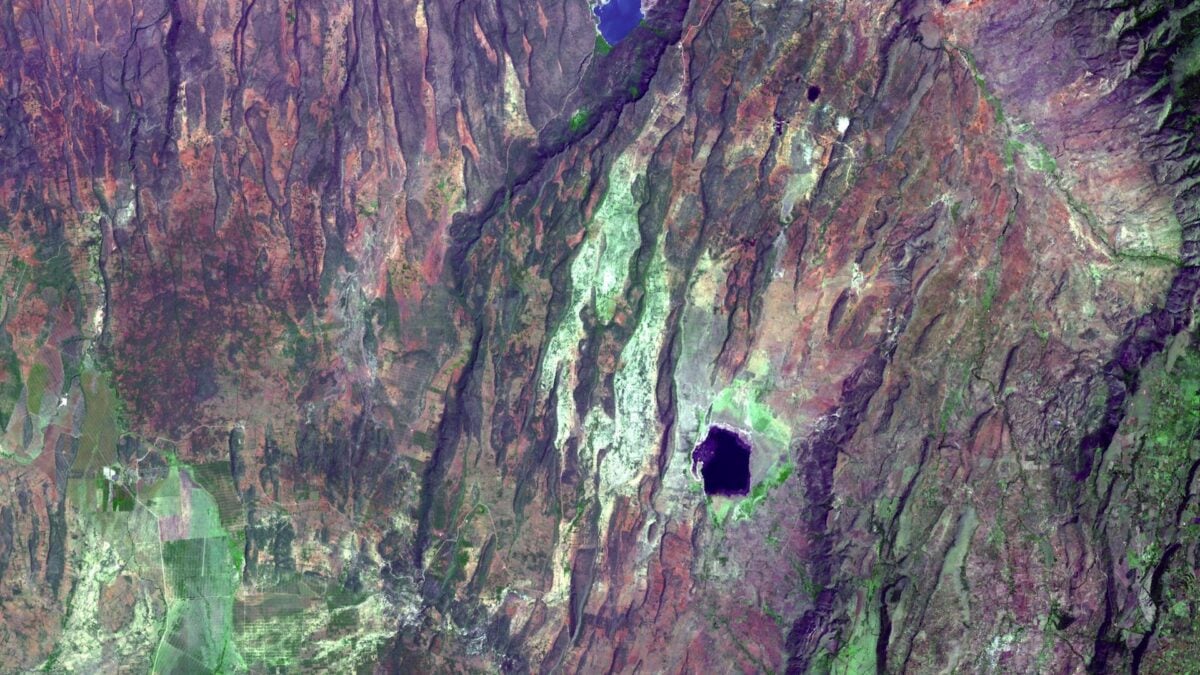
In April 2017, a magnitude 6.5 earthquake struck central Botswana, shaking a part of southern Africa that scientists had generally considered stable. The earthquake was particularly puzzling because it occurred within the Kalahari Craton, an ancient block of continental crust that’s relatively resistant to the forces that pull continents apart. Nearly a decade later, scientists have uncovered evidence that this seemingly dormant region may be experiencing the early stages of a much larger geological transformation. A new study suggests that an ancient rift system beneath Botswana may be stirring back to life, potentially extending the reach of the tectonic forces slowly pulling Africa apart. The findings, published in the journal Tectonics, reveal new insight into what’s happening beneath a seemingly unshakable geological foundation. A failed rift A continental rift forms when tectonic forces pull Earth’s crust in opposite directions, stretching and thinning the landmass until it begins to fracture along large faults. If this process continues for millions of years, the continent can eventually split apart, allowing seawater to fill the gap and form a new ocean. But not all rifts reach this stage, and some eventually stop developing. Most continental rifts develop along regions where Earth’s crust is already relatively weak, such as old mountain belts or boundaries between tectonic plates. The Kalahari Craton in eastern Botswana is different. It is an ancient block of continental crust that has remained relatively stable for billions of years. “Whether rifts do propagate through cratons has been a really big question in geoscience,” Boniface Kgosidintsi, a researcher at the Botswana International University of Science and Technology and lead author of the study, said in a statement. The researchers behind the study set out to understand how the rift in Botswana could be breaking through the craton. They focused on the Khurutshe Fault, a major fracture in the Earth’s crust associated with a 50-mile-long (80-kilometer-long) geological structure near the location of the 2017 earthquake. The fault’s steep scarps suggested a history of significant movement, but scientists wanted to establish when that movement occurred and whether the structure was becoming active again. The team dug trenches across the fault and imaged the underground rock layers using electrical resistivity tomography, which sends electrical currents through the ground and measures how easily they pass through different materials. The researchers found evidence that the structure first developed around 180 million years ago, when tectonic forces stretched the region during the Jurassic Period. The rocks also revealed signs of more recent movement, suggesting that the fault has become active again after millions of years of dormancy. The findings suggest that the rift first opened during a period of continent-wide stretching. It eventually stalled before it could split the continent, leaving the fault system dormant for millions of years. Now, the researchers believe the forces stretching eastern Africa appear to be reactivating these ancient weaknesses in the crust. Exactly when this renewed activity began remains unclear, but the team found that the Khurutshe Fault has displaced younger layers of Kalahari sand, most of which accumulated within the past 2.6 million years. This suggests that the fault has moved relatively recently, providing evidence that the region’s tectonic history may not be entirely in the past. Continental breakup So why did the rift develop in such an unexpected location? The researchers suggest that it exploited an ancient geological seam buried within the Kalahari Craton. Known as an intra-cratonic suture zone, this boundary formed billions of years ago when separate blocks of continental crust collided and joined together. Although the surrounding craton is exceptionally strong and resistant to deformation, these ancient seams can remain relatively weak, creating natural points where tectonic forces can stretch and fracture the crust. The researchers believe this pre-existing weakness provided a pathway for the Jurassic rifting and may now be facilitating renewed fault activity. “While cratons are regarded as strong old continental blocks, they do have inherent zones of weakness that can localize a new plate boundary,” Folarin Kolawole, a structural geologist at the Lamont-Doherty Earth Observatory and co-author of the study, said in a statement. “Maybe you need to reactivate the rift multiple times. You need to try multiple times before it actually succeeds.” The findings could also challenge scientists’ understanding of the tectonic structure of southern Africa. The region south of the Okavango Rift Zone—an active, emerging continental rift in northern Botswana—has traditionally been considered part of a relatively stable microplate known as the San Plate. However, the discovery of renewed fault activity within this area suggests that it may not be moving as one coherent block after all. The researchers suggest that the San Plate may eventually split into two smaller tectonic plates, adding another boundary to the complex network of rifts slowly pulling the African continent apart. While this doesn’t mean a new ocean is about to form in Botswana, and any breakup would unfold over millions of years, the study does offer a glimpse into how the forces driving continental breakup can reach into regions once considered tectonically stable.
An Earthquake Shook a Part of Africa That’s Supposed to Be Stable. Scientists Finally Know Why
Full Article
Original Source
Read the full article at Gizmodo →KhanList aggregates and links to publicly available news content. We do not host full articles from third-party sources. Always verify important information with original sources.