
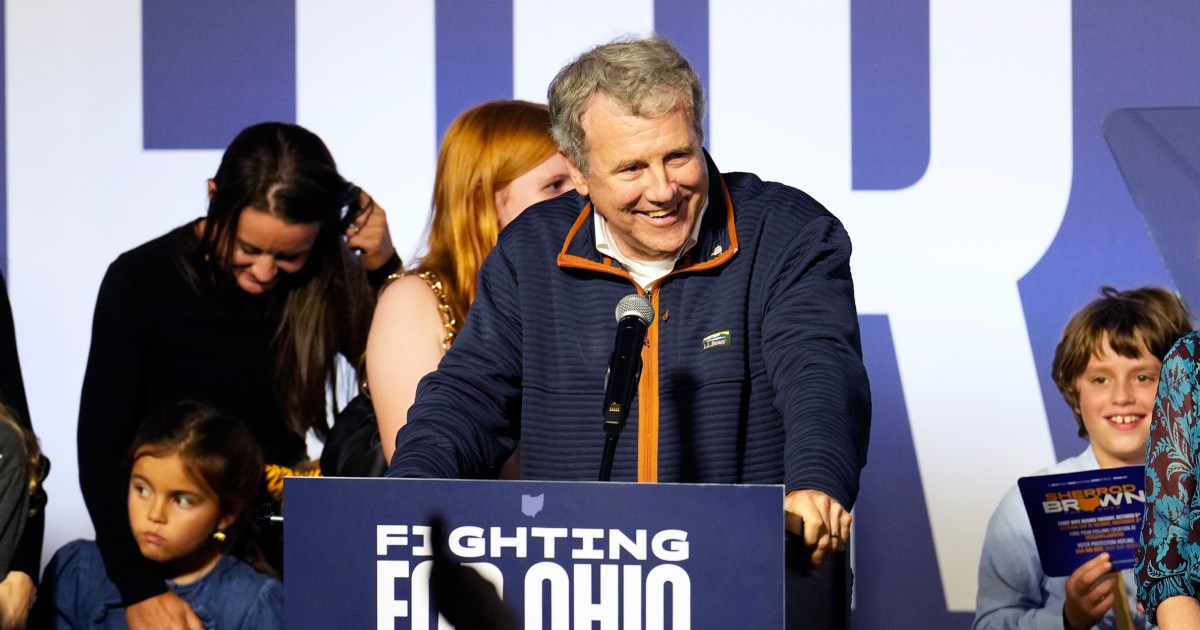
Welcome to From the Politics Desk, a daily newsletter that brings you the NBC News Politics team’s latest reporting and analysis from the White House, Capitol Hill and the campaign trail.In today’s edition, Sahil Kapur dives into the next battle for the Senate. Plus, Megan Brand explores how Black voters fueled the inroads Democrats made this year in the South. — Adam WollnerAn early look at the 2028 Senate mapAnalysis by Sahil KapurIn one election night, Democrats turned a deep structural disadvantage in the Senate into an upper hand heading into the next presidential cycle.After Republicans entered the year as favorites to maintain control, Democrats are now on pace to gain nine seats, with NBC News Decision Desk characterizing the Alaska Senate race as a likely victory for former Rep. Mary Pelotla. That would give the party a 56-44 majority, which would be the largest since 2009. It also means the GOP would need to pick up at least six seats to flip control of the chamber in 2028 (and seven if they don’t control the vice presidency).Here’s an early look at the 2028 Senate map.Core battleground: There are six states that were decided by single digits in the last three presidential elections. That includes four Democratic-held seats in Arizona (Mark Kelly), Nevada (Catherine Cortez Masto), Georgia (Raphael Warnock) and Pennsylvania (John Fetterman).Republicans will need to capture all four of those seats to give themselves a realistic shot at the majority in 2028.Of the four Democrats, Fetterman faces the greatest danger of getting a primary challenger after his popularity with Democrats has plummeted. Kelly and Warnock are in the early 2028 presidential conversation; they’ll both have an important decision to make about whether to seek re-election or make a run for the White House.There are also two Republican-held seats in this category: Wisconsin (Ron Johnson) and North Carolina (Ted Budd).Johnson survived in 2022 by just 1 point while Budd won by 3 points in a midterm year in which Democrats were on the receiving end of backlash from voters with Joe Biden in the White House.Extended battleground, red-state edition: There are six states President Donald Trump carried by double digits two years ago that became highly competitive in 2026.The first is Ohio, which Trump won by 11 points in 2024 and Democrat Sherrod Brown won by 5 points this year. Brown’s victory was a special election, so the seat is up again in 2028. It will mark the only double-digit Trump state represented by a Democrat in the next cycle.The others include four Republican-held states where the other Senate seat flipped from red to blue this year: Iowa (Chuck Grassley), Kansas (Jerry Moran), South Carolina (Tim Scott) and, assuming Democrats officially prevail, Alaska (Lisa Murkowski).Rounding out the list is Florida, where GOP Sen. Ashley Moody defeated underfunded progressive Democrat Angie Nixon by less than 3 points. Like Ohio, this was a special election, so Moody will have to run again in two years.Can lightning strike twice? Democrats needed a dream environment (and, in some cases, weak GOP candidates) to make those states competitive in 2026. It’s far from clear they can replicate that in two years. But if they can, a filibuster-proof majority of 60 seats could be within reach for Democrats.Extended battleground, blue-state edition: If Republicans sweep every red and purple state mentioned above, they’ll have picked up five Democratic-held seats, needing at least one more to capture Senate control. That’s where blue-leaning territory comes into focus.Judging by recent presidential elections, New Hampshire (Maggie Hassan) is probably the GOP’s best chance.From there the hill gets much steeper, with seats up in the solidly Democratic states of California, Colorado, Connecticut, Hawaii, Illinois, Maryland, New York, Oregon, Vermont and Washington.How difficult are those states? In 2022, Republicans zeroed in on Colorado and Washington as sleeper races after recruiting who they viewed as strong candidates. They ultimately lost both by double digits.It’s almost a mirror image of the rough environment Democrats faced entering 2026 — they needed to win at least two solidly red states to have a shot at Senate control. Now it’s Republicans who would need to win at least one blue state to give themselves a chance.How the tables have turned.How a surge in Black turnout propelled Democrats in key Southern statesBy Megan BrandBlack voters turned out in South Carolina at a level more similar to a presidential election year than a midterm year, according to state data, helping propel Sen.-elect Annie Andrews across the finish line in the longtime red state, while similar patterns powered other Democrats across the country.Political experts and activists say higher Black voter turnout paved the way for Democrats to flip both the House and the Senate, with Democrats making gains in other traditionally red states with large Black populations, including Mississippi. Black voters played key roles in races in Georgia and Louisiana, too.Running underneath it all, the activists told NBC News, was an undercurrent of anger and motivation stemming from redistricting efforts and the Supreme Court’s Louisiana v. Callais decision, which weakened the Voting Rights Act. The April decision kicked off redistricting efforts in some Republican-led states to cut Democratic seats where many Black voters live.Read more →🗞️ Today's other top stories✈️ One battle …: Air travel across the country largely returned to normal, although some disruption persisted as airlines scrambled to get back on schedule after a rare nationwide ground stop Friday. Read more →🏦 … after another: A nationwide outage impacting Chase banking services led some customers to report trouble accessing their accounts and withdrawing funds. Read more →🤔 On second thought: Trump said he “would not mind” if Jensen Huang were reinstated as CEO of Nvidia after he resigned following allegations of multiple extramarital relationships. Read more →⚖️ SCOTUS watch: The Supreme Court rejected Trump’s move to cancel academic funding for researchers in California because his administration deemed the projects to be inconsistent with policies such as his opposition to DEI initiatives. Justices also declined to hear a challenge to Maryland’s restrictions on people carrying firearms in a broad range of public areas.🔎 Warning shot: A Justice Department official accused Sen. Elizabeth Warren, D-Mass., of intending to target private individuals close to Trump with investigations. Read more →That’s all From the Politics Desk for now. Today’s newsletter was compiled by Adam Wollner.If you have feedback — likes or dislikes — email us at politicsnewsletter@nbcuni.comAnd if you’re a fan, please share with everyone and anyone. They can sign up here.
An early look at the 2028 Senate map: From the Politics Desk
Full Article
Original Source
Read the full article at Nbcnews →KhanList aggregates and links to publicly available news content. We do not host full articles from third-party sources. Always verify important information with original sources.