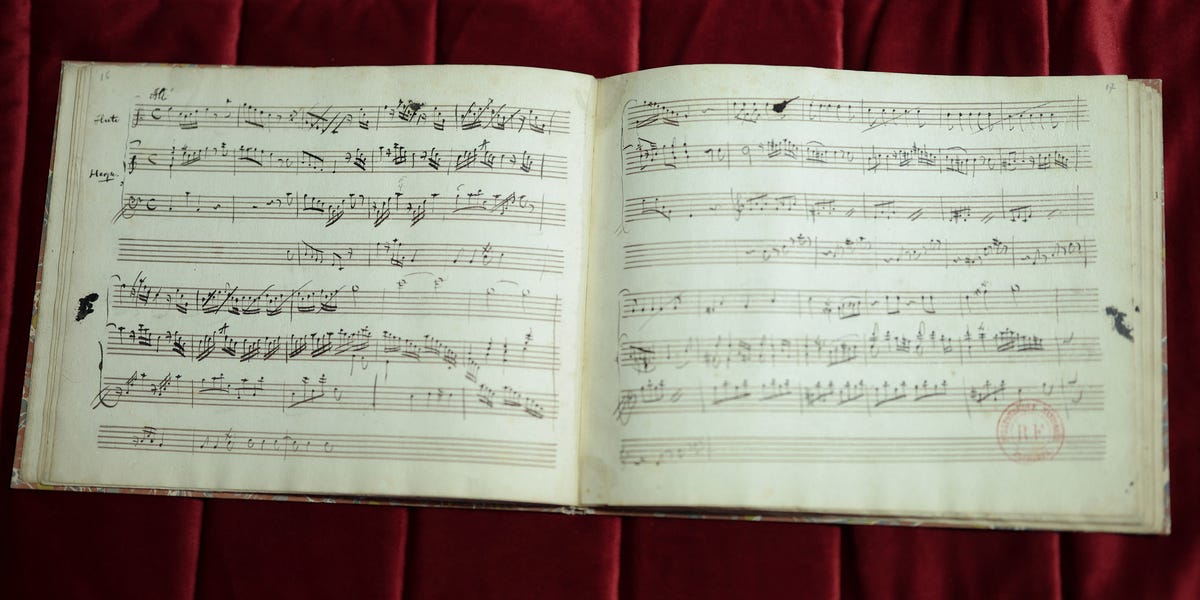
4 min readHere’s what you’ll learn when you read this story:Six Mozart compositions sat unidentified in a Paris library for nearly 250 years.The duke who commissioned the compositions was a stock-manipulating diplomat who cheated the young composer.Mozart refused the insulting partial payment and walked away—but history vindicated his genius.This story is a collaboration with Biography.comIn March 1778, Wolfgang Amadeus Mozart arrived in Paris in a mood that was anything but triumphant. He had left the stifling atmosphere of Salzburg with his mother, hoping to make his fortune in the city where he had once been celebrated as a child prodigy. But at 22, Mozart was no longer a novelty, and patrons were hard to find. He had little money, mounting anxiety, and an urgent need to earn a living. Like most professional composers of his time, he turned to teaching the children of wealthy aristocrats.One of those aristocrats appeared just a couple months later: Adrien-Louis Bonnières de Souastre, better known as the duc de Guînes. The duke had pursued music passionately in his youth and liked to play the flute. His daughter, Marie-Louise-Philippine, was an accomplished harpist. Guînes hired Mozart to teach her composition and, almost certainly, to supply music that father and daughter could perform together.The pairing was unusual. Mozart wasn’t especially accustomed to writing for flute and harp, and some contemporary accounts suggest he wasn’t particularly fond of the combination, either. Still, over the next several weeks, he gave Marie-Louise-Philippine 24 two-hour composition lessons and produced a work that’s long been considered a minor masterpiece called the Concerto for Flute and Harp (often referred to by its catalogue number, K 299).For more than two centuries, that was nearly the whole story: A young composer received an aristocratic commission and wrote a graceful concerto. Then, in February 2026, a small mystery surfaced in the music department of France’s national library, the Bibliothèque nationale de France (BnF). An archivist named François-Pierre Goy was examining a pile of anonymous manuscripts when a 44-page notebook filled with musical exercises and short compositions caught his eye.Goy opened the notebook and immediately suspected that the handwriting was Mozart’s. He took it to a colleague at the BnF, Laurence Decobert, who recognized the same distinctive penmanship. Scholars at the BnF and the Bibliotheca Mozartiana in Salzburg soon confirmed the attribution. The notebook contained the lessons Mozart had given to the duc de Guînes’ daughter in 1778, along with six previously unknown short compositions for flute and harp. On June 21, 2026, the six rediscovered pieces were recorded and performed live for an audience for the first time in the Salle Ovale of France’s National Library.Scholars had long believed that the Concerto for Flute and Harp was written in a sudden moment of inspiration characteristic of Mozart’s emerging genius. The newly rediscovered notebooks drastically changed that conclusion. Mozart had labored for months over lessons, exercises, and music tailored to a flute-playing duke, his harpist daughter, and the sound they wanted to make together.There was just one problem. Mozart never received the money Guînes owed him.In July 1778, Mozart went in person to the duke’s Paris residence, the Hôtel de Castries, to ask for payment. Guînes refused to see him. Instead, the duke sent a servant with a bag containing only half of the agreed-upon sum. Mozart refused the money and walked away. He considered the underpayment an insult to his honor, or as he put it to his father, as an indication that the duke considered him a “stupid German.”If Mozart felt he had been used, Guînes’ past suggests he had reason to be wary. After all, only a few years earlier, Guînes barely avoided going to prison over a long-running and well-publicized legal scandal.In 1770, eight years before he met Mozart, the duc de Guînes was the French ambassador to Court of St. James’s in London, where one of his closest allies was the Spanish ambassador, the Prince de Masserano.At the time, war seemed likely to erupt between England and Spain over who owned the Falkland Islands near Argentina. Through his close interactions with the Prince de Masserano, Guînes was privy to secret information about how likely it was at any given moment that war would really break out between Spain and Britain over the Falklands. It’s likely that he used this inside knowledge of the Falklands crisis to buy shares on the London Stock Exchange at advantageous moments and even manipulate stock prices directly, first by spreading false rumors of war, and later by delaying official announcement of the peace deal he helped to conclude. Historians have long suspected that politics, not innocence, saved him, as he was ultimately acquitted.Despite his narrow acquittal, the duc de Guînes reportedly became suspicious in the years after the trial. So perhaps it was no accident that Guînes treated Mozart with open rudeness in 1778. It’s also possible that the duke’s own musical aspirations caused feelings of rivalry or jealousy toward Mozart that played a role in his refusal to pay the young composer in full.But history eventually staged a reversal neither man could have imagined. On July 14, 1789, eleven years after the duke cheated Mozart, a crowd stormed the Bastille in Paris and the French Revolution began. As one of the wealthiest and most powerful aristocrats in France, the Duke of Guînes soon ran afoul of the Republic. In 1793, he was forced to flee France and most of his property and assets were seized by the revolutionary government—including the notebooks with the lessons he never paid Mozart for.What had been private aristocratic property became, by accident, a public archive. The same revolution that stripped Guînes of wealth preserved a record of Mozart’s labor. It was a small but elegant settlement with history. Mozart never got the full lesson fee, but the music outlasted the debt, the duke, and the world that made both possible.Shawn Gorman is Deputy Editor of News for Popular Mechanics. Before joining Pop Mech, he specialized in academic reading for educational testing. His diverse academic background also includes time spent as a lecturer and librarian at institutions such as the University of Kentucky, SUNY, and Harvard University. Shawn holds a Ph.D. in Modern Foreign Languages and Literatures from Boston University, an M.A. from The Ohio State University, and a B.A. in History from the University of Oregon. His favorite subjects to explore include computer science, physics, math, and biology. He lives on a medium-sized cat ranch in Easton, Pennsylvania, with his wife and two daughters.
An Archivist Found Mozart’s 248-Year-Old Notebook. The Lost Masterpieces Inside Tell a Wild Story.
Full Article
Original Source
Read the full article at Popularmechanics →KhanList aggregates and links to publicly available news content. We do not host full articles from third-party sources. Always verify important information with original sources.