
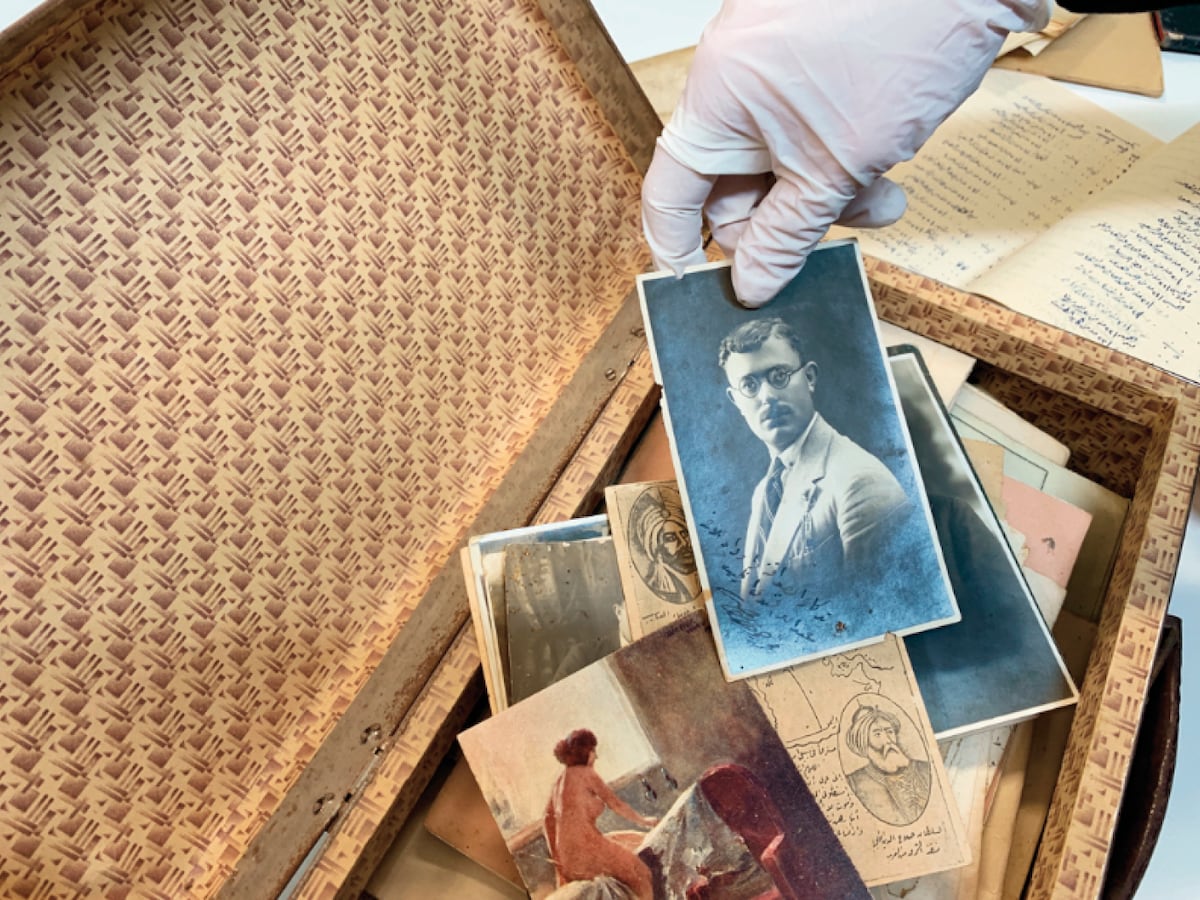
The genocide against Palestinians is also a story of looters determined to erase a people from history and of archivists who emerged from the need to protect that legacy. “It has been a continuous battle: us archiving and them looting,” says Amer Shomali, director of the Palestine Museum (Birzeit, West Bank), referring to the plundering of national archives, private collections, and materials belonging to Palestinian intellectuals since 1948. “But the digital archive is designed in such a way that it is impossible to destroy. Even if they bomb the museum, the archive will survive,” he says by video call, sounding as if he knows copies of this repository are well safeguarded.The Palestine Museum Digital Archive contains more than 390,000 digitized documents, covers more than 200 years of history and has been built from the ground up. It is not a compilation of official records but of letters, diaries, photographs, audio recordings and video that reflect the everyday life of a society: joys, sorrows, birthdays, weddings, street life, school life. Since it was created in 2018, the team has gone door to door asking Palestinians for their most personal belongings to photocopy and upload to the web.The repository is split into 436 collections. If they notice, for example, a gap in documentation on Palestinian cultural activities in Egypt, they ask who the key figures were and who their children and grandchildren are. They contact them on Facebook, ask about the legacy they may have inherited from their grandparents and try to fill that gap. This year, during a trip to Malaysia, the team found a correspondence archive containing letters between a woman who had spent 30 years in prison in Palestine and her daughter, who was imprisoned after her mother’s release. These experiences are part of the biography of many Palestinian families. As writer Adania Shibli recently said in an interview on an EL PAÍS podcast: “Prison is very present in Palestinian life. It is an intimate experience, important in one’s formation.”The museum has become the custodian of Palestine’s culture and its diaspora. A few weeks ago, the son of one of the foremost Palestinian cultural figures found a suitcase buried in a wall while renovating his home and called Shomali so he could be there when it was opened. The museum director jokes that perhaps losing the national archives was even beneficial, because the way this archive tells the story of its people from within is more interesting and useful. “We live in a very polarized world. Immediately after October 7, 2023, when the Hamas terror attacks on Israel began and the genocide in Gaza started, we saw the number of archive visitors multiply — at times by as much as 500. When there is uncertainty and people begin to question what they have believed for generations, they look for a neutral resource to understand what is happening,” he says.Although the collection has grown exponentially since its creation, of the 25 people who used to work on it, only three remain today: two archivists and one digitizer. The reason: massive funding cuts over the past three years. Now this small team is working on the creation of a cellphone application. “Suddenly we can have thousands of people involved in the responsibility of recovering our collective memory,” Shomali says, excited about the platform’s possibilities. After decades of war, exile, and dispersion, there is a virtual space where Palestinians can see themselves, read about one another, and know they are a people.Sign up for our weekly newsletter to get more English-language news coverage from EL PAÍS USA Edition
An app to preserve Palestinian memory
Full Article
Original Source
Read the full article at English →KhanList aggregates and links to publicly available news content. We do not host full articles from third-party sources. Always verify important information with original sources.