
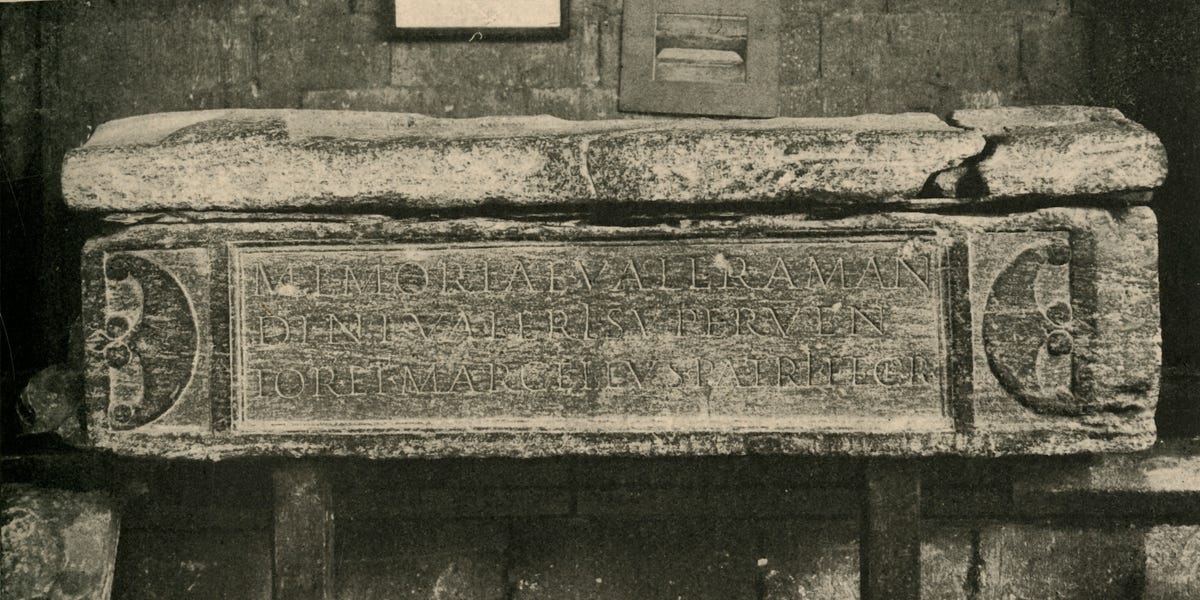
3 min readFor more than 150 years, a burial found on the grounds of Westminster Abbey remained a mystery. Clues from the coffin itself, not to mention the skeleton inside, puzzled experts until Westminster Abbey’s consultant archaeologist, Warwick Rodwell, identified the deceased as a high-ranking medieval monk. He went one step further, determining the bones belonged to Aelfwig, an abbot of the Abbey’s Benedictine monastery, although Rodwell left open the possibility that the occupant was another abbot.If you went only by the inscription carved on the limestone sarcophagus excavated on the North Green at Westminster Abbey in 1869, you’d understandably assume it held the remains of Valerius Amandinus, a wealthy Briton who lived in Roman Britain around 300 C.E. Archaeological research isn’t that simple, though. A Latin cross dated to the 10th or 11th century was also carved across the lid, likely when the coffin was reused, so with conflicting symbology muddying the waters, the identity of the person entombed on the Abbey’s grounds remained unknown for generations.It certainly didn’t help that a written account in 1873 declared the skeleton lost. In 2016, however, conservators found the bones where they had presumably been all along: inside the coffin.Rodwell worked on the puzzle for years, eventually publishing a study in the Journal of the British Archaeological Association explaining how the evidence led him to two abbots who served at the monastery. His first candidate, Aelfwig, died around 1020, but the second option was Aelfwig’s successor, Wulfnoth, who died 29 years later.“We have two viable contenders for the occupant of the sarcophagus,” Rodwell said in a statement from the Abbey. He ruled out Aelfwig’s predecessor because that abbot left the area and died elsewhere. “We do not know the date of birth of either. But either would fit equally well if we assume the abbot was in his early 20s when the appointment was made and close to 50 when he died. The fact Aelfwig was already a monk of Westminster might favor him.”The sarcophagus’s own history reveals little. The limestone probably came from Oxfordshire, England. But Rodwell wrote that no clues link the sarcophagus to its original burial site or explain why it was later moved, even though the inscription clearly ties it to a Briton who lived about 1,700 years ago. Identification is further complicated by the Anglo-Saxon cross added to the lid centuries later and by Rodwell’s belief that grave goods were stolen in the early 19th century.To learn more about the man himself, Rodwell worked with James Young Langhorne, a human bone specialist from Pre-Construct Archaeology. They determined that the man was between 35 and 49 years old and stood about 5 feet, 9 inches tall. That contradicts the 19th-century assessment, which described him as a “robust young man” no older than 30 and about 5 feet, 7 inches tall. The analysis also showed osteoarthritis in multiple joints, two healed rib fractures, and signs of an old infection in one leg. There was no obvious cause of death.Radiocarbon dating by the Scottish Universities Environmental Research Centre placed the bones between 987 and 1052 C.E. This confirmed that the sarcophagus had been reused, and the date range matches the Saxon-period cross on the lid. With that range established, Rodwell looked more closely at the possible candidates.He concluded the man was an abbot because he was “honored” with burial in a “fine sarcophagus”: his wooden coffin was packed in lime and placed inside the stone casket. To support his theory further, Rodwell wrote that he believes the “prestigious burial” first took place in the eastern arm of the abbey church. The sarcophagus would have been fully buried, with the recut lid serving as a cross-slab in the church floor. Then, after Henry III began rebuilding the abbey in the 1240s, workers moved the sarcophagus into the “newly constructed sacristy courtyard” in 1258.Today, the sarcophagus is on permanent display in the Abbey’s museum, The Queen’s Diamond Jubilee Galleries.Tim Newcomb is a journalist based in the Pacific Northwest. He covers stadiums, sneakers, gear, infrastructure, and more for a variety of publications, including Popular Mechanics. His favorite interviews have included sit-downs with Roger Federer in Switzerland, Kobe Bryant in Los Angeles, and Tinker Hatfield in Portland.
An Ancient Coffin in a Famous Church Held the Wrong Body for 1,000 Years. Now We May Know Who’s Inside.
Full Article
Original Source
Read the full article at Popularmechanics →KhanList aggregates and links to publicly available news content. We do not host full articles from third-party sources. Always verify important information with original sources.