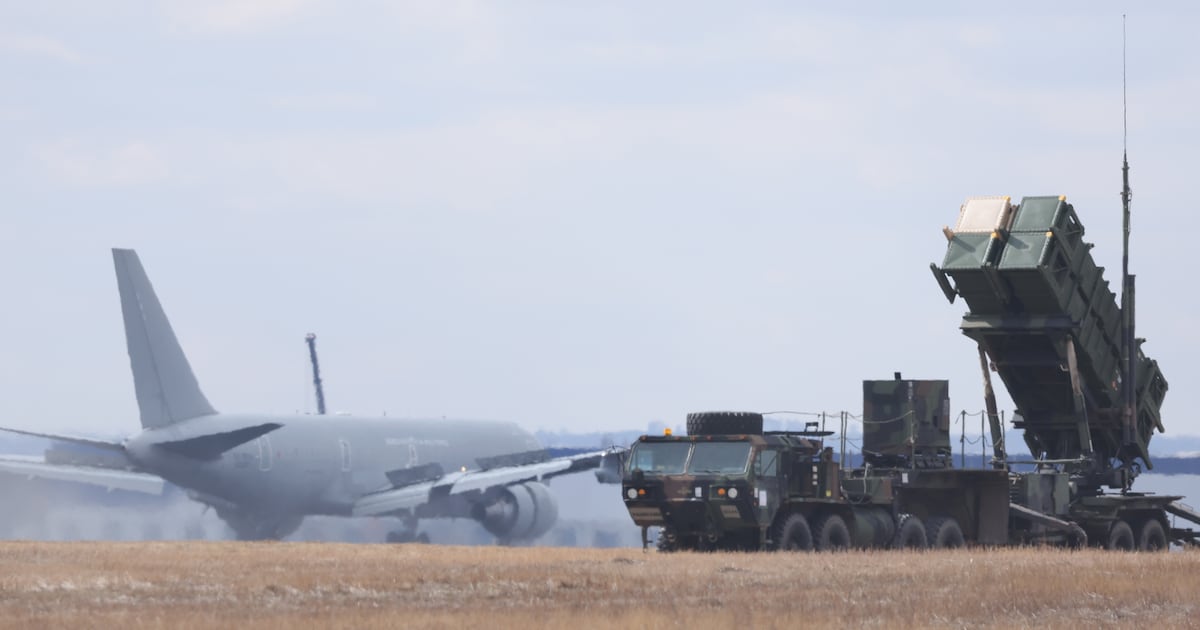
As your plane begins its descent into Rzeszów airport, you can spot the row of Patriot air defence launchers along the runway, pointed up towards the sky and ready to shoot down incoming enemy missiles.The city in southeast Poland is one of the last stops before crossing into Ukraine and has been transformed into a staging post for military aid and politicians heading onwards to Kyiv. About an hour drive from the Polish-Ukraine border, convoys of trucks arrive at Rzeszów airport every day to load up military equipment, weapons and other aid that has been flown in from Europe and beyond, to transport it into Ukraine, where it is desperately needed. That’s the reason for the $1 billion Patriot missile interceptors guarding the airport. About 150 Dutch troops are deployed to Rzeszów to secure what has become an important logistical Nato hub funnelling military aid to Ukraine. READ MOREThe mayor of Rzeszów, Konrad Fijołek, jokes that the arrival of US troops co-ordinating supply efforts after Russia’s invasion pushed local restaurants to put steak on the menus. Then they had to bring in herring for the Dutch. The next rotation will see French soldiers take over the defence of the airport and Fijołek is worried about what they will think of Polish cuisine. “It will not be easy,” he says with a laugh. “Before the war, our city was located on the outskirts of the EU, quite far from Warsaw, Brussels and Paris … We were a mono-nation city, so I would say easy life and quiet life,” Fijołek says. That has all changed. Rzeszów is the first stop on a well-trodden route to Kyiv for visiting politicians. There’s a no-fly zone in operation for civilian aircraft in Ukraine, for obvious reasons, so political leaders and other delegations take the train in. Usually that involves flying to Rzeszów and driving to the border, near Lviv on the Ukrainian side, to board an overnight military train that takes about 10 hours to pull into Kyiv the following morning. For security reasons the trips follow a familiar template. The Ukrainians limit visits to less than 24 hours to minimise the risk to their guests. Rzeszów has turned into an unlikely diplomatic hotspot, somewhat in the way Shannon Airport became a stopover where the Irish government of the day met politicians coming or going across the Atlantic to or from the United States while their planes refuelled. The Polish city has almost certainly hosted more visiting heads of state than the capital, Warsaw, in the 4½ years since the war began. Polish prime minister Donald Tusk travelled down here to meet Simon Harris when the then taoiseach was returning from a visit to Kyiv in 2024. “Today, only New York and Brussels could compete with Rzeszów in terms of the frequency of visits by heads of states, prime ministers and political leaders,” Tusk told a joint press conference that day. A remarkable 640 visiting political leaders have passed through Rzeszów since the full-scale invasion, Tusk said. French president Emmanuel Macron, German chancellor Friedrich Merz and then UK prime minister Keir Starmer met Tusk at the airport in Rzeszów last year, before the European leaders journeyed into Kyiv together the next day. “I’m not a normal mayor,” Fijołek says. The local politician has to keep a close eye on international developments. “I have to know what Mr Trump said,” he says. Rzeszów had a population of about 200,000 people before Russia’s invasion of Ukraine. Its proximity to a train line coming from Lviv meant more than 1.5 million Ukrainian refugees transited through the city in those early weeks of the war. About 100,000 stayed. “It was quite difficult to manage this crisis, of course we did it,” the mayor says.The city hall where Fijołek’s office is based has been rebuilt several times. It was levelled during the Northern War between the Swedish empire and the Polish-Lithuanian commonwealth in 1657, and again during the second World War. The thought of invading tanks rolling into Poland in the 21st century would have been unimaginable a couple of years ago, but Russia’s war in Ukraine has forced Europe to rethink its own security. That threat is felt acutely along the eastern border. They have begun building bomb shelters in Rzeszów. “During the last 40 years in Poland, we didn’t build any shelters. We thought war here is impossible. Now we have to build new shelters,” Fijołek says. “Of course we are still afraid Ukraine can lose and in this terrible case, we will have here aggressive Russian troops next to our border,” he says. “It could be a nightmare for us”.
An airport in Poland is ‘the Shannon stopover’ of eastern Europe
Full Article
Original Source
Read the full article at Irishtimes →KhanList aggregates and links to publicly available news content. We do not host full articles from third-party sources. Always verify important information with original sources.