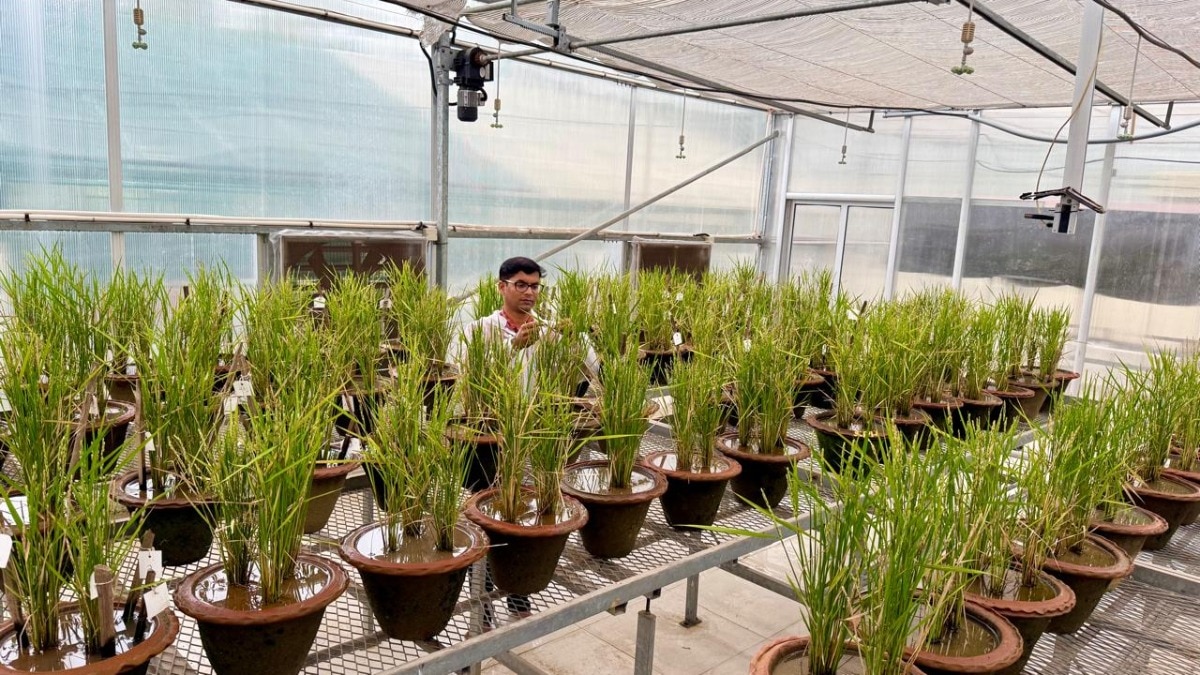
Hold a grain of rice between two fingers. It is the most ordinary thing in India, so ordinary it has become almost invisible, the quiet centre of a billion meals a day, the first solid food of the newborn and the last offered to the dead. We have been improving it for 10,000 years in the only way we knew, by choosing the best plants, saving their seed, and waiting a whole season for the harvest to tell us whether we had chosen well.In a laboratory in Cuttack, that ancient, patient bargain was quietly rewritten.A small team slipped a set of molecular instructions into a living rice cell, and then there was nothing left to do but wait. What made the waiting almost unbearable was the messenger. The team behind POC1 at the ICAR-National Rice Research Institute, Cuttack, where an AI-designed enzyme was first shown to edit a crop. (Photo: By special arrangement) The tool carrying those instructions had never existed in nature, in any bacterium, plant, or animal that had ever drawn breath across four billion years of life on Earth. It had been conjured, letter by letter, by artificial intelligence. “There was a real scientific tension in the lab back then,” Dr Kutubuddin Ali Molla, who led the work at the ICAR-National Rice Research Institute (NRRI) in Cuttack, told India Today Digital. “Nearly every day, we talked about potential outcomes, wondering if the experiment would be successful or if we had missed something.”The question was almost childlike in its simplicity. Could an enzyme dreamed up by a machine cut the DNA of a plant? The answer, it turned out, was yes. And in that single syllable, a rice cell in Odisha eased open a door that plant science had never before walked through.THE ENZYME THAT NATURE NEVER MADETo understand what happened in Cuttack, you first have to meet the enzyme, and reckon with where it came from.Its name is OpenCRISPR-1. It is a nuclease, which is simply a protein that snips DNA at a chosen spot, the way scissors part a ribbon. Its provenance is the astonishing part.In 2025, scientists at the American artificial intelligence-first protein design company Profluent Bio did not go prospecting for it in some obscure microbe, as every widely used gene-editing enzyme before it had been unearthed.Instead, they trained large language models, the same broad family of artificial intelligence that animates today’s chatbots, on more than a million natural CRISPR systems, and asked the software to compose a wholly new one. The result, published in Nature, was OpenCRISPR-1. Edited rice raised to maturity in the institute's glasshouse, the proof that an enzyme built by a machine can carry all the way from a single cell to a grain-bearing plant. (Photo: Radifah Kabir) It is a chain of 1,380 amino acids, the tiny building blocks that link up to form any protein. In more than 400 of those spots, it differs from Cas9, the natural enzyme behind most gene editing today. Yet, in human cells, it cut just as neatly, and made far fewer mistakes.One doubt remained. Cas9 comes from bacteria and OpenCRISPR-1 has only ever worked in human cells. Nobody knew whether a tool built by a machine would work inside a plant, whose cells are very different from ours.The Cuttack team took the AI enzyme's genetic recipe and transcribed it into the dialect a rice cell reads most fluently, a routine step called codon optimisation.They christened the plant-adapted version Plant OpenCRISPR-1, or POC1. Their findings, first released as a preprint on January 22, 2026, now appear in the pre-eminent journal New Phytologist.WHAT IT ACTUALLY MEANS TO EDIT A GENEEvery living being carries its instructions in DNA, a code written in just four chemical letters: A, T, G and C. Change the letters, and you change the instructions.Gene editing is the craft of making that change deliberately, at one precise address in a genome of billions of letters.The tool that made it practical, and won its inventors a Nobel Prize, is CRISPR-Cas9, often likened to a pair of molecular scissors. A short strand of RNA acts as a satnav (satellite navigation), steering the Cas9 scissors to the exact spot where they cut. Rice cells stripped of their walls glow green under the microscope, a marker confirming the editing machinery has been delivered inside more than 80 per cent of them. (Photo: By special arrangement) When a cell repairs that cut, it often stumbles, adding or dropping a few letters. That small scar silences the gene. Scientists call it a knockout.For its opening test, the team used POC1 to make two incisions in a rice gene, 573 letters apart, and let the cell splice the loose ends together, excising the fragment in between. It worked. Across several genes, POC1 edited between 10 and almost 17 per cent of the cells it reached, a rate statistically indistinguishable from Cas9's.The machine's enzyme, in other words, could hold its own against nature's.FOUR TOOLS FROM A SINGLE ENZYMESnipping a gene out is the blunt end of the craft. The real prize is finesse, and here the team went much further, fashioning POC1 into a full repertoire.The first refinement is base editing, which rewrites a solitary DNA letter without severing the strand, like correcting one typo without tearing out the page. One version converts an A into a G.Another turns a C into a T. POC1 manages both. Tellingly, its C-to-T editor outperformed the Cas9 equivalent at several targets, making the correction more reliable. The first sign of success: green shoots rise from clumps of edited rice tissue in a petri dish, the moment a laboratory edit begins its journey towards a whole plant. (Photo: By special arrangement) The second refinement is prime editing, the most versatile of all. Picture a search-and-replace function for DNA, able to rewrite short passages of code to order.POC1 could do this too, though at some sites, it trailed the sharpest Cas9 systems.Knockout, two kinds of base editing, and prime editing, all riding on an enzyme no organism ever produced. “We wanted to determine if it could be developed into a fully functional platform for plant genome editing,” Dr Molla told India Today Digital. It could.THE PATENT PUZZLE AT THE HEART OF ITThe most talked-about promise of this work owes less to biology than to lawyers, and here you, the reader, must slow down, because the story has a second side.Cas9 is ensnared in a long and costly thicket of patents, held largely by foreign institutions. Every Indian scientist or seed company hoping to turn a Cas9-edited crop into a product must thread those licences, and the expense eventually alights on the farmer. Dr Kutubuddin Ali Molla, who led the study, has already used POC1 to create disease-resistant and nitrogen-efficient rice. (Photo: By special arrangement) OpenCRISPR-1 was released as an open-source enzyme, expressly to sidestep that snare. “AI provides an interesting possibility to create whole new genome-editing enzymes from scratch and overcome the IP challenge for commercialisation of crops,” Dr K.C. Bansal, former Director of India's National Bureau of Plant Genetic Resources, tells India Today Digital.Yet the picture is not immaculate, and Dr Molla is candid about it. A patent has, in fact, been granted to Profluent Bio on OpenCRISPR-1. The company has indicated, he says, that the enzyme is meant to circumvent existing licensing constraints rather than erect fresh ones.Whether that assurance survives contact with the real world will decide how freely the tool can travel. To smooth its passage, the Cuttack team has lodged its POC1 kits with the global non-profit repository Addgene for open use.WHY INDIA HAS BEEN WAITING FOR A TOOL LIKE THISFor Dr Bansal, the allure is national as much as scientific.“It is quite consistent with India’s vision of Atmanirbhar Bharat in agriculture,” he tells India Today Digital. “With the availability of an open CRISPR system, India will not have to rely on solutions developed overseas.”The timing is auspicious. On March 30, 2022, India exempted the gentlest forms of gene editing, known as SDN-1 and SDN-2, from the onerous regulations that govern genetically modified crops, on the strict condition that no foreign DNA is left behind in the plant. India cleared its first gene-edited rice varieties, Pusa DST Rice 1 and DRR Rice 100 (Kamala), in 2025. (Photo: By special arrangement) In 2025, the country cleared its first two gene-edited rice varieties, Pusa DST Rice 1 and DRR Rice 100, nicknamed Kamala. Because POC1 leaves no foreign gene behind, crops made with it would tread the same lighter path.Asked what the technology might realistically deliver first, Dr Bansal does not equivocate.“Climate resilience is the most important issue,” he says. “Climate change is no longer a prediction. It is already impacting crop production.” A high-yielding crop, he adds, is worth little if it cannot weather a heatwave or a flood.THE HONEST LIMITSNone of this anoints POC1 a miracle, and its makers make no such pretence.Across the board, it matched Cas9 rather than dethroning it, edging ahead in places and falling short in others. In the one experiment carried all the way to whole plants, it actually trailed slightly, editing 36 per cent of lines against Cas9’s 48, a gap too small to be statistically meaningful but honest to report.Its off-target behaviour, the hazard of accidentally editing the wrong spot, has been measured in human cells but not yet in plants. Side-by-side trials show Pusa DST Rice 1 standing visibly healthier than its parent variety MTU1010 under both drought and severe salinity stress. The grain circles at the bottom confirm the yield difference: Pusa DST Rice 1 produces a significantly larger, denser harvest under both conditions. (Photo: Special arrangement/Dr Chinnusamy) Dr Molla intends to interrogate it with computational prediction followed by meticulous sequencing. And for now, the whole edifice rests on a single crop, rice.There is one further note of humility. At almost the same moment, an independent team also tested OpenCRISPR-1 in rice, in a study that cited the Cuttack preprint. Dr Molla is unruffled.“When a brand-new technique is independently verified by several labs, it boosts confidence in the area,” he says, calling the two efforts complementary rather than adversarial. His own group ventured further, he notes, building the base and prime editors the other team did not.FROM THE LAB BENCH TO THE DINNER PLATEThe story does not end at proof of concept. Dr Molla’s team has already used POC1 to create disease-resistant rice, now under evaluation, and rice that husbands nitrogen shrewdly, matching ordinary yields on roughly 70 per cent of the usual fertiliser.That is where the promise turns tangible. “A major impact could be on the availability of desired value-added crops for food processing,” Dr Bansal says, imagining faster, cheaper innovation coursing “from the lab to the fields of farmers, the food processing industries, and ultimately the plates of common people.”The steepest hurdle, Dr Molla cautions, is the long march from a promising edit to a field-ready variety, proven season upon season across India’s punishing spread of climates. An enzyme that never existed in nature just edited rice DNA. Indian scientists in Cuttack built POC1, an AI-designed, open-source gene editor that matches CRISPR-Cas9, and could help India grow climate-resilient crops without the usual patent burden. (Photo: Gen AI/India Today) Even so, something quietly historic happened in that Cuttack laboratory. The oldest companion of Indian civilisation, that grain held between two fingers, was rewritten by an enzyme that biology never invented.Curiosity, not fear, is what carried the team through the waiting. “Curiosity is frequently a more powerful motivator for scientists,” Dr Molla says.This time, curiosity edited a genome. You may never hold a grain of rice the same way again.- EndsPublished By: Radifah KabirPublished On: Jul 31, 2026 09:00 IST
An AI-designed enzyme edited rice DNA. Is this Indian farming's future?
Full Article
Original Source
Read the full article at Indiatoday →KhanList aggregates and links to publicly available news content. We do not host full articles from third-party sources. Always verify important information with original sources.