
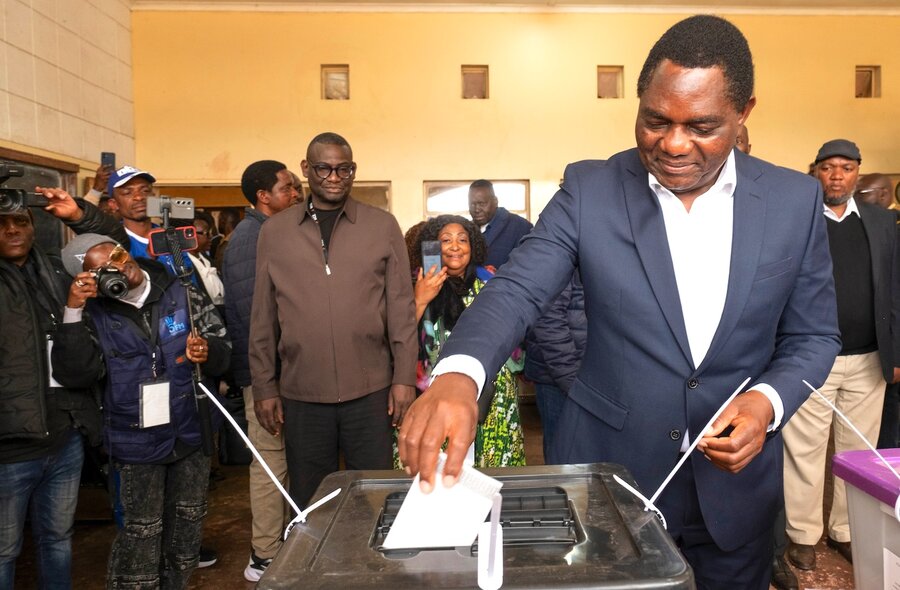
In recent years, Africa’s economies have felt a powerful impact from drought, debt, and violent discord. Yet, amid the turbulence, the southern nation of Zambia has charted a determined, if halting, course toward potential growth. Its latest election, on Aug. 13, set another example in its ability to achieve economic gains while – mostly – protecting its democratic system.The election “has far greater international significance than the country’s landlocked status and modest economic size might imply,” in the view of a senior researcher at Chatham House, a respected London-based think tank. President Hakainde Hichilema, who was elected to a second five-year term with 60% of the vote, will govern “a country at the centre of Africa’s critical minerals competition, debt diplomacy and shifting regional alliances,” wrote Christopher Vandome this month. And, he added, “Zambia’s prized democratic reputation will also be tested.”A former businessman and rancher, Mr. Hichilema won office in 2021 on the promise of upholding democracy and undoing years of economic mismanagement, which led to the country’s debt default in 2020. He has since restructured 80% of the debt and slashed inflation from about 25% to 6.5%. In 2025, the Zambian kwacha was the world’s best-performing currency, gaining nearly 25% against the dollar.“For investors, the priority is continuity and clarity,” a mining executive told the Financial Times last week, noting that Zambia’s “fiscal discipline ... restored its access to international capital markets.”Consistency of policy and fiscal discipline, and leaning toward trade rather than aid, are lessons that other African nations such as Ghana and Ethiopia also appear to be heeding. Both their economies have grown and are attracting foreign investment. And mineral-rich Zambia and Ghana have been helped by higher commodity prices and demand, with more than $12 billion being invested in the Zambian copper industry since 2023.In the wake of drastic cuts to foreign aid, President Hichilema has indicated continuity and pragmatism, viewing current global conditions as an opportunity to “take care of our own affairs.” Referring to a “sea change” in the global minerals trade, he told the Financial Times this year, “It was [previously] a one-way traffic. Now we are talking of working together as partners ... where investors see the bigger picture of the country’s vision.”The challenge that emerging African economies face in coming years is translating these gains into everyday improvements for their populations. Zambia has instituted free secondary education (bringing 2.3 million children back into the school system), and recruited more than 40,000 health workers to serve communities. But 70% of its citizens live in poverty, a situation exacerbated by extensive drought conditions.As citizens become impatient for change, the tendency is for political leaders to also become impatient – with those they perceive as critics or opponents. Mr. Hichilema and his party have apparently not been immune to this. While the election was generally free of violence and widespread fraud, international observers expressed concern over clampdowns on the media and political opposition during the run-up.The Zambian president’s initial election in 2021, as Mr. Vandome noted, was “premised upon support for democracy and pluralism. He ... did not come to power with a blank cheque, but a mandate to protect the institutions that carried him there.”It would do well for Mr. Hichilema and other leaders pursuing growth to recall that the economic stability and free markets valued by investors rarely exist without political stability and freedoms.
An Africa that prizes economic – and political – freedoms
Full Article
Original Source
Read the full article at Csmonitor →KhanList aggregates and links to publicly available news content. We do not host full articles from third-party sources. Always verify important information with original sources.