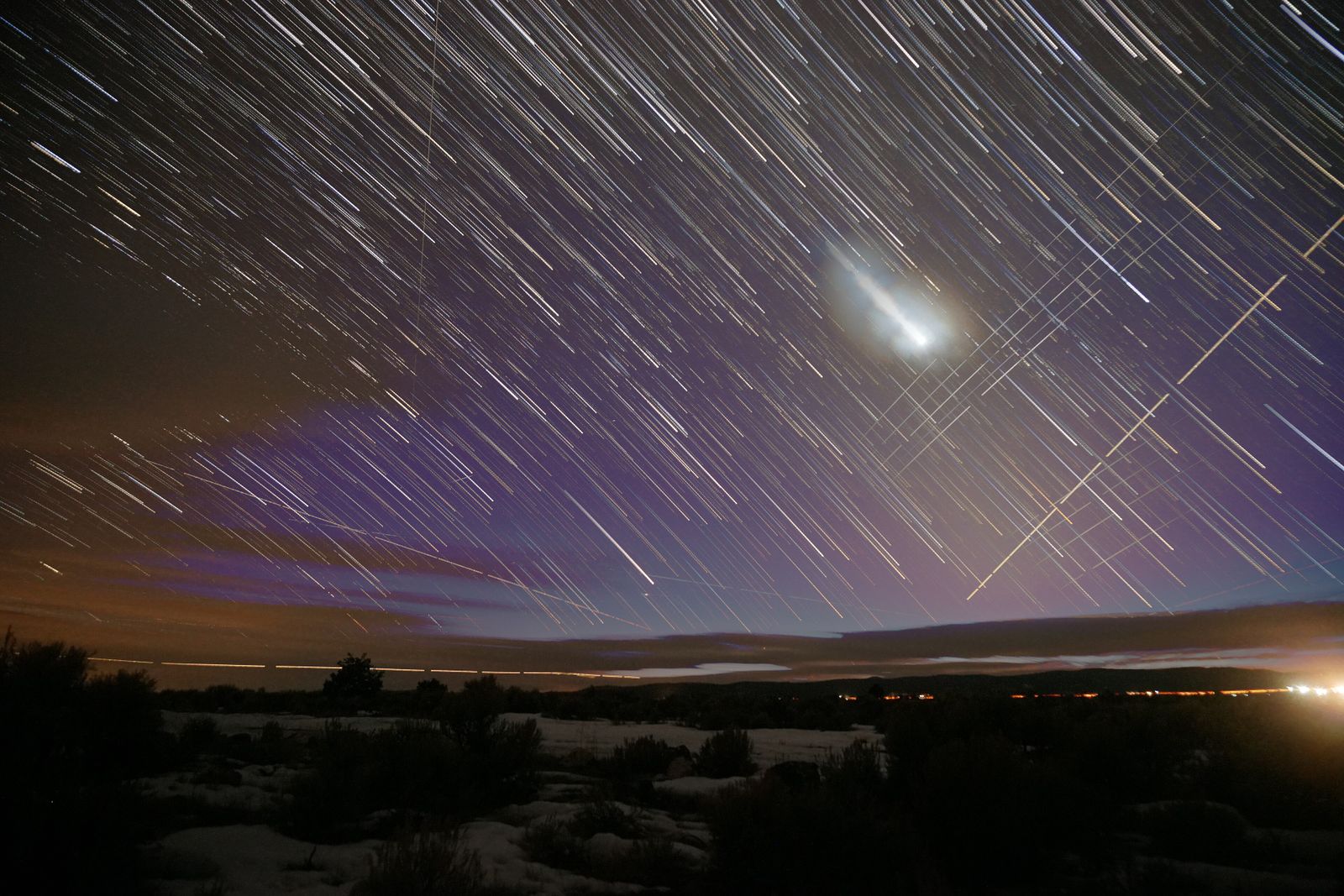
By 2035, Reflect Orbital aims to launch up to 50,000 satellites equipped with mirrors to provide sunlight to Earth-based solar panels. Critics are concerned about impacts on wildlife, astronomy research and human health August 13, 2026 1:38 p.m. Streaks of light from Venus and satellites Mike Lewinski via Wikimedia Commons under CC BY 2.0 A California-based aerospace startup aims to beam sunlight from space to Earth using a fleet of satellites carrying mirrors. The goal is to improve a source of clean energy: solar power. Panels that soak up sunlight operate only during the day, but the company Reflect Orbital wants to extend the devices’ working hours to nighttime. Now, the startup has received approval from the Federal Communications Commission—which regulates radio, television, wire, satellite and cable communications—to launch its first test satellite, slated to happen later this year. But scientists are worried about the artificial sunlight’s effects on wildlife, astronomy research and human health. Some have even filed a petition for the FCC to reverse its decision. The agency greenlit the company’s request on July 9 to “construct, launch and operate” a demonstration satellite. According to the FCC’s memorandum, the proposal “serves the public interest by permitting Reflect Orbital to test emergent technology that advances American leadership in space.” The test spacecraft is called Earendil-1, and it will sport a mirror that’s about 59 feet by 59 feet. It will live in low-Earth orbit, where it is expected to shine a roughly three-mile-wide beam of reflected sunlight onto Earth’s surface. It should launch within the coming months, and Reflect Orbital aims to have 36 shiny satellites circling our planet by the end of next year, a company spokesperson tells Newsweek’s Soo Kim. The startup wants to launch up to 50,000 mirror-bearing spacecraft by 2035. “Reflect Orbital is exploring a new way to extend the utility of sunlight: reflecting sunlight from orbit to precise, targeted areas on Earth,” per a statement from the company. “Our goal is to deliver light and energy to help make existing solar infrastructure more useful beyond the hours when direct sunlight is available, reduce fossil-fuel dependence, increase energy resilience and support critical operations.” By the numbers: How many satellites right now? There are more than 18,500 active spacecraft currently looping around our planet. However, on August 6, several environmental organizations filed a petition for the FCC to rescind its approval. They include Earthjustice, DarkSky international, Environment America, Public Employees for Environmental Responsibility and the American Bird Conservancy. The aerospace startup’s proposal is “a uniquely bad idea,” Earthjustice attorney Jan Hasselman, tells NBC’s Jean Lee. “It is the Wild West in space right now, and corporations like Reflect Orbital are rushing to fill the gap.” Astronomy advocacy groups and other organizations have publicly opposed the company’s plans long before the recent FCC approval. Individual scientists have expressed concerns, too. The technology is “an abomination,” Stacy McGaugh, an astronomer at Case Western Reserve University, tells Newsweek. For one, the bright beams might interfere with the activities of animals, which are already dealing with light pollution from devices on Earth. “We don’t know how a space mirror is going to disturb wildlife, because it’s never been done before. But we do know how light at night disturbs wildlife,” Ruskin Hartley, CEO and executive director of DarkSky International, tells NBC. “Basically, every animal that has been studied at night, if you introduce artificial light into their environment, there is an impact from bats to birds.” The satellites might also interfere with astronomy studies, scientists say. “I need access to dark skies in order to do my research,” Samantha Lawler, an astronomer at the University of Regina in Canada, tells the New York Times’ Hiroko Tabuchi. “If you’ve got giant mirrors shining down, then we’ve lost that.” What’s more, the reflected sunlight could damage people’s eyes and cause issues for pilots and drivers. Eric Bretschneider, an LED lighting expert and chief technology officer at EB Designs & Technology, points out that health professionals and scientists always warn people not to look at solar eclipses with the naked eye. “Sunlight is incredibly intense,” he tells NBC. Reflect Orbital’s “business plan is predicated on artificially recreating the lighting scenario of a near-total eclipse.” In its statement, the company says it will have strict limits, precise control, independent reviews, public data and “honest discussions about the risks of action and of inaction.” Reflect Orbital’s spokesperson tells Newsweek that Earendil-1 is a test-and-learn mission so the company can figure out “precisely how, where and when our service is delivered.” However, the single satellite isn’t the issue, writes the Verge’s Georgina Torbet. The problem is the lack of regulations regarding the technology. “There is no government body regulating satellite brightness—a concern that will only become more pressing as more and more satellites are launched,” Torbet writes. You Might Also Like Get the latest stories in your inbox every weekday. More about: Astronomy Business Energy Engineering Outer Space Satellites Solar Power Space Travel Sun
An Aerospace Startup Just Got Approval to Test Beaming Sunlight to Earth. Here's Why Experts Are Worried—and Petitioning
Full Article
Original Source
Read the full article at Smithsonianmag →KhanList aggregates and links to publicly available news content. We do not host full articles from third-party sources. Always verify important information with original sources.