
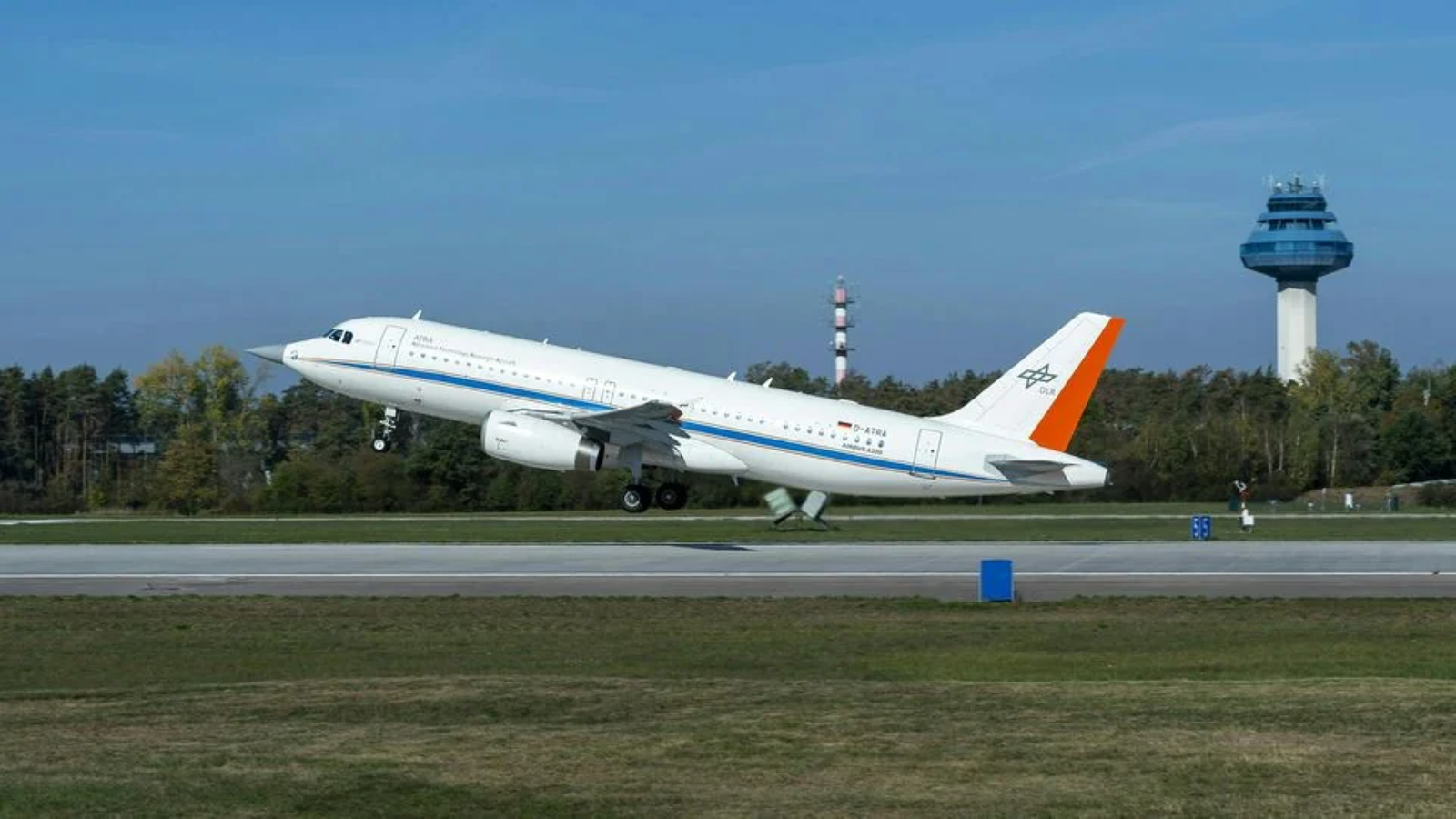
Published Nov 6, 2026, 9:01 AM EST A graduate in German, Jake has a passion for history and regional aviation, and enjoys sampling new carriers and aircraft. He has visited OEM facilities as far and wide as Bristol, Toulouse, and Seattle, and recently enjoyed the milestone of flying his 150th sector as a passenger. Based in Norfolk, UK. One of the world's rarest and most interesting examples of the Airbus A320-200 has just completed a series of commissioning flights wearing a new nose cone as part of a research program concerning the Eurofighter Typhoon. As Airbus explained in a statement that it released earlier today, the aircraft is being "used to test and further develop the Eurofighter Typhoon's s next-generation radar system." Most recently, this work saw the jet, which is known as the Advanced Technology Research Aircraft and thus bears the rather apt registration D-ATRA, complete a series of five commissioning flights between October 7 and November 5. Sporting a customized pointy Eurofighter nose, the jet stands out compared to other A320s with their rounder noses, and it has been used as a testbed for 20 years. Commissioning Complete Credit: Airbus Airbus confirmed on Friday, November 6, 2026, that D-ATRA had undergone final validation and completed its commissioning flights out of Ingolstadt Manching Airport (IGS), a German military base in the state of Bavaria. The multinational European planemaker is working with the German Aerospace Center (Deutsches Zentrum für Luft- und Raumfahrt / DLR), which has owned the aircraft for two decades. Considerable structural modifications were required in order to support the Eurofighter nose, and D-ATRA actually flew with it attached for the first time back in early 2025. However, it had not yet been fitted with the new radar system. This has now been installed, and, after ground tests, it has been put through its paces in the air using the special A320 with the Eurofighter nose. Airbus's Sebastian Ritz explains: "It is a distinguished platform that has already spent years flying as a research aircraft. We have taken it and repurposed it for our needs." A Month Of Bavarian Test Flights Credit: Simple Flying The bulk of 2026 has been relatively quiet on the flying front for D-ATRA. According to Flightradar24, it flew from Braunschweig Wolfsburg Airport (BWE) to Hamburg Airport (HAM) in February and then onwards from Hamburg to Ingolstadt in April, after which it sat parked for close to six months. Recently, however, it has been up in the air again, capturing the imagination of users of Simple Flying's flight tracker. Between October 7 and November 5, the jet completed five circular commissioning flights that started and ended in Ingolstadt. The first of these on October 7 was also the longest, lasting three hours and 46 minutes. This was followed six days later on October 13 by one that lasted three hours and six minutes, while D-ATRA was also in the air for a further two hours and three minutes a week later on the 20th. That was the shortest of its five test flights, with the fourth one on October 29 clocking in at two hours and 45 minutes. The commissioning program came to an end earlier this week on Thursday, November 5, 2026, when D-ATRA spent two hours and 48 minutes flying around the south of Germany. During this time, it reached a maximum altitude of 27,000 feet, as it cruised in a rectangular pattern east of Ulm. The Life & Times Of D-ATRA Credit: Airbus According to data from Planespotters.net, D-ATRA is 29.8 years old, having first been delivered to German carrier Aero Lloyd back in March of 1997. It stayed with the airline for more than seven years, eventually departing for Austrian airline Niki in May of 2004. During its time at Aero Lloyd, it also spent three lease periods away from the carrier at Ryan International Airlines in the United States of America. The jet had been registered as D-ALAE while at Aero Lloyd, and it initially retained this registration while at Niki. It then switched to the Austrian registration of OE-LOE, and spent just under two years flying under this designation before departing to join the DLR as the research testbed aircraft D-ATRA in June of 2006. It was re-registered as F-WWDB that December, but, in 2012, it reverted to D-ATRA.
An A320 Like No Other: Airbus Jet Completes Commissioning Flights With Eurofighter Nose
Full Article
Original Source
Read the full article at Simpleflying →KhanList aggregates and links to publicly available news content. We do not host full articles from third-party sources. Always verify important information with original sources.