
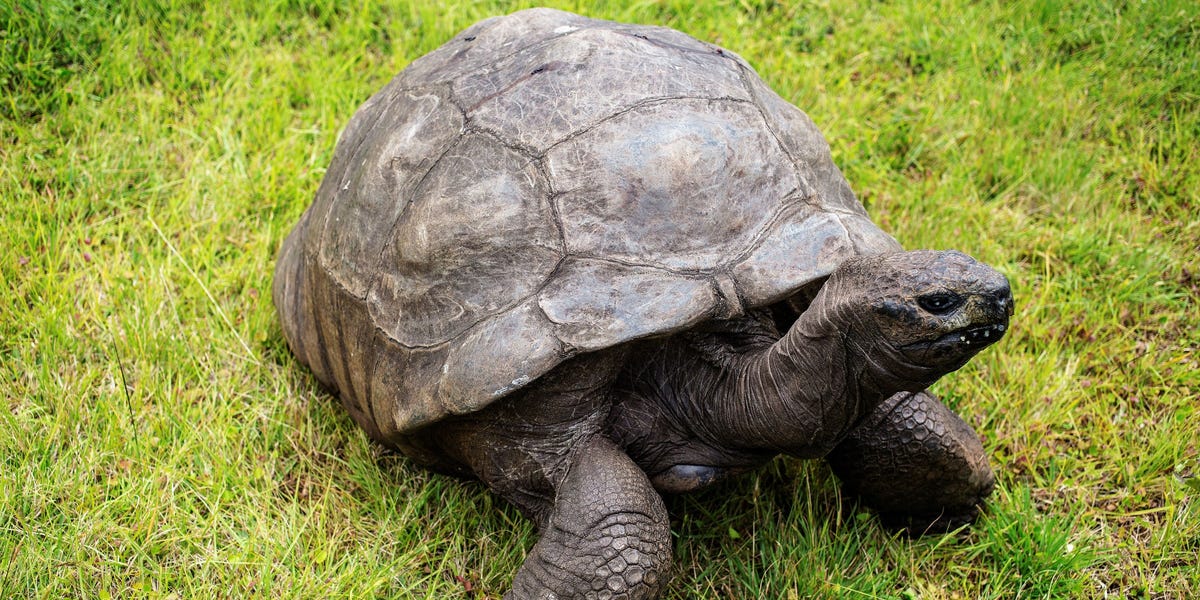
Here’s what you’ll learn when you read this story:Famous for being the oldest known land animal, Jonathan, an Aldabra giant tortoise who is at least 194 years old, is revealing why he’s outlasted the expected lifespan for his species.Researchers who studied Jonathan’s genome from cheek swab and saliva samples found multiple copies of several genes involved in preventing decline and disease.While Jonathan’s epigenome showed the overall disorder, or entropy, expected for his age, entropy stayed remarkably low in a handful of key gene switches—a finding that could inform treatments for age-related conditions.Off the west coast of Africa, a living relic slowly plods through the grass. This Aldabra giant tortoise, known as Jonathan, is oblivious to the human world. The ancient reptile is thought to have been born in the Seychelles, but he was presented to the governor of the island of Saint Helena in 1882 and has lived there ever since. Today, he spends his days sunning himself and languidly meandering around the governor’s estate, unaware that he has lived through 194 years of a rapidly changing outside world.Why this tortoise has been surviving and thriving since the Victorian age—far outpacing the average lifespan of his species, which is around 80 years—has remained a mystery. He has certainly succumbed to some of the ravages of age: he developed cataracts and lost his sense of smell. Even so, he’s still kicking, despite a recent hoax about his death. Now the oldest turtle in recorded history and the oldest known living land animal, Jonathan still isn’t giving up all of his beauty secrets, but he is finally beginning to reveal why he has endured for so long. Few researchers ever get the rare chance to study an animal that has lived to such a Methuselan age. So with the help of veterinarian Joe Hollins, Jonathan’s caretaker since 2009, a team led by physician-scientist Stephen Clark of the nonprofit Kallel Foundation—with genomics experts at Vanderbilt Health and UCLA epigeneticist Steve Horvath—analyzed DNA scraped from the inside of Jonathan’s cheek.Jonathan isn’t the only creature that seems to live for an eternity. In the skies, Brandt’s bat has made it past 40 years, almost unheard of for a bat, while in the depths of the ocean, Greenland sharks can live to 400, with some thought to have made it past 500. Stranger still, the immortal jellyfish can actually reset its life cycle and essentially Benjamin Button itself. Closer to Jonathan’s own branch of the family tree, previous studies have identified genetic markers that contribute to longevity in other Aldabra giant tortoises, and also in the Galápagos giant tortoise Lonesome George, who refused to mate but still lived to see a hundred. Jonathan, however, posed a particular challenge. Horvath and his team weren’t permitted to draw blood from him because of the risk of infection. Instead, they isolated genetic material from cheek swabs and saliva samples provided by Hollins, then compared his genome to those of his scaly peers.“Giant tortoises are known for their long life spans, and some species harbor longevity-associated genetic features,” the researchers said in a study recently published in Science Advances. “However, no existing study has assessed whether giant tortoises delay or avoid the epigenetic changes that typically accrue with aging in other vertebrate lineages or whether exceptionally long-lived individuals like Jonathan have unique epigenetic features.”The team’s analysis of Jonathan’s genome focused on positively selected genes—those that evolution favors and that consequently tend to dominate a population. Some of the most significant turned out to sit in aging-related pathways, governing cardiovascular function, DNA repair, metabolism, mitochondrial function, immunity, insulin regulation, and oxidative stress response. One gene, HAS2, stood out in particular. It promotes the excess secretion of hyaluronic acid (the same ingredient found in many anti-aging skincare potions), and it has also been found in naked mole rats, which can live up to 37 years and are nearly impervious to cancer. A few of Jonathan’s variants, meanwhile, differed from those of every other Aldabra tortoise the team studied.Jonathan also turned out to have several genes in common with Lonesome George. Both tortoises showed two copies of LAMTOR4, which regulates an important pathway known to be a factor in human longevity, and VCP, which prevents cells from self-destructing and responds to DNA damage by remodeling proteins and clearing out damaged or excessive ones. Lonesome George and Jonathan also had multiple copies of PRF1. This gene provides instructions for synthesizing the protein perforin, which is found in immune cells and is thought to boost the immune system, especially against cancer cells and cells that are degrading. Jonathan’s epigenome did show signs of entropy, however. The epigenome consists of chemical markers that switch genes on and off, and as those markers drift out of order with age, entropy is the inevitable result. Overall, Jonathan’s entropy was about what you’d expect for an animal his age. But in the promoters controlling mitochondrial function, RNA processing, and DNA repair, his epigenome looked startlingly young—closer to that of the 5-year-old juvenile in the study than to the older adults.“While we identified many genetic variants in Jonathan associated with known aging pathways, our most notable finding is the low entropy maintained within specific gene promoters,” said Horvath. “We hypothesize that maintaining this low-entropy state…partially protect[s] him from age-related decline.”Elizabeth Rayne is a creature who writes. Her work has appeared in Popular Mechanics, Ars Technica, SYFY WIRE, Space.com, Live Science, Den of Geek, Forbidden Futures and Collective Tales. She lurks right outside New York City with her parrot, Lestat. When not writing, she can be found drawing, playing the piano or shapeshifting.
An 194-Year-Old Tortoise Named Jonathan Is an Anti-Aging Marvel—and We Finally Know His Secret
Full Article
Original Source
Read the full article at Popularmechanics →KhanList aggregates and links to publicly available news content. We do not host full articles from third-party sources. Always verify important information with original sources.