
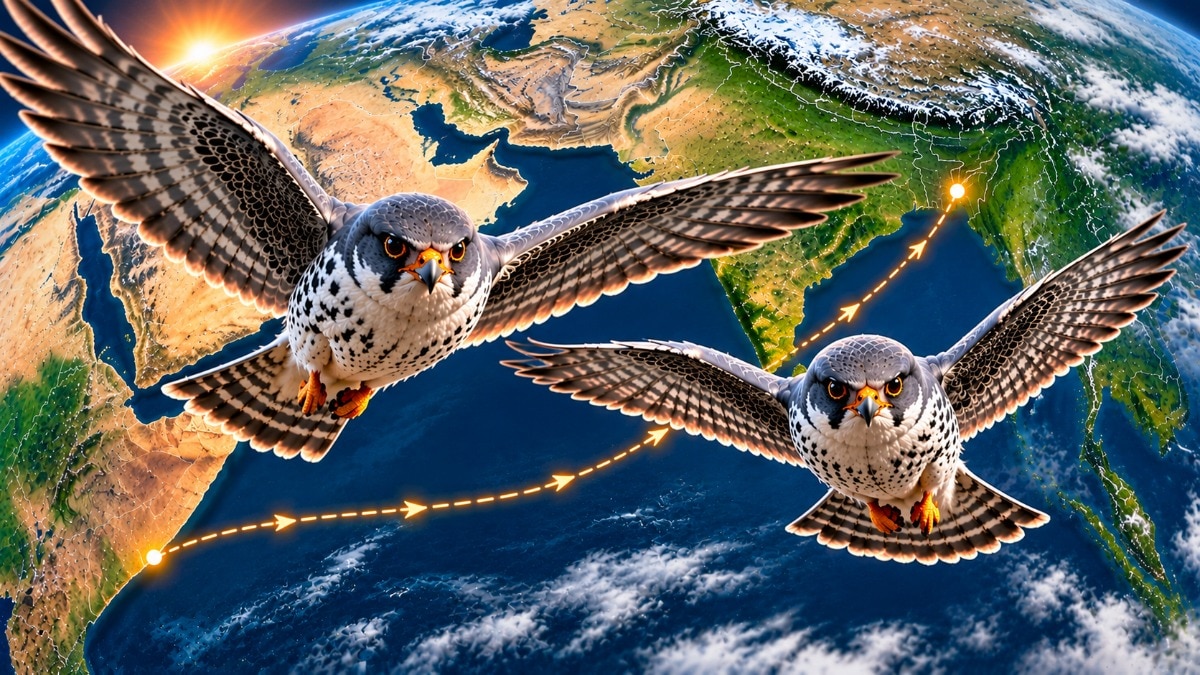
Every autumn, thousands of Amur falcons descend on the hills of Manipur, where they feast on termites and other insects before embarking on one of the most extraordinary journeys in the animal kingdom. It is in Manipur that the tiny birds build up energy reserves that help them fly thousands of kilometres, including a nearly 3,000-km non-stop crossing of the Arabian Sea, without landing for food or water.The latest proof of the remarkable endurance and the even more remarkable journey came on Monday (November 23), when Apapang, a satellite-tagged male Amur falcon, reached Somalia after flying 5,400 km non-stop from Tamenglong in Manipur. He followed Alang, a young female, which had completed a 5,700-km non-stop journey to the African country in just 101 hours, said Indian Administrative Service (IAS) officer Supriya Sahu on X.Their movements were monitored through satellite transmitters fitted by the Tamenglong Forest Division in collaboration with the Wildlife Institute of India (WII), allowing researchers to follow their journeys towards Somalia. The two birds had returned to Manipur from their breeding grounds in northeastern China in late October, before setting off again around November 19. Scientists led by RS Suresh Kumar of WII, working with the Manipur Forest Department, tracked the birds' movements through lightweight satellite transmitters fitted on their backs.Apapang and Alang had spent nearly 25 days at Chiuluan, a village in the Tamenglong district of Manipur, before beginning their journey towards Africa. The extraordinary migration and satellite tracking of the falcons' flight paths, including their non-stop flight over the Arabian Sea, have drawn attention to what makes these tiny birds capable of such endurance. It is the feeding, especially in Manipur, that adds fat to the Amur Falcons and acts as a powerhouse to energise their over 5,000-km journey, which is part of their annual journey of up to 22,000 km. Their loop migratory route sees them travelling across 23 countries annually.So what do these falcons feast on in Manipur that fuels their weeks-long marathon flights. Male Amur falcon Apapang reached Somalia after flying 5,400 km non-stop from Manipur, joining female Alang. (Image: Supriya Sahu) WHY AMUR FALCONS FEAST IN MANIPURThe secret to the endurance of the falcons lies partly in what they eat before taking off. A 2022 WII technical report, titled 'Satellite Tracking Amur Falcons from Their Stop-over Sites in Manipur to Support Conservation Efforts', noted that the birds feed extensively on insects during their autumn stopover in Manipur.Researchers examined 270 regurgitated pellets collected at Puching in Tamenglong. Termites accounted for 65% of identifiable insect prey occurrences, followed by bugs and related insects at 30%, beetles at 4% and grasshoppers and crickets at 1%.The researchers identified the termite species as Odontotermes feae as an important food source.The report, authored by scientists Amarjeet Kaur, A Jacob and RS Kumar, concluded that the availability of termites likely influences the falcons' choice of stopover sites.A separate study of Amur falcons in Nagaland found an even greater dependence on termites. In an October 2024, Nature report, WII scientist Suresh Kumar explained, "They stop here to fuel up on protein-and fat-rich termites, as well as to rest."The study suggested that a million falcons could consume two billion termites in just over a fortnight. Amur falcons in 2000 gather at the Yaongyimchen roosting site in Nagaland's Longleng district during their annual migration. (Photo: X/@sureshwii) HOW TERMITES POWER OCEAN CROSSING OF AMUR FALCONSThe timing of the birds' arrival in Manipur is crucial for their long-distance migration. During October and November, winged termites emerge in large swarms from their underground colonies. The falcons hunt these insects, often catching them in flight.This feeding helps the birds accumulate fat, an energy-dense fuel that can sustain prolonged flight when food and water are unavailable.According to the WII report, the birds typically spend around 13 days at Manipur's stopover sites, although individual stays vary. Apapang and Alang remained for nearly 25 days this year.The study also found that favourable winds play an important role in helping the Amur Falcons cross the Arabian Sea. The endurance is not simply a matter of feeding, but is a result of a combination of stored energy, flight efficiency and wind assistance. Amur falcons Apapang (left) and Alang were fitted with satellite transmitters in Manipur's Tamenglong district in November 2025 to track their migration. (Photo: X/Bhupender Yadav) AMUR FALCONS: FROM INDIA TO SOMALIA WITHOUT STOPPING, AND BACKOn October 22, 2026, Apapang and Alang returned to Manipur from their breeding grounds in northeastern China, completing another leg of a migration cycle spanning 23 countries across Asia and Africa. Union Environment Minister Bhupender Yadav confirmed their arrival the following day.The birds had originally been satellite-tagged at Chiuluan (in Tamenglong district of Manipur) in November 2025, alongside a third falcon named Ahu.On November 19, IAS officer Supriya Sahu reported that the two birds had resumed their southward journey. That day, Apapang had reached India's western coast near Goa, while Alang was already flying over the Arabian Sea.Two days later, on November 21, Sahu in another post on X, announced Alang's arrival in Somalia after 101 hours of uninterrupted flight.On November 23, Apapang completed his own journey too.Indian Forest Service (IFS) officer Ramesh Pandey took to X and confirmed that the male falcon had arrived in Somalia after flying 5,400 km non-stop from Tamenglong, slightly behind Alang.The 3,000-km Arabian Sea crossing is a part of the longer journey from India to Africa that these falcons undertake. Somalia is also not their final destination. The birds continue towards their non-breeding grounds in southern Africa after reaching eastern Africa. So, the Amur falcons follow a loop migration route. They travel from their breeding grounds in East Asia to southern Africa and return by a different route, completing an annual journey of up to 22,000 km. A map showing the breeding range, wintering grounds and migration corridor of Amur falcons between Asia and Africa. (Graphic: India Today/ AI-edit/LShyamal) HOW MANIPUR'S VILLAGERS HELP PROTECT THE FALCONSWhile the falcons' endurance has brought attention to how they feed and build up energy reserves in Manipur, their extraordinary migration also has a conservation story.Amur falcons were once hunted in large numbers in Manipur's Tamenglong district. According to some estimates, more than one lakh of the migratory birds used to be killed there in a single season about a decade earlier. The threat persisted even after conservation efforts began. In November 2018, a satellite-tagged falcon named Manipur was shot dead by a hunter near Puching village (in Tamenglong district), prompting authorities to tighten restrictions on hunting.Subsequent protection campaigns, hunting restrictions and community participation helped change attitudes towards the birds.In Manipur's Tamenglong, villagers, forest officials and conservation volunteers have helped protect roosting sites. The WII report credited local communities, awareness campaigns and church-supported conservation efforts with helping curb large-scale hunting.While weeks of feasting on insects in Manipur provided Apapang and Alang the fuel for their marathon flights, local conservation efforts have ensured a safe stopover on the ground. The story of the two Amur Falcons is an incredible one of animal migration and human conservation efforts.- Ends
Amur falcons fly non-stop 3,000 km over ocean. How feasting in Manipur gives fuel
Full Article
Original Source
Read the full article at Indiatoday →KhanList aggregates and links to publicly available news content. We do not host full articles from third-party sources. Always verify important information with original sources.