
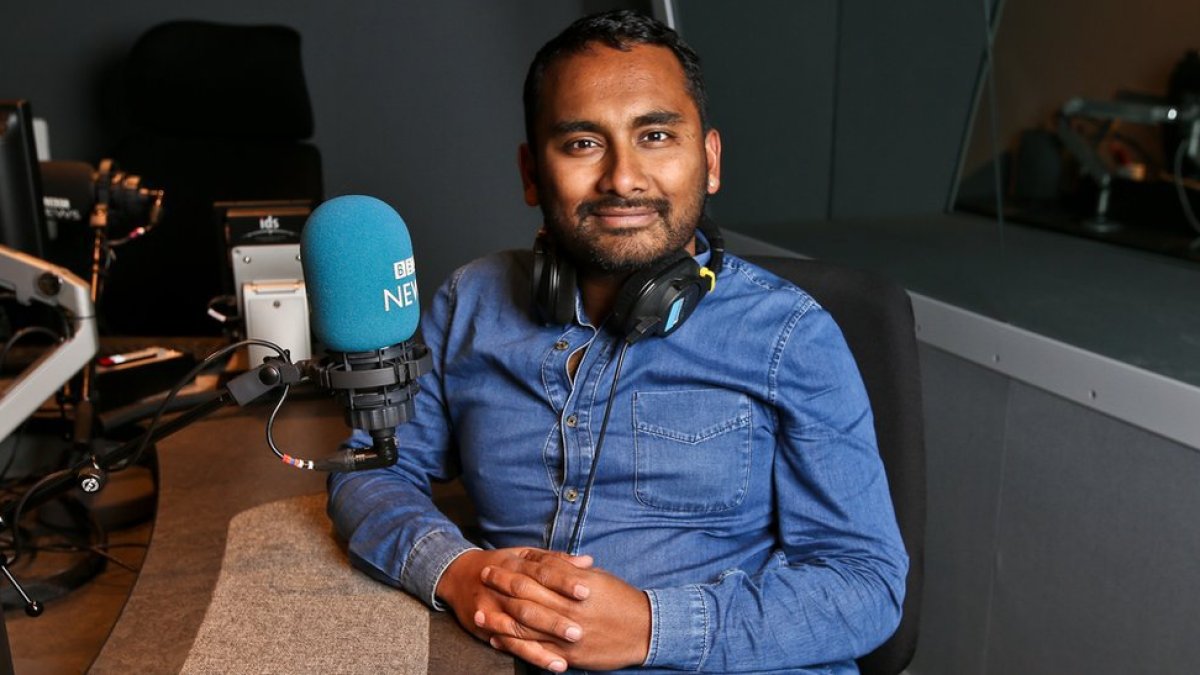
Amol Rajan has crashed his final pips. He’s quoted his last philosopher. He’s got jungle music onto the Today programme for the very last time. This morning, he bade farewell to BBC Radio 4, bowed out to the Only Fools and Horses theme tune, and prepared to unleash his inner Del Boy, entering the “creator economy” with a new production company, a new YouTube show, and a “club”: The Amol Rajan Connection. As the self-proclaimed “Reithian rascal” – with his positive energy, breathless enthusiasm, easy laughter, south London accent and gold chain – leaves legacy media behind, he leaves Today in a stronger position than he found it. Ever since he started on the Today programme in 2021, Rajan has been getting blamed for its decline. It’s become too lightweight, too casual, too personal, people complain. There’s too much focus on pop culture, too much focus on the presenters, too many mentions of “I” when it has always been “we” – a far cry, they say, from the stern tone and interrogations of John Humphrys at full pelt. Humphrys himself had a rant in The Guardian earlier this year about how “irritating” the programme has become, citing “Rajan’s insistence on emphasising, without fail, the definite and indefinite articles in any given sentence. In his world, “A” bomb has exploded in “THE palace of Westminster.” He also mocked his patterns of speech and criticised the congratulatory gushing between interviewer and guest. A year earlier, Rajan’s former colleague Mishal Husain reflected in a Vogue interview about leaving the BBC for Bloomberg. “Personality-focused journalism doesn’t have to be bombastic… It doesn’t have to be about the presenters centring themselves. Hopefully, if they’re a personality with journalistic integrity, journalistic values, then they can be a conduit to the news for people.” She tactfully avoided naming names, but her opinion was implicit: the identity of Today under Rajan and Emma Barnett is very different from the one over which she presided in her 11-year tenure. Amol Rajan in the studio on his second morning as presenter of the BBC Radio 4 ‘Today’ programme in 2021 (Photo: BBC) Both are right, of course: Today has changed. It is more relaxed; there are more human-interest and pop culture items and we do know more about the presenters – Rajan’s love of reggae and Shakespeare, Barnett’s love of tea – than ever before (though I think we have all been long apprised of Nick Robinson’s love of Manchester United). It is still nowhere near as informal as your average podcast – even the BBC’s own news shows, Newscast and Americast, lean heavily on personalities and presenter banter – but that medium’s less uptight structure has seeped in. And Rajan, with his zeal and agility, has led the charge for Today’s identity shift. But rather than destroy it, he has helped it to survive. There are few people with as astute an understanding of British media – and such willingness to adapt along with it – as Rajan. When he joined Today, he was the BBC’s media editor; he had already been editor-in-chief of The Independent and he had done a stint as the right-hand man of its owner Evgeny Lebedev. Early on in his career he’d worked in TV production; later he’d hosted BBC Radio 2 programmes and his own in-depth TV interview series. Before Today – alongside which he also got the University Challenge job – he had fingers in so many pies that few were better placed to observe the way the landscape was changing. The combined power of podcasting – exploding exponentially – and social media – allowing anyone to tell stories in whatever way they choose – had shifted the old order. The BBC was losing its authority among sceptical older generations and younger ones not raised to trust it and tune in by default. Commercial radio stations like LBC and Times Radio were gaining ground by broadcasting bigger, more divisive opinions. In this new attention economy, where “news” can be sourced from anywhere and anyone, it became vital for Radio 4 to demonstrate more “personality” – the exact thing many news journalists had been bred to conceal. Authenticity and honesty were starting to trump stiff-upper-lip straight facts. For both journalist and subject, short “gotcha” interview moments, in which Today had always triumphed, began to feel less and less constructive or essential a mode of communication. Now, politicians had new opportunities on longform podcasts and their own social media channels to articulate themselves more fully – the quick skewering at 8.10 on Today was losing its relevance, let alone its appeal. Perhaps even more important than the media’s evolution was the loyal listener one. Rajan joined the Today roster in spring 2021. Over a year into the Covid pandemic, life was still unrecognisable and restricted, hope for a return to normality was still tentative, and the relationship people had with their radios had transformed. It wasn’t a habit anymore; it was a lifeline: it had been our company when company was banned, it had kept us informed when misinformation threatened to eclipse the truth, it was a connection to the world and to each other. Detachment, businesslike delivery and combative interviews no longer felt appropriate. If Today was to retain its towering influence as an institution and draw in a younger audience, it now needed warmth and humanity. Rajan with ‘Today’ co-host Emma Barnett in 2024 (Photo: Instagram) Enter Rajan: so human, he admitted to having a “full-on panic attack” the night before he made his debut. His nerves settled, and he met the moment: conversational, unashamedly passionate, well-read and inquisitive: the kind of person you imagine you could talk to for several hours in the pub. It proved infectious, and Today has become more accessible and more democratised because of him. Rajan’s style might appear casual, but it is a canny deception. He chooses not to beat us over the head proving his intelligence, but there is no Today presenter demonstrably better researched than him, and by leading with curiosity rather than combat, he often ends up conducting some of Today’s most thought-provoking interviews. His familiar approach to guests is regularly accused of being “matey”, but I wonder if this is purely down to his working-class background and the occasional dropped “T” – he makes people comfortable and the conversations are richer for it. Surely that is a lesser crime than the posh chumminess of broadcasting generations past. I also find his perspectives and ideas inspiring – the Today podcast, which developed into Radical, is one of BBC Sounds’ best new properties and I’m sorry he’s leaving it behind. Yes, he uses “I” and “me” more than some bristling listeners are used to, but that is almost always to convey his own sincere interest in the subject in question – whether it is social mobility, cricket, tech policy or geopolitics – rather than to make the story about him. But it could never last forever. The days when a job on the BBC’s flagship news programme marked the pinnacle of a journalist’s career are long over. Each of the current presenting roster – Rajan, Robinson, Barnett, the affable and shrewd Justin Webb and the encouraging, cool-headed Anna Foster – fits Today around other projects like podcasts, books, Substacks, columns, documentaries and paid commercial appearances. The more diffuse the media landscape, and the more thinly spread and inconsistent its presenting line-up, the more the programme – already competing with commercial rivals and podcasts and phones – loses prestige. Rajan, despite embracing the 3am starts with loud gratitude on-air and on Instagram, is more restless and entrepreneurial than any of them. There are “bigger things” than Today, and I’m not surprised he is chasing them. But his departure is a great loss. Today’s audience was at 5.8m earlier this year. That is down from around 6.7m when Rajan started, a reduction in line with BBC trends and one I suspect would have been far more dramatic without his disruptive influence. He has made mornings livelier, less stuffy – simply put, he has made Today a lot more fun. Without descending into the silliness of Radio 1 or the lightness of Radio 2, Radio 4 now manages to capture an optimism it had long mislaid. Rajan forced his colleagues to loosen up with him, and Today had no choice but to adopt a bit of his enterprising, experimental spirit. He will not be replaced – brutal BBC cuts mean there will be only four main presenters from now on, which may improve the chemistry between them and restore some consistency. But his spark, good humour and openness have changed the show forever. Today needed Rajan more than he needed it – and the BBC cannot turn back the clock.
Amol Rajan made the Today programme more human – it can never go back
Full Article
Original Source
Read the full article at Inews →KhanList aggregates and links to publicly available news content. We do not host full articles from third-party sources. Always verify important information with original sources.