
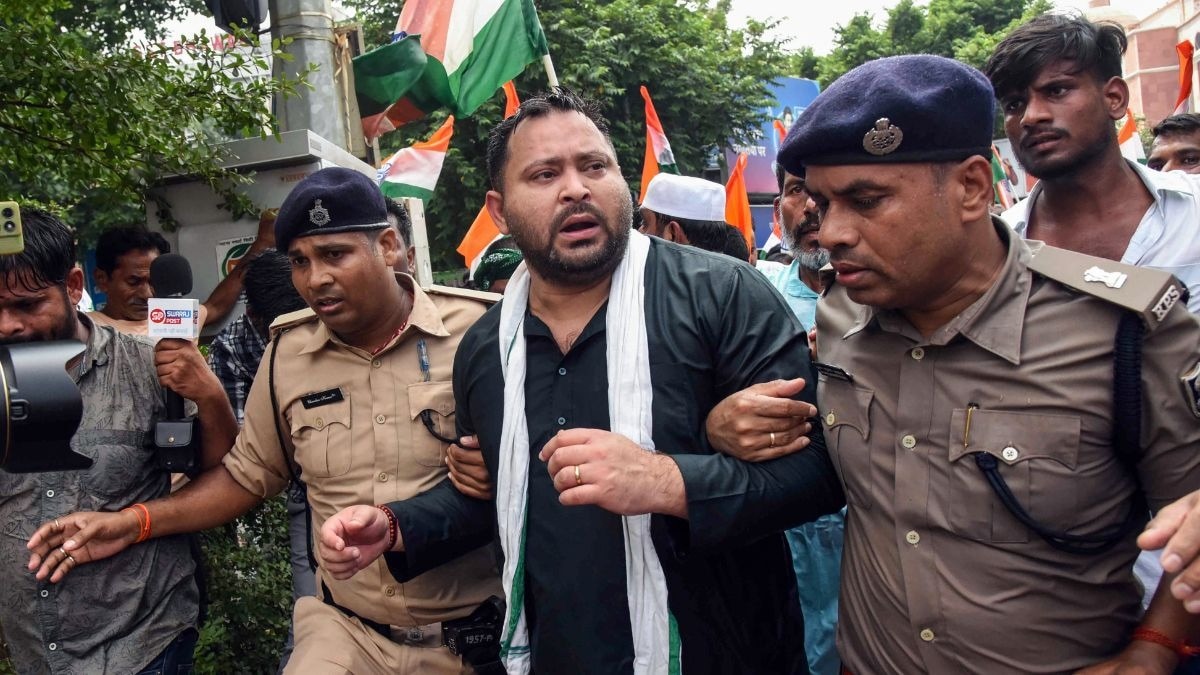
If young protesters see the RJD as merely attempting to appropriate their movement, Tejashwi may get the headlines without gaining credibilityFor Rashtriya Janata Dal (RJD) leader Tejashwi Yadav, the march to Lok Bhavan (official residence of the Bihar governor) in Patna on August 19 was about paper leaks, student protests and the use of an AK-47 by a police constable in Siwan during a youth demonstration. But politically, it was about something larger: reclaiming the streets—and perhaps some relevance too—in the state.The leader of the Opposition led RJD workers and supporters, demanding action over alleged irregularities in competitive examinations, unemployment and the police response to student protests. Police used water cannons to disperse the protesters, and Yadav and several other RJD leaders, including Misa Bharti, were detained briefly.Yadav’s intervention comes at a politically vulnerable moment for the RJD. The party suffered a severe setback in the 2025 Bihar assembly elections, winning only 25 of the 243 seats, down from 75 in the previous assembly. Eight months later came another warning. In the Bankipur assembly by-election, RJD candidate Rekha Kumari Gupta finished a distant third and forfeited her security deposit. Jan Suraaj founder Prashant Kishor won the seat with over 64,000 votes, ending the BJP’s three-decades-long hold over the constituency.For an RJD accustomed to being Bihar’s principal Opposition force, the Bankipur result was particularly uncomfortable. Gupta had been the runner-up in the same constituency in the 2025 election. Her collapse to third position—and below the threshold required to retain her deposit—is a question that stares Tejashwi in the face.Against this backdrop, Tejashwi’s decision to embrace the student issue looks significant. He has faced criticism in recent months over what opponents and some political observers described as a hands-off approach to leadership. Questions have been raised over his long absence during the assembly session and his limited campaigning during the Bankipur bypoll. The Lok Bhavan march allowed Tejashwi to reassert his presence on the ground and remind supporters and rivals alike that he remains Bihar’s principal Opposition leader.But one high-profile protest is unlikely to be enough. To turn the growing anger among students and young people into political capital, he will have to sustain that engagement, build credibility around their concerns and demonstrate a more visible, hands-on style of leadership.The recent student agitation in Bihar did not begin as an RJD campaign. Much of the mobilisation was led by student and youth organisations, including the All India Students’ Association (AISA) and the Revolutionary Youth Association (RYA). On July 25, these groups called for a Bihar bandh over alleged irregularities surrounding the NEET examination and police action against students. Demonstrations spread across several districts, including Patna, Siwan, Chhapra and Ara.Tejashwi has sought to seize that momentum. He has accused the BJP-led government of allowing Bihar’s examination system to collapse and argued that students protesting paper leaks were being beaten and subjected to excessive force. He demanded action not merely against the constable involved in the Siwan episode but also against those who ordered use of AK-47 rifle.As Manoj Jha, RJD leader and Rajya Sabha member, put it: “The fundamental question is this: why was an AK-47 fired at students? The fundamental question is also why not a single examination is being conducted fairly. They (government) have mortgaged the entire architecture of education and employment.” The BJP counter-questioned Tejashwi’s aim. Dr Nikhil Anand, a senior BJP leader in Bihar, remarked: “Tejashwi Yadav has become a ‘runaway Opposition leader’ who seems to enjoy the good life. After the RJD lost its deposit in Bankipur, he is desperately trying to regain some relevance by launching this movement. But the people of Bihar have already rejected his party. They have made their choice clear.”For many, the RJD finetuning its strategy to launch the Lok Bhavan march does raise a central question: is Tejashwi tapping into a genuine youth movement or attempting to appropriate a movement that developed outside his party?The grievances driving student protests are hardly manufactured by Opposition parties. For young people preparing for competitive examinations, a leaked paper or an irregular recruitment process can mean months or years of hard work going waste. Bihar has also struggled for years with the larger problems of educated unemployment and migration. The current agitation has therefore provided an unusual opportunity for the Opposition. They can attach themselves to an issue that carries emotional weight among students.Tejashwi’s political calculation appears to be less about creating the movement than about riding its momentum and positioning himself at its front once it acquired political weight. He has reason to do so: Prashant Kishor.The emergence of Kishor as an elected politician has complicated Tejashwi’s position even further. The Bankipur verdict demonstrated that a section of Bihar’s electorate is willing to back a political alternative outside the traditional RJD-NDA contest. Kishor has built his political identity around governance, education, employment and corruption—precisely the issues that resonate strongly with younger voters.That creates a direct challenge for Tejashwi. For years, the RJD leader has attempted to move beyond his party’s traditional social-justice and caste-based political identity and present himself as a leader of a younger Bihar. The 2020 election, when the RJD-led alliance came close to power, had appeared to validate that strategy. The 2025 election did not. And Bankipur made the problem more visible.Kishor now has an electoral mandate and a seat in the legislative assembly. Tejashwi remains leader of the Opposition and has a far stronger statewide organisation, but he can no longer assume that the anti-NDA space belongs exclusively to the RJD.That makes the student issue politically valuable. By taking up paper leaks, recruitment irregularities, unemployment and police action, Tejashwi is speaking directly to a constituency that has the potential to reshape Bihar politics: young voters who may be less attached to traditional party identities. The Lok Bhavan march allows him to reclaim a familiar political role—the Opposition leader on the street, confronting the government and presenting himself as the voice of ordinary citizens.Yet, if young protesters see the RJD merely as another political organisation attempting to appropriate their movement, Tejashwi could get the headlines without gaining credibility. The fact that the initial mobilisation came from independent student and youth organisations makes that distinction particularly important.The RJD also has its own credibility problem. The challenge for Tejashwi is therefore to convert protest into political relevance. For now, the student movement gives Tejashwi something he badly needs: an issue that cuts across caste and traditional party loyalties. But whether that translates into a durable youth constituency is another question.The stakes are unusually high. After the electoral reversal of 2025, the Bankipur humiliation and the emergence of Kishor as a new Opposition voice, the streets have offered Tejashwi an opportunity to reconnect with a generation that is increasingly impatient with established political formations. The question is whether that generation sees a political leader in Tejashwi or simply wants its demands heard. And that may be the hardest question Tejashwi Yadav now has to answer.Subscribe to India Today Magazine- EndsPublished By: Akshita JollyPublished On: Aug 21, 2026 18:28 IST
Amidst Bihar student protests, how to read Tejashwi Yadav's Lok Bhavan march?
Full Article
Original Source
Read the full article at Indiatoday →KhanList aggregates and links to publicly available news content. We do not host full articles from third-party sources. Always verify important information with original sources.