
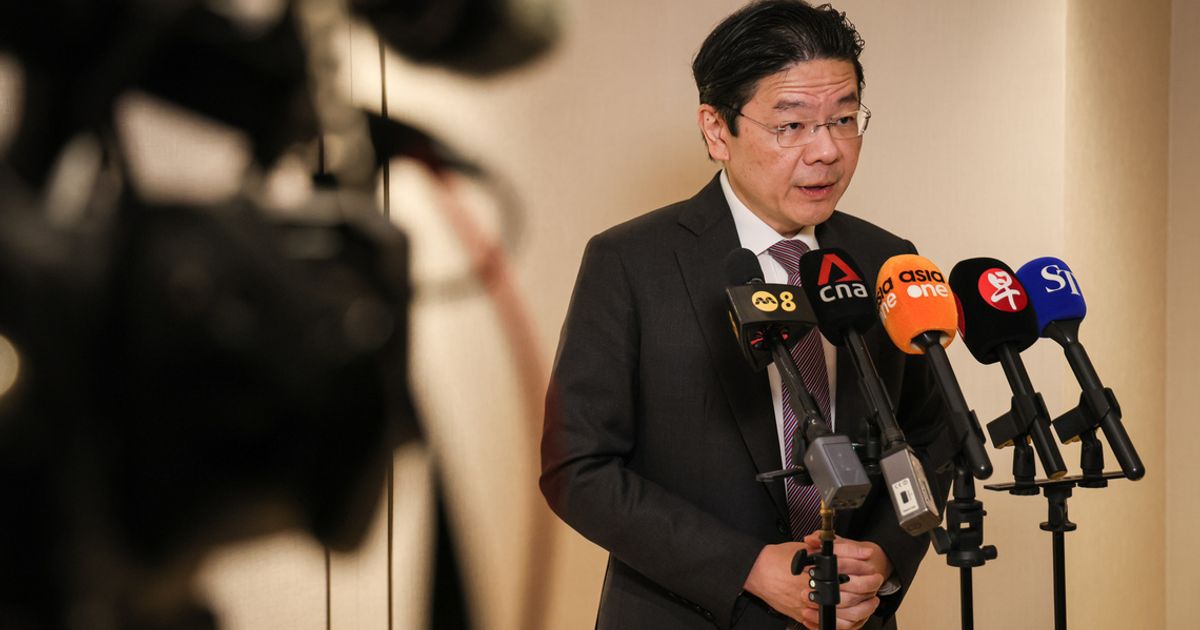
– Singapore wants to remain a place where American, Chinese and other foreign technologies can be tested and deployed, even as growing US-China rivalry threatens to divide the world into competing technological ecosystems, Prime Minister Lawrence Wong said on Nov 21.Speaking to Singapore media as he wrapped up a four-day working visit to China, he said Singapore wants to use the best technologies available, regardless of their country of origin, while providing a platform for companies to showcase their innovations and potentially expand into South-east Asia.He also touched on Singapore’s bilateral ties with China, noting that the two countries have found ways to complement each other even as China has advanced rapidly and moved well ahead of Singapore in some areas.On the geopolitical tensions of today, PM Wong said Singapore, together with many other countries, wants to move beyond the rivalry between the US and China to build bridges and connections, adding that “there are many opportunities for us to do so when we take over as chair of ASEAN next year”.In the technological arena, while some split may be inevitable in sensitive, high-end areas, PM Wong hopes that countries would remain free to use technologies from the United States, China and elsewhere in other sectors.He cited autonomous vehicles as an example, noting that Chinese companies Pony.ai and WeRide are already conducting commercial self-driving trials in Singapore, while American company Waymo plans to launch commercial autonomous ride-hailing services here in 2028.“That’s what Singapore wants to do: to be a place that’s open, where technologies from different countries can be showcased, can be deployed, and we can use the best technology available for Singapore’s own needs,” he said.Singapore is also seeking to keep its artificial intelligence ecosystem open by helping businesses navigate different governance frameworks, including those of the US and China.The Infocomm Media Development Authority (IMDA) and the China Academy of Information and Communications Technology have completed an exercise mapping their respective AI governance frameworks, according to an IMDA factsheet.The exercise could help businesses operating in both markets avoid duplicating compliance efforts while deploying AI safely.Singapore’s AI Verify Testing Framework has also been mapped against the US National Institute of Standards and Technology’s AI Risk Management Framework, among other international standards.Beyond AI governance, PM Wong said Singapore and China have considerable scope to cooperate on practical applications of the technology in areas such as healthcare and manufacturing.This was among the issues discussed when PM Wong met Chinese Premier Li Qiang at the Diaoyutai State Guesthouse in Beijing on Nov 21.According to a statement from Singapore’s Ministry of Foreign Affairs (MFA), the leaders also discussed the need for international coordination on AI safety and governance, and welcomed the joint mapping exercise.PM Wong and Premier Li also reaffirmed their shared interest in an open and economically integrated region, and discussed closer cooperation during Singapore’s ASEAN chairmanship in 2027, including on regional connectivity, energy security and combating transnational scams.Both leaders reiterated the importance of international law and freedom of passage in international waterways, according to MFA.PM Wong’s meeting with Premier Li followed his discussions with Chinese President Xi Jinping in Shenzhen on Nov 20, where both leaders reaffirmed their commitment to strengthening bilateral cooperation amid global uncertainty.PM Wong was in the Chinese tech hub to attend the Asia-Pacific Economic Cooperation (APEC) Summit on Nov 18-19, hosted by Xi.Singapore-China cooperation expandsDuring PM Wong’s visit, both countries also welcomed the launch of negotiations to upgrade the China-Singapore Free Trade Agreement, with potential areas of cooperation including government procurement and the digital economy.PM Wong said cooperation could also expand in areas such as cross-border data flows, which are increasingly important to businesses operating in the digital economy.“Singapore has always found a way to complement and match China’s development priorities and needs,” he told reporters.Singapore is also looking to build on its existing government-to-government projects with China, including the Suzhou Industrial Park, Tianjin Eco-City and Chongqing Connectivity Initiative.For example, businesses in Tianjin Eco City can look to tap opportunities not just in Tianjin itself, but also in the wider Beijing-Tianjin-Hebei region, PM Wong said. This was discussed when he met Beijing Communist Party Secretary Yin Li on Nov 20, who briefed him on the developments in the region, including the Xiong’an New Area, where there could be further scope for Singapore-China cooperation.Similarly, the Chongqing Connectivity Initiative has expanded beyond Chongqing through the International Land-Sea Trade Corridor, which links western China with South-east Asia.PM Wong said Singapore and China could explore how to better connect the corridor with other infrastructure projects, including the Pinglu Canal in the Guangxi region, to strengthen trade links between western China and South-east Asia.Singapore and China are also expanding cooperation in transport and green industries, according to factsheets released by the Singapore government on Nov 21. A new transport agreement covers AI and other technologies, green shipping and the movement of goods and people, while a separate agreement seeks to deepen cooperation in green industries, including clean energy, recycling and environmental protection.The two countries are also expected to sign an agreement on AI in education at the Joint Council for Bilateral Cooperation (JCBC) meeting in Singapore on Nov 23. It will cover the testing of AI-powered educational tools and exchanges of teaching practices.World ‘too complex for a G3 order’Asked about the implications of the historic trilateral summit between Xi, US President Donald Trump and Russian President Vladimir Putin in Shenzhen on Nov 19, PM Wong cautioned against viewing the world through the lens of a Group of Three (G3).“It’s always good when leaders come together to … build bridges rather than to raise barriers,” he said.But the increasingly multipolar world is too complex for a handful of countries to “decide the fate of all of us”, he said.For Singapore, this means strengthening ASEAN as an economic centre in its own right, while building closer ties with other countries and regions, PM Wong said.Singapore will have an opportunity to advance such cooperation when it chairs ASEAN in 2027. Discussions are under way on a possible ASEAN-EU summit, coinciding with the 50th anniversary of dialogue relations, as well as a potential ASEAN-EU free trade agreement.ASEAN is also discussing a summit and free trade agreement with Canada, while looking to strengthen ties with India and the Gulf Cooperation Council.PM Wong said many countries are keen to deepen cooperation rather than view every relationship through the lens of US-China competition. Singapore will continue working to build these bridges, even as geopolitical tensions and trade barriers increase.PM Wong was confident that Singapore could maintain good relationships with both Washington and Beijing.He said he had held good meetings with Trump and Xi during his recent travels, and both leaders understand Singapore’s position.“So long as the two superpowers do not collide with one another,” he said, “there would be space for Singapore to navigate this complex international environment and to find a good living for ourselves through doing business with both powers and countries everywhere in the world.”PM Wong returned to Singapore on Nov 21.
Amid US-China tech rivalry, S’pore wants to be open to both: PM Wong
Full Article
Original Source
Read the full article at Straitstimes →KhanList aggregates and links to publicly available news content. We do not host full articles from third-party sources. Always verify important information with original sources.