
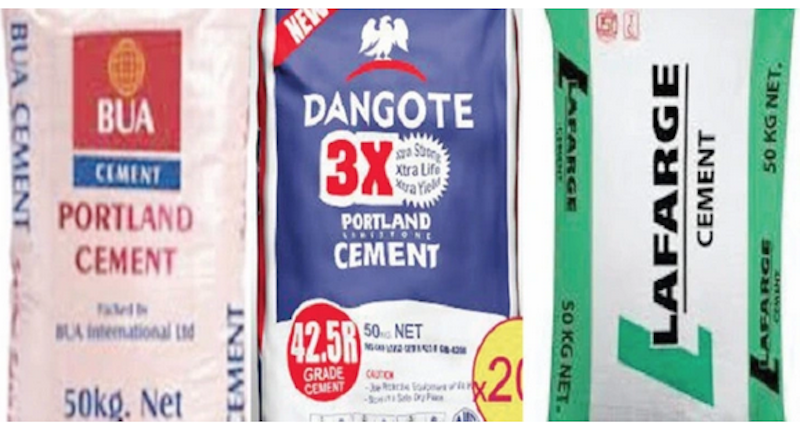
Kayode Tokede The three largest cement manufacturers in Nigeria Dangote Cement Plc, Lafarge Africa Plc, and BUA Cement Plc reported a combined N5.8 trillion revenue for the nine months ended September 30, 2026, driven by a spike in the price of cement. According to their unaudited result and accounts, the N5.8 trillion revenue is about 21 per cent increase over the N4.8 trillion revenue reported in nine months of 2025. A breakdown revealed that Dangote Cement reported N3.8 trillion revenue during the period under review, about 19.6 per cent increase when compared to N3.15 trillion in 2025. Dangote Cement’s production capacity increased by 9 per cent to 22.1million metric tonnes from 20.2 million tonnes in the corresponding period of 2025. It sold 14.1Mt, up by 6.4 per cent in the period under review. Its average selling price also rose by 9.4 per cent to N170,493 per tonne. Exports of cement and clinker from Nigeria increased by 41.8 per cent to 1.5Mt, including 26 clinker shipments to Ghana, Cameroon and Ivory Coast. The company’s operations in other African countries sold 9.1Mt, up by 14 per cent. Senegal grew by 30%, Ethiopia by 19 per cent and Tanzania by nine per cent, and a new grinding plant in Ivory Coast sold 0.53Mt. Sales in Ghana and Cameroon were lower. The first phase of the company’s 6Mt/yr plant at Itori in Ogun state is on track to be commissioned in 2027, part of a plan to increase capacity to 80Mt/yr from 55Mt/yr across Africa. On its part, BUA Cement posted N1.09 trillion revenue, a growth of 26.5 per cent from N858.72 billion in 2025, while HBM Nigeria declared N928.25 billion revenue, representing an increase of nearly 19 per cent from N780.5 billion in 2025. THISDAY checks revealed that a 50kg bag of cement sold for approximately N12,000 to N15,000 between July and September 2026 in Lagos and Ogun States, compared with around N10,000 sold in September 2025. The improved revenue generation is on the backdrop of renewed activities in Nigeria’s construction sector, supported by Federal and State governments infrastructure projects, housing development and private-sector investments. Nigeria’s construction sector expanded by 6.38 per cent year-on-year (YoY) in the second quarter of 2026, following 6.4 per cent growth in the first quarter of 2026. Its performance contributed to the country’s overall economic growth of 4.5 per cent during the second quarter. Government infrastructure programmes have also strengthened the industry’s demand outlook, with more than 2,700 kilometres of highways and major roads under construction. These include the Lagos-Calabar Coastal Highway, Sokoto-Badagry Superhighway, Abuja-Kaduna-Zaria-Kano corridor and East-West Road. Additionally, approximately 10,000 housing units are under construction across 14 states, including Lagos, Abuja and Kano, providing another potential source of demand for cement producers. However, the spike in revenue also resulted in hike cost of sales with significant growth in profit generation in the period under review. The three companies posted N2.23 trillion cost of sales in nine months of 2026, which is about N2,04 trillion reported in nine months of 2025. In terms of profit generation, the three companies generated a combined profit before tax of N2.01 trillion in nine months of 2026, representing a 21.4 per cent increase from N1.66 trillion reported during the corresponding period of 2025. Dangote Cement remained the industry’s largest earnings contributor, recording profit before tax of N1.04 billion, representing a 3.5 per cent increase from N1.01 billion in the corresponding period of 2025. The company accounted for approximately 57 per cent of the combined profit reported by the three manufacturers. The improved balance sheet provides additional financial flexibility for expansion and shareholder returns. During the period, Dangote Cement spent N566.7 billion on capital expenditure and paid N753.8 billion in dividends. BUA Cement delivered the fastest profit growth among the three manufacturers, with profit before tax increasing by 64.4 per cent to N556.7 billion from N3388.6 billion. Cost of sales grew by just 8.8 per cent to N466.4 billion, considerably below revenue growth. Consequently, gross profit increased by approximately 44.2 per cent to N620.3 billion. However, BUA Cement identified energy costs, operational difficulties, geopolitical tensions in the Middle East, heavy rainfall and poor road conditions as challenges affecting production and distribution. The company is also pursuing capacity expansion, targeting an increase in installed production capacity from 17 million to 23 million tonnes annually through projects in Ososo, Edo State, and Kalambaina, Sokoto State. The Managing Director/CEO, Yusuf Binji said: “I am delighted with our performance, which demonstrates resilience despite challenging conditions, particularly on account of the heavy rainfall and its impact on road infrastructure. We surpassed our quarterly performances of 2025 through the addition of bulk customers, the acquisition of LNG trucks, and the further restructuring of our logistics operations. “The LNG trucks are eco-friendly, thus reducing our carbon footprint on the environment while harnessing the country’s abundant gas reserves. This investment will also enhance market penetration and operational efficiency. Energy costs were elevated during the quarter due to supply constraints but have since normalised.” He added that, “Looking ahead to the fourth quarter, we remain committed to achieving our objectives through profitable partnerships with our distributors and sustained efforts to reduce our cost to serve.” HBM Nigeria, formerly known as Lafarge Africa also recorded stronger nine-month earnings, with profit before tax rising by 32.3 per cent to N414.43 billion from N313.29 billion. CEO, HBM Nigeria Lolu Alade-Akinyemi maintained their nine months of 2026 performance reflects sustained volume growth, improved distribution efficiency, and disciplined cost management across the business. He said, “Third-quarter performance was moderated by planned annual maintenance at our existing plants to correct restriction of output and unlock effective capacity accessibility. As a result, Q3 closed with a Net Sales of N250 billion and Profit After Tax of N64 billion, a decline of five per cent and 15per cent, respectively, than in the same period last year. “The maintenance work strengthens the reliability and efficiency of our existing assets; as we enter Q4, traditionally a period of stronger demand, we are well positioned to capture the demand now and in the future.”
Amid Price Hike, Cement Manufacturers Rake N5.8tn Revenue in 9 Months
Full Article
Original Source
Read the full article at Thisdaylive →KhanList aggregates and links to publicly available news content. We do not host full articles from third-party sources. Always verify important information with original sources.