
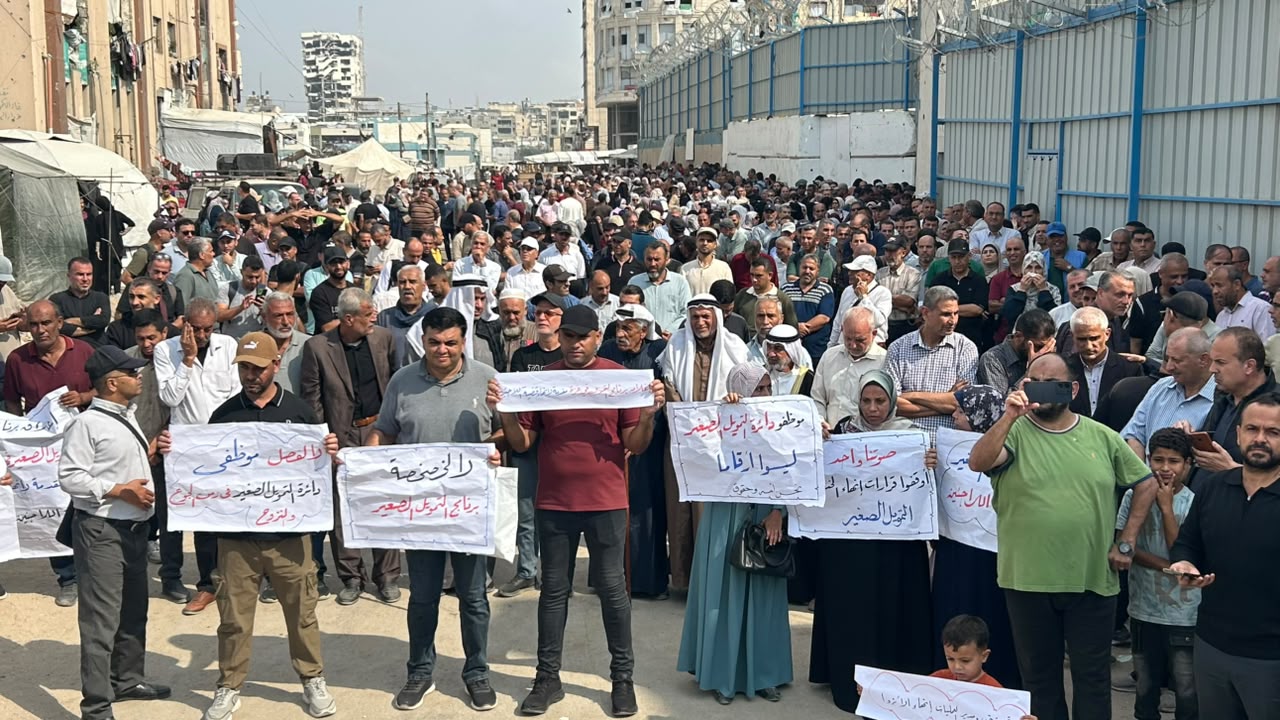
Shaaban Eid spent 13 years at UNRWA helping Gaza’s refugees start small businesses. In mid-September, the agency ended his contract, along with 42 colleagues in its microfinance department. “I’m broke after the agency fired the bullet of execution at us,” said Eid, 45, a father of four. “I used to make it easier for people to start their projects and help them. Now I have nothing, and I’m looking for someone to help me. Imagine being an employee and then finding yourself in the street.” Eid is among hundreds of UNRWA employees in Gaza who have already been dismissed, and more are expected to follow. The agency’s acting Commissioner-General, Christian F. Saunders, told the staff union earlier in October that he intends to end the services of thousands across the agency’s areas of operation, citing a $70 million deficit. Employees, union officials and former agency staff reject that explanation. For them, the layoffs strike at the institution established under UN Resolution 302 of 1949 to serve Palestinians driven from their homes in the Nakba, an agency that Palestinian refugees see as a standing witness to that expulsion and to their right to return to land that is now inside Israel and has been operating in Gaza since May 1950. The cuts come as the Board of Peace, the U.S.-led body chaired by Donald Trump and endorsed by the UN Security Council to oversee Gaza’s post-war governance and reconstruction, prepares to take charge of the Strip’s future. The Board has made its position on the agency plain. In one statement on X, it said UNRWA has “no place in New Gaza.” In another, it said its policy on the agency’s involvement in Gaza “has not changed,” that it will work only with “trusted partners,” and that UNRWA does not meet its standards. ‘Imagine finding yourself in the street‘ Eid, 45, joined UNRWA in 2013. After he was let go, he expected to at least receive severance for his years of service. But his end-of-service payment never reached him. The bank seized it to settle the loan he had taken out years ago to build his apartment. A father of four, he had no income besides his monthly salary. “I was a loan officer. I made it easier for people to start their projects and helped them,” he said. “Now I have nothing, and I’m looking for someone to help me, but because of the war there is no one. My life suddenly became hell without warning. Imagine being an employee and then finding yourself in the street.” At a recent protest against the dismissals in Gaza City, Eid carried a sign that read: “Turning the microfinance program over to the private sector is the beginning of the end of the refugee question.” UNRWA’s microfinance program was halted only in Gaza and continues in the agency’s other areas of operation. That, he said, is “a suspicious message, professionally, as a union matter, and even politically.” “We worked through the war in emergencies and risk management. We risked ourselves in every part of the agency’s work,” he said. “Is this how we are honored, by being dismissed?” Raeda Abu Shamala, who ran the microlending program in central Gaza, said she was forced to resign after 24 years at the agency and was threatened with the loss of her end-of-service entitlements if she refused. She supports a family of six, including her 73-year-old father, Samih, who has cancer, and her brother Saeed, 31, who has Down syndrome. Displaced during the war from the east of Bureij camp to its west, she kept working in UNRWA’s emergency programs throughout. “After 24 years of devotion, we are forced to resign,” she said. “This is a disaster not only for us as dismissed employees, but for the refugees who are losing the services we provided.” Other employees, who asked not to be named, said they fear they are next. ‘Gaza is the target‘ The head of the Arab Staff Union in Gaza, Mustafa Al-Ghoul, has announced ten days of “administrative disobedience” across the agency’s institutions, extendable depending on management’s response, while services continue. He said UNRWA has dismissed around 1,000 staff in Gaza and let 2,000 retire without replacing them, leaving roughly 10,500. Across its five fields, the workforce has fallen from 32,000 to 25,000. “We reject the dismissal of any employee on the pretext of a financial crisis,” he told Mondoweiss. “Look for funding as you always have, but not at the expense of the staff. The Commissioner said the layoffs would cover all areas, but it is clear Gaza is the target.” Sami Mshasha, UNRWA’s former spokesperson, said the 4,000 to 5,000 figure circulating among staff is exaggerated, but expects the cuts to reach hundreds or more. He said the Commissioner’s office alone holds the real numbers and which departments are targeted. Gaza will likely bear the largest share. The agency employed 13,000 people there before the war, Mshasha said, before hundreds were killed, 600 were dismissed in a single batch, and the agency turned to daily-wage workers instead of permanent hires. “After three years of war, Gaza needs more workers, not fewer,” he noted. The U.S.-led Board of Peace maintains a firm position that the United Nations Relief and Works Agency for Palestine Refugees in the Near East (UNRWA) has no role in post-war Gaza. The Board of Peace is an international body founded and chaired by U.S. President Donald Trump. It was formally launched at the World Economic Forum in Davos on January 22, 2026, endorsed by UN Security Council Resolution 2803, and has since expanded its mandate into a broader conflict-mediation body. Its dozens of member states, among them Israel, Egypt, Saudi Arabia, the UAE, Qatar and Turkey, serve renewable three-year terms, with permanent membership costing more than $1 billion. Mshasha called the deficit “a manufactured crisis,” created “to be a sword hanging over the agency,” which the Board of Peace wants to eliminate. He pointed to 2018, when the United States cut its funding, and UNRWA’s Dignity campaign raised hundreds of millions of dollars. “The decision to dismiss staff aligns with the plans of the Board of Peace, which does not want any future role for the agency,” he said, adding that he speculated it may have been coordinated with UNRWA’s management, though Mondoweiss could not independently verify those claims. He described a handover in which the Board draws on the expertise of Gaza staff during a transition, after which “some services may stay with the agency for a while, and others will move to other international, regional or Palestinian institutions.” The aim, he said, is to keep UNRWA out of Gaza’s reconstruction and to weaken it step by step in the West Bank. “They started in the north, and they will continue to the center and the south when the time comes. The agency has already been ended in Jerusalem.” He warned of salary cuts of more than 20 percent and of plans to borrow from the staff compensation fund, “one of the most dangerous risks and a red line.” The acting Commissioner-General, he said, exceeded his powers by failing to convene the Advisory Commission of host and donor states. “Clearly he is being pressured or given a green light by others.” The goal, Mshasha said, is “abolishing the camp, abolishing refugee status, and circumventing, if not eliminating, the right of return.” Mahmoud Khalaf, a member of the Central Committee of the Democratic Front for the Liberation of Palestine, called the measures an effort “to empty UNRWA of its staff for political goals,” in violation of Resolution 302. “The main target is the political content related to the return of refugees,” he said. “What is different this time is the unprecedented boldness.” The decisions, he added, affect six million Palestinian refugees. For Abu Shamala, the stakes are the same. “UNRWA was established as an agency that affirms the right of an entire people to return to the places they were driven from,” she explained. “What happened to hundreds of us was not arbitrary. These are studied, planned decisions, and they will not be the last,” she said. “Our demand is professional, yes. But it is also national.”
Amid deepening financial crisis, UNRWA conducts mass layoffs in Gaza
Full Article
Original Source
Read the full article at Mondoweiss →KhanList aggregates and links to publicly available news content. We do not host full articles from third-party sources. Always verify important information with original sources.