
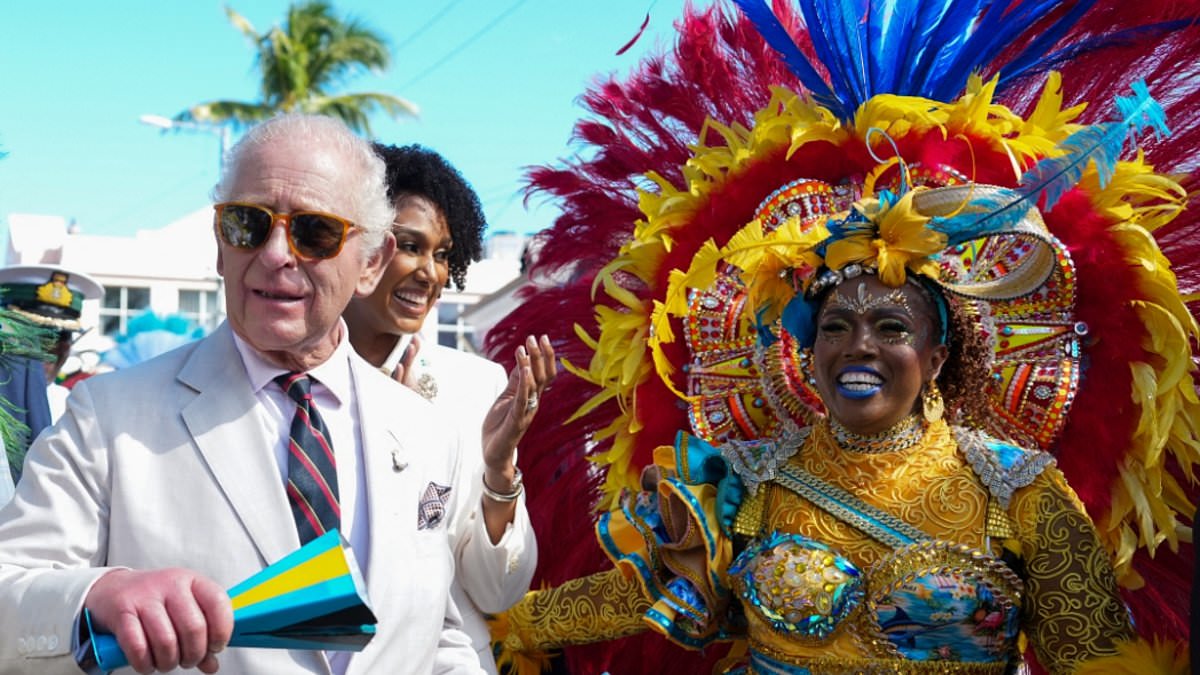
No one should doubt the King's diplomatic skills. After all, his address to a joint session of the US Congress in April was a charm-offensive masterclass at a time when the 'special relationship' looked anything but special following the Labour Government's refusal to back the joint US-Israeli war.Even so, spare a thought for Charles today when he opens the 28th Commonwealth Heads of Government Meeting in Antigua. There'll be plenty of talk about Britain's links to the slave trade, along with calls for vast sums of money to be given out by way of reparation payments.The Government, of which he is Head of State, has made clear there will be no formal apology and nothing in the way of financial handouts. But the Church of England, of which he is Supreme Governor, is full of apologists who want to divert £100 million to black communities in Africa and the Caribbean as a means of atoning for what may or may not have happened 300 years ago.The King finds himself in an impossible position. And it is the self-lacerating Church, obsessed as it is with the past evils of slavery, that has placed him there.The Church Commissioners' decision in 2023 to set aside £100million was followed by the appointment of an Oversight Group of 'experts' to advise on how the money should be spent. The group promptly recommended the figure should be increased to £1billion. King Charles, who joined a Junkanoo parade in Nassau, the Bahamas, last week, will open the 28th Commonwealth Heads of Government Meeting in Antigua on Sunday The Archbishop of Canterbury, Sarah Mullally, has said she hopes for 'justice and reconciliation to all who are still impacted' by the slave tradeJustin Welby, the former Archbishop of Canterbury, who presided over the Coronation of King Charles III and then resigned over his failure to report a prolific child abuser, spoke of his 'shame' about the Church's historic links to slavery after claims that some 300 years ago, it invested in the wicked trade. His successor, the Most Reverend Sarah Mullally, has meanwhile said she hopes for 'justice and reconciliation to all who are still impacted by its legacy'.And yet abominable though slavery was, a poll of 500 Anglicans in December last year showed that 81 per cent believe the £100 million should be used to support struggling local parishes, rather than diverted to the Fund for Healing, Repair and Justice, otherwise known as Project Spire.The Church Commissioners manage a central endowment fund of £11.6 billion but only £85million of the annual £653 million income went to parishes in 2024, according to the campaign group Save the Parish.Pews are empty; ordinations are at an historic low; choirs (and choir schools) are giving up; churches and cathedrals are crumbling; parishes are amalgamating to save money (while the number of diocesan desk staff is increasing). Biblical literacy has declined – and, on the 25th anniversary of 9/11, the hapless Archbishop of Canterbury is photographed giving an interfaith prize to a Muslim cleric who praised Osama Bin Laden.Something clearly has gone horrifyingly wrong, and anger is brewing. Indeed, so incensed is author, barrister and church warden Bijan Omrani, from the village of Shute near Axminster in Devon, that he is taking the Church Commissioners to court for failing 'to promote the mission and ministry of the Church of England'. Mr Omrani's legal challenge, with co-claimant the Reverend Jamie Franklin, rector of Holy Trinity church in Winchester, has been triggered by Project Spire – but the mission is far broader.As we shall see, what they and a growing number of like-minded priests and disaffected lay people are demanding is a radical overhaul of the Church. To watch it dying is not an option for them.Project Spire was born from research that claimed one of the Church of England's endowment funds in the early 18th century put money into the slave-trading operations of the South Sea Company and that a 'significant' portion of the fund's income may have been linked to slavery.The claim has been condemned as wholly misleading by many historians. Richard Dale, Emeritus Professor of International Banking at Southampton University and author of a book on the South Sea Company, was withering: 'First, no investor in the South Sea Company benefited financially from the slave trade, since it was consistently loss making.'Second, the Church Bounty [fund] did not even stand to benefit from the trade, because it declined to buy shares in the company.'Third, the investments that it did make, in South Sea annuities, represented...claims on the Government which had no connection with the trade in slaves.'Meanwhile, the make-up of the now disbanded and 'Black-led' Oversight Group that advised the Church Commissioners on the £100 million fund and helped shape their agenda remains highly contentious. Its chairman was The Right Reverend Rosemarie Mallett, Bishop of Croydon, who was born in Barbados but came to Britain after her mother emigrated as part of the Windrush generation. She went to Sussex University to study history and French – and it was there that 'all church-going stopped and activism started,' she said in an interview with Premier Christianity magazine in 2023.Dr Mallett, 67, who has a PhD in sociology, rather than theology, said: 'We've got to be out there in the world making a difference – whether it's joining the protests of Black Lives Matter or joining in with climate justice protests.'She was criticised for describing the fatal shooting by police in 2011 of Mark Duggan, a black 29-year-old in possession of a handgun, as 'murder' during a BBC interview – even though an inquest concluded his killing was lawful.Another member of the Oversight Group was Esther Xosei, 53, whose mother is from Guyana and father from Barbados. On X, she describes herself as a dedicated 'Reparationist, Jurisconsult, Community Advocate, Educator, Environmentalist & Ourstorian of the International Social Movement for African Reparations'.Xosei clearly has little time for the King. In 2022, when he was still the Prince of Wales, he was invited to be guest editor of The Voice, Britain's leading Black newspaper.This enraged Xosei, who called on the paper to apologise for such a 'nauseating advert for the Prince's Trust and what it's doing'. Warming to her theme, she said: 'The Royal Family, as an institution, is doing nothing to remedy the harm [caused by slavery] and Prince Charles's editorship sends a dangerous message to the rest of the world and shows the schizophrenic identity that is part of the internalisation of colonisation.' The Right Reverend Rosemarie Mallett said: 'We've got to be out there in the world making a difference – whether it's joining the protests of Black Lives Matter or joining in with climate justice protests'Xosei was born with the surname Stanford, but regarded it as too colonial and so adopted her African name. And, although she was part of the Oversight Group, she is actually critical of Project Spire because the 'descendants of enslaved people' should decide where the money is spent. 'The British Empire was the largest ever known empire, colonising hundreds of millions of people and the Union flag represents its depravity and its barbarity,' she has said.Another member of the group was Dr Richard Drayton, professor of Imperial and Global History at King's College London. He teaches undergraduates about 'the History of the British Empire', 'Atlantic slavery', 'Caribbean intellectual history' and 'Calypso and reggae as cultural forms'.Dr Drayton is a Rhodes scholar, but in 2022 he successfully led the charge at King's College to scrap the 100-year-old Rhodes Professorship of Imperial History named after Cecil Rhodes – and complained that the college was built using donations from people made rich by slavery in the West Indies.None of this makes any sense to Bijan Omrani, who has just published his latest book, God is an Englishman.'There is no forensic evidence that the church gained anything from slavery but, rather, there is plenty of evidence to show that the church played a major role in the abolition of slavery,' he says.'Sadly, this is hardly ever mentioned and, instead, we wallow in unfounded guilt.'And he is aghast at the lack of intellectual diversity in the Oversight Group, asking: 'Why didn't they choose any theologians or historians with a different perspective on historical and moral questions?'Mr Omrani, 47, is not your typical rebel. As well as being a barrister, teacher, speaker, husband and father he has a doctorate in Classics and Ancient History.He is passionate about the importance of the Church in British life. 'The hierarchy seems happy just to manage the decline of what potentially should be one of the most respected institutions in the country,' he says. 'The death of Christianity would do grave damage to our national identity and make it almost impossible to understand who we are.'While the Church Commissioners claim they have a 'moral obligation' to promote Project Spire, Mr Omrani believes the Commissioners have a moral – and legal - obligation to put the £100 million towards helping the imperilled Church of England.Full-time stipendiary clergy fell to 6,295 this May, compared with 14,603 in May 1960, according to official Ministry Statistics.Whether we like it or not, we are a country built on Christian principles (both the House of Commons and House of Lords still begin each sitting day with Christian prayers), and yet school assemblies up and down the country are loathe to talk about the parables and miracles of the New Testament lest they cause offence.We enjoy comedies starring the likes of Dawn French playing TV vicars, but go all coy when it comes to jokes about Muslim clerics. Monty Python's The Life of Brian is hailed as a classic by many Christians, but woe betide a Christian who dares to satirise the life of the Prophet Muhammad. Mr Omrani, whose father comes from Iran and mother is English, has been widely praised for his new book. It focuses on the role Christianity has played in our national story for more than 1,700 years and offers compelling arguments as to why the Church needs to be saved – not least from itself.The Reverend Canon Dr Alison Milbank, professor of Theology and Literature at the University of Nottingham, said: 'Everyone should read this book…whatever our ethnic or religious background.' Lord Chartres, the former Bishop of London, said it uncovers 'the deeper reasons for our current malaise'.As Mr Omrani writes: 'The origins of English kingship, the very idea of English nationhood, English law, education, spirituality, notions of ethics, charity, tolerance and public duty all have their roots in Christian doctrine.'And English culture – the arts, landscape, language, literature, music, social life – would be unrecognisable without it.'Who knows what the King thinks of the Church of England and its stance on reparation – but the impression one gets is that he wants the institution to flourish and that he appreciates the contribution it could make to the country.For now, he has to walk a depressingly fine line. Perhaps the legal action brought against the Church Commissioners by Omrani and Franklin might succeed. If so, the Church could then get on with the saving of souls rather than the wasting of money. One can only pray.Additional reporting by Tim StewartREAD MORE: Burnham slave trade pledge sparks new reparations row for the King on Caribbean tour as PM's ill-timed intervention triggers fresh calls for billionsREAD MORE: Prime Minister's staggering naivety has left Charles in a diplomatic quagmire, says ex-diplomat Ameer Kotecha
Amid calls for an apology and huge payout for Britain's role in the slave trade 300 years ago, King placed in impossible position by self-lacerating Church of England leaders determined to splurge £100m on reparations
Full Article
Original Source
Read the full article at Dailymail →KhanList aggregates and links to publicly available news content. We do not host full articles from third-party sources. Always verify important information with original sources.