
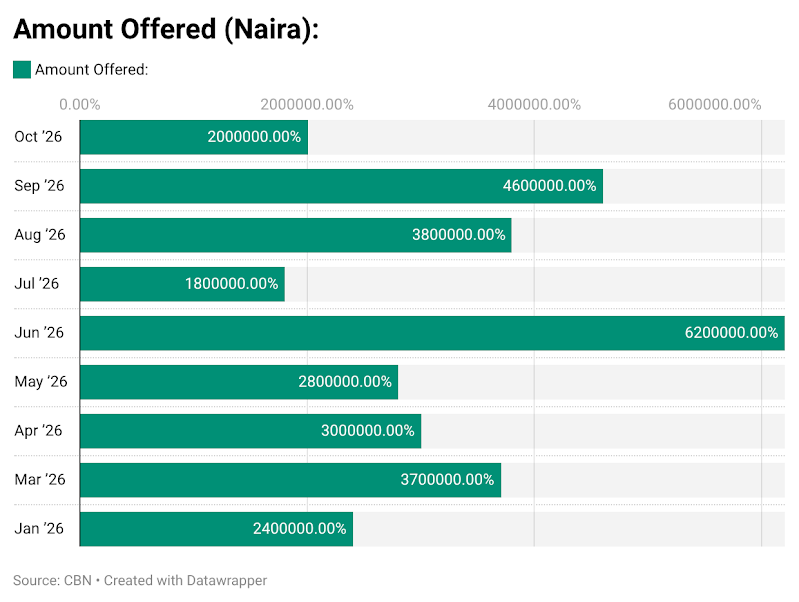
Kayode Tokede On the back of attractive yields, the Central Bank of Nigeria (CBN) raised N95.7 trillion through Open Market Operations (OMO) instruments in 10 months of 2026. This represents about 295.36 per cent increase when compared to N242 trillion in 10 months of 2025. Aside from the attractive yields, which attracted N121.51 trillion in total subscription from N47.34 trillion in 2025, the CBN revised policy on OMO also boosted individual investors participation this year. According to CBN data, N17.5 trillion total successful amount mopped up in September 2026 was the highest this year, influenced by a framework that allows individuals, corporates and non-bank financial institutions to participate in the OMO instrument. The total amount offered by CBN in 10 months of 2026 stood at N30.3 trillion, which is 119.01 per cent growth when compared to N13.84 trillion total amount offered in 10 months of 2025. Capital market analysts believe the surge reflects both liquidity pressures and broader monetary policy objectives, with implications for investor behaviour and financial stability. Managing Director, Highcap Securities Limited,, Mr. David Adonri explained that the surge in OMO issuance reflects periods of excess liquidity, prompting the CBN to intensify its mop-up operations. “OMO is used to stabilise liquidity. When there is too much money in the system, the CBN withdraws it. When liquidity tightens, it allows funds to flow back,” he said. He also highlighted a policy tension between growth ambitions and monetary tightening. “A $1 trillion economy requires liquidity, but too much liquidity fuels inflation and exchange rate instability. The CBN is balancing these competing priorities,” he added. The CBN conducts OMO to manage day-to-day liquidity in the banking system. OMO involves the CBN selling or buying short-term securities to either reduce excess liquidity or inject cash as needed. The CBN issues its own OMO bills to banks/individuals or buys back previously issued securities. The CBN’s decision to widen access to its OMO market, potentially increasing competition between stock market and high-yielding fixed-income instruments for investors’. Since the policy was announced on August 12, 2026, the OMO instrument has seen an uptick in subscriptions as investors take positions in risk free instruments that offer yields over 19 to 20 per cent. Analysts at Cordros Securities Limited said the core target of the CBN decisions is the sterilisation of domestic naira liquidity. “As a result, the reopening of the OMO market to domestic investors is a market liberalization policy on its face, but a liquidity sterilisation measure in practice. In summary, we expect these decisions to result in systemic reconfiguration of Nigeria’s financial markets, including helping the CBN achieve its monetary policy objectives through more efficient transmission,” the firm added in a report. The CBN so far in October 2026 offered to raise N2.00 trillion in OMO bills, that attracted N2.73 trillion demand, and ultimately allotted N2.63 trillion. Stop rates settled at 17.63 per cent and 17.14 per cent for the 138 Days and 180 Days tenors, respectively. The sustained demand recorded at successive auctions, despite the substantial liquidity already withdrawn from the financial system, suggests that liquidity conditions remain robust enough to support continued participation in OMO instruments. The Acting Director, Financial Markets Department of the CBN, Mr. Okey Umeano, had announced in a circular dated August 12, 2026, that participation in both the primary and secondary OMO markets would be open to all eligible investors through Deposit Money Banks (DMBs). “OMO participation (primary and secondary markets) shall be open to all eligible investors through Deposit Money Banks (DMBs). Eligible investors include individuals, corporates and non-bank financial institutions. DMBs shall continue to submit bids and settle transactions on behalf of their customers,” the circular stated. Under the previous framework, access to the CBN’s Discount Window was restricted for banks that participated in the Nigerian Foreign Exchange Market (NFEM) or purchased government securities at primary auctions. The restriction on accessing the Discount Window on the same day as participating in OMO operations also applied. The circular removes the restrictions, allowing banks to participate in the markets without losing same day access to the CBN’s liquidity facility. However, the restriction on using the Discount Window and participating in OMO auctions on the same day remains in place. With OMO bills now accessible to individuals and other eligible investors through banks, rather than being largely restricted to institutional market participants, analysts believe the policy could divert some funds from the Nigerian stock market to the fixed-income market, particularly given the attractive yields on offer.
Amid Attractive Yields, CBN Mops Up N95.7tn via OMO in 10 Months
Full Article
Original Source
Read the full article at Thisdaylive →KhanList aggregates and links to publicly available news content. We do not host full articles from third-party sources. Always verify important information with original sources.