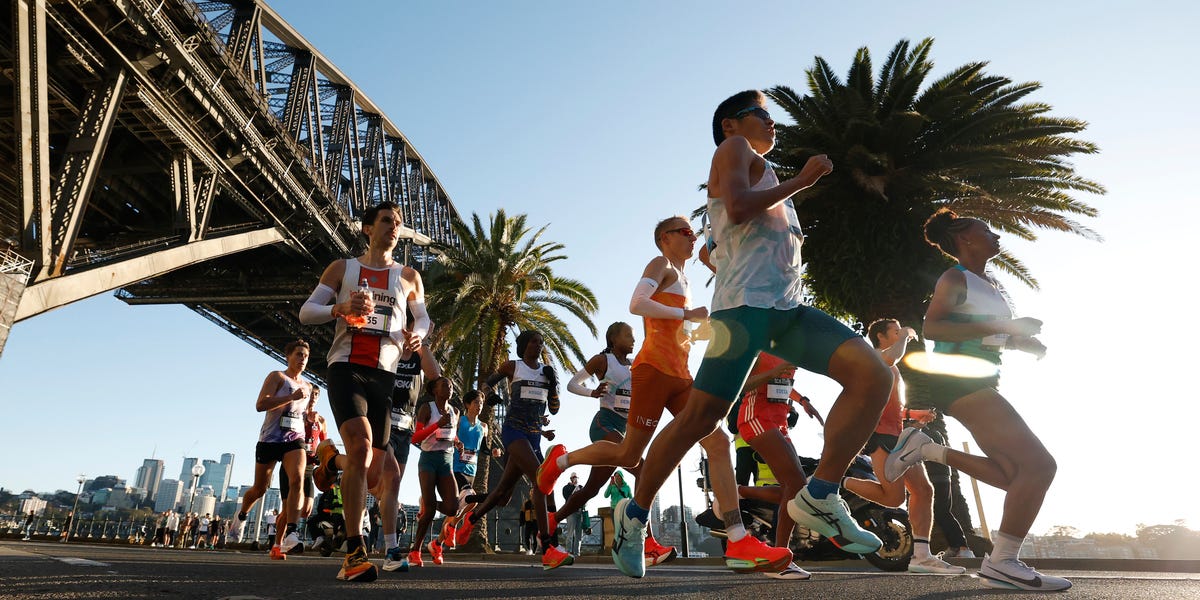
Other than the fact that we run marathons, you may think that I—a thirtysomething amateur runner—don’t have a ton in common with the likes of Clayton Young and Susanna Sullivan. While they win races, I’m middle of the pack. In fact, both of these runners have completed a marathon in literally half the time it’s taken me.But dig a bit deeper and you’ll see some similarities between pros and recreational runners: To the best of our own abilities, we all care about optimizing our training plans, diets, and recovery strategies, and we all deal with some level of performance anxiety and race-day nerves.So, when I had an opportunity to talk to Young, Sullivan, and a few other pro American marathoners, I asked them if they had any advice for their mortal counterparts. (Yes, I realize how lucky I am!) I was training for the Sydney Marathon at the time, so I applied their tips to my personal 26.2 preparations.Here are the most resonant insights that can make a difference for any marathon you have on the books—whether you’re aiming to podium, PR, or just cross the finish line.Trust Your Training“One of the latest lessons that I’ve learned is this idea of believing not only in yourself but in the training program that you are [following],” says Young, a Brooks athlete who finished 11th at the 2026 Boston Marathon in a PR time of 2:05:41. “There are so many training plans out there, and there’s so much information out there because of Strava and social media, and you have to be careful because it can affect how you’re training and maybe cause you to question what you’re doing.”Similarly, Brooks-sponsored Sullivan, 10th on the U.S. all-time list with a marathon personal record of 2:21:56, says that it’s critical to stay confident in your buildup. “Especially if you are training for a fall race, you might be training in conditions that are rather unpleasant now,” she says. “Trust that if you put in the work, when you taper and conditions are better, you’ll be ready for a great race!”Commit to Strength and Mobility WorkSullivan says that of everything she’s doing in training, she believes being consistent with her strength and mobility workouts has the biggest effect on her performance, because injury prevention is such a big focus. “It’s often said that being 90 percent fit and 100 percent healthy is better than being 100 percent fit and 90 percent healthy, and I really believe that to be true,” she says.I had scaled my strength workouts back to twice a week during peak Sydney training (down from three times per week), but continued to do my 20-minute mobility routine at night at least three times a week, inspired by Sullivan.My strength workouts included major lifts like barbell back squats, deadlifts, chest presses, and pull-ups, plus accessory movements focused on hip stability and strength. Meanwhile, my mobility routine included moves like 90/90 hip openers, calf stretches against a wall, and a prone back stretch, all held for two minutes per side.I definitely feel mobility and strength have made a difference in helping me to be more resilient to injury: I’ve had nagging tendinitis in my left hip for years that comes and goes, but since I’ve been doing the 90/90s consistently for the past several months, it’s been quiet.Inject Some Speed“Running enough mileage for a marathon is essential, but doing some running close to a max sprint can be helpful as well,” says Brooks-sponsored CJ Albertson, who holds a 2:08:17 marathon personal record. “[Sprinting] trains your neuromuscular system as well as your muscles, tendons, ligaments, etc., since there is a lot more force production and impact versus easy running.”He suggests adding two to three strides or 100-meter accelerations to the end of two runs per week.My training plan had a built-in speed workout weekly—including kilometer repeats at a pace faster than goal race pace interspersed with rest—so I focused on making that a quality session (rather than being tempted to turn it into an easy run).Master the Recovery Basics“There are so many things that you can do to rest and recover, and there are so many products you can buy, but I feel like we get them in the wrong order sometimes,” Young says. “I’ve been really focusing on two things that I can do to recover: Number one is nutrition, and number two is sleep.”After those two reigning champs of recovery, you can add in the extras like massage guns, compression boots, or nutritional hacks like tart cherry juice. “[Those things] make a difference [but] maybe don’t move the needle as much as just doing the basics,” Young says.One change I made to prioritize sleep: Because I’m an early riser, I like to start winding down for bed before 8 p.m. on many nights, which means that dinners out with friends that start at 7 p.m. cut into my sleep. While most of the time I might prioritize the social connection over the sleep, during this training block I made a big push to ask friends to meet earlier for dinner. The surprising result was that many of them actually preferred eating at 6 p.m. as well!Nutritionally, I know I do a good job of hitting my protein goals, but historically have struggled to add more carbs during heavier training blocks. I worked on sprinkling in more throughout each day (like getting the bread and adding sweet potatoes to my salad).Another nutritional tweak I made was focusing on getting enough salt during my runs. I’m a salty sweater and realized that a few SaltStick FastChews in addition to my GU gels made me feel mentally, as well as physically, stronger. I also experimented with adding electrolytes to my handheld bottle, which I ended up bringing with me on the Sydney course.Recruit a Training Partner“If you’re not training with somebody, you’re missing out,” Young says. “The social side of the sport is one of the best parts. At the end of the day, I feel like you’re going to get a better quality workout when you’re working out with somebody than if you were doing it by yourself.”I’m somewhat of a lone wolf when it comes to running, so this was a challenge for me. But after hearing this advice from Young, I committed to running my 20-miler with a friend who had 14 miles on her schedule. I’m so glad I did: The 14 miles we ran together flew by, and then I felt like I was set up for success to finish strong on my own.I’ll likely start looking for more opportunities to buddy up as we enter fall running season in New York.Expect the Unexpected“26.2 is a long way, so think through what you will do if you drop a gel or you get a blister or anything else goes wrong,” Sullivan says. “And then, if everything miraculously goes according to plan, even better!”I leveraged this bit of advice ahead of Sydney by creating a list of issues I might encounter, and how I would handle them:If my calf cramps up, I will focus on my form to take the pressure off my calf, or I’ll compress it with my hands for a minute.If I chafe, I will remind myself that it’s not dangerous, and I’ll get through it. If I drop a gel, I will get one on the course. GU gels are available at the 20K and 30K drink stations.Luckily, none of these things actually happened, but having a game plan gave me confidence and kept me from wasting time fretting.Sharpen Your Decision-MakingI started the Sydney Marathon with two other runners and was faced with a big decision right out of the gate: Try to run their pace and stay together, or stick to my own. It was very tempting to keep pace with them as we sailed through the first few downhills, but I made the swift and firm choice to pull back and run the smart pace I’d trained for.I was proud of this decision not only because I didn’t hit the wall at mile 20 but also because I didn’t agonize over it for a kilometer or so before making the choice.Young inspired me by saying he has been working on being more assertive in his midrace decisions: “Being physically prepared and having realistic expectations going into the race is important, but then the execution of that plan comes down to making a decision,” he says.For example, should you stick to your pace or alter it? Should you stay with your training partner or go for that kick to the finish? Many of us, myself included, spend a lot of mental energy laboring over these choices versus just making them, or as Young puts it: “We spend so much time in the middle gray area, the wishy-washy middle, that we don’t truly commit.”Young says you can practice making these decisions quickly and efficiently in your training runs and “it’ll become automatic or second nature on race day.”Find Your CalmTwo days before the Sydney Marathon, I did a three-mile shakeout run. My legs felt heavy, and so I panicked a little. But then I remembered Albertson’s advice: “It’s helpful to stay calm and positive amidst the potentially discouraging times and still believe you’re going to hit your goals,” he says. “During every training block, even before my PR races, I’ve had weeks of thinking I was so out of shape and should drop out of the race. But I almost always end up being where I need to be on race day.”After that shakeout, I literally shook off the bad vibes and nerves I felt ahead of getting to the start and reminded myself how ready I was for this marathon. By the time I lined up, those less-than-stellar miles were a distant memory not worth fretting over.“Training for any race, even the most exciting one, is going to have ups and downs,” Albertson says, including physically, mentally, emotionally, and even logistically. And not every day, workout, or week is going to go perfectly. But that doesn’t mean it won’t go well.Lean Into Gratitude“I really think gratitude is the number-one performance indicator I’ve found in my career,” says Reed Fischer, an Adidas athlete who ran a 2:09:47 personal record at the 2026 Seville Marathon, where he finished as the third American.He spends time reflecting on what his body’s been able to do to get to the starting line healthy; how fortunate he is to have coaches, teammates, family, and friends who invest their time and energy into his success; and what a powerful experience it is to race a marathon surrounded by other runners.“Spend some time on race morning and throughout the race reflecting on the people in your life who’ve supported you in your race goal and you’ll be able to dig much deeper when the pain inevitably comes,” he suggests. Fischer adds that you could even write the name of a loved one on each of your race gels, make a list of moments you’re grateful for from your training build, or write a thank-you note to your partner or family members.I took this to heart ahead of the marathon, adding an extra moment of gratitude to my morning meditation, which I do every day. And honestly, the gratitude flowed through me naturally during most of the 26.2 miles.Courtesy Caitlin CarlsonThe writer after the 2025 Sydney Marathon.I didn’t have to actively think about being thankful, but I had this subtle awareness of how lucky I was to be able to be in Sydney running this marathon that I’d been dreaming about since I heard it was a World Marathon Major contender. To have the support of family and friends, to get to explore the other side of the world—I felt gratitude for all of it, even when my body started to feel the weight of the later miles.Take It One 5K at a TimeYou often hear about the 10/10/10 strategy for pacing a marathon: breaking the race into the first 10 miles, the next 10 miles, and the final 10K.But this strategy was new for me: “One of my favorite tips for marathoners new and old is to try setting up your GPS watch to split every 5K instead of every mile or kilometer,” says Fischer. “I started doing this in 2021 before the Boston Marathon and it’s been a game changer. I find breaking the race into eight chunks instead of 26 or 42 helps make it feel more approachable mentally, and getting 5K splits also helps smooth out some of the volatility of an uphill or downhill mile that might otherwise make you worried about hitting the wall or running too fast.”Reflect on Your RaceGoing into the Sydney Marathon, I thought not having a time goal would keep the pressure low, but it somehow had the opposite effect and left me feeling kind of ungrounded—especially as I walked to the starting line.I think if I had set a goal, even a “slow” one for me, like 4:30, that would have given me a target that I could deliberately pace for and strive toward. But without it, there was this sense of questioning whether I could do it faster, or if I would need even more time to cross the finish line.This is the biggest thing I was thinking about when I reflected on my race—something that Young recommends doing—later that evening.“I feel like your next marathon is often a reflection of your previous marathon, of that 24 hours postrace when you’re thinking, ‘Oh, that was such a great experience . . . but what if [next time I try doing] this instead?’ and ‘How can I get ready [for the next race]?’” Young says.For my next marathon, I’ll have the opportunity to set a more specific goal. I think in the past I’ve thought that a time goal had to be big and ambitious, but I’m now realizing it can be just that—a goal.
America’s Top Marathoners Share Advice for Racing Your Best 26.2
Full Article
Original Source
Read the full article at Runnersworld →KhanList aggregates and links to publicly available news content. We do not host full articles from third-party sources. Always verify important information with original sources.