
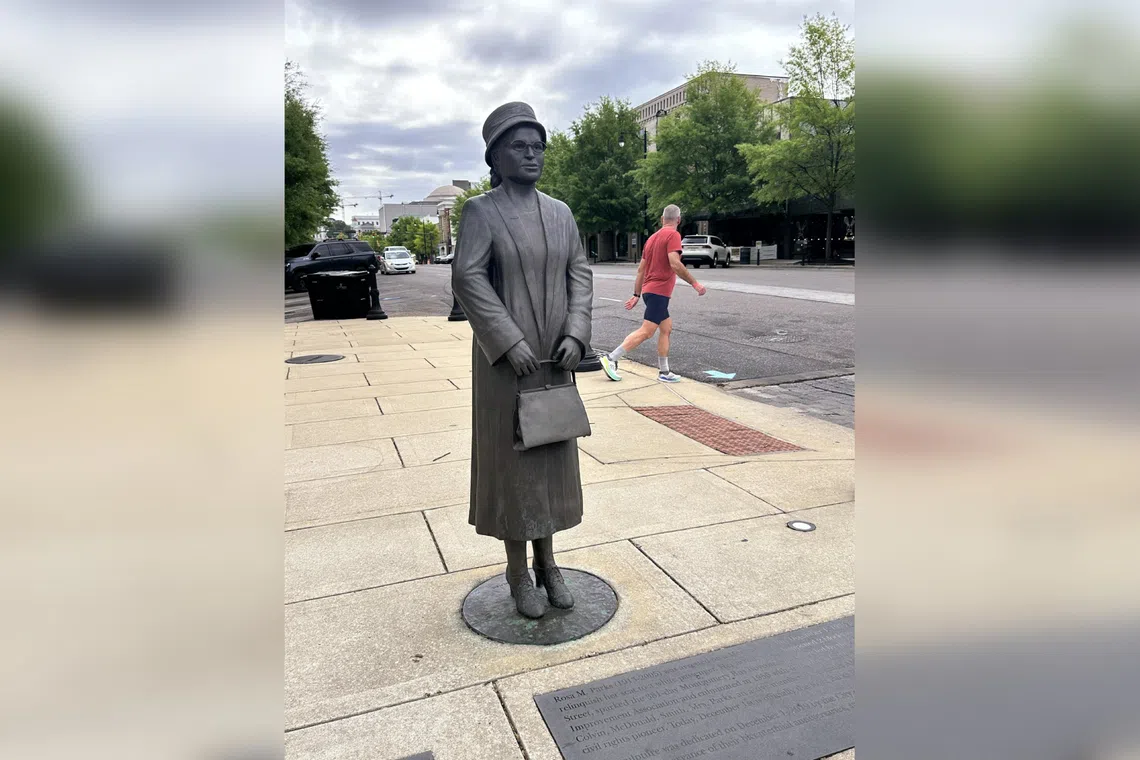
VIDOR, Texas – A 10-minute detour to get to a cheaper hotel on a drive from Houston to Philadelphia led me to a “sundown town”. That may evoke sunsets and beaches in a resort town. But that illusion was quickly dispelled. This label had overtones of menace, I soon discovered.Waiting at the front desk to get the room keys, I asked what I thought was a casual question – what’s this place like? The young receptionist, with hair swept up in a blonde ponytail, went quiet. “Well, it doesn’t have the best history for black and brown people,” she said after a beat. “They say it was a sundown town. But I’ve been here for two years, and it’s all fine now,” she added quickly. “It has a reputation – I don’t know that it’s deserved.”That was my abrupt introduction to Vidor, tagged for decades as the “most hate-filled town in Texas”. Curious to learn more, I googled local news. Only a few crime reports turned up, none too recent. And nothing leapt out during a late evening drive around the town, just modest low-rise houses, small shops and fast food restaurants. A “sundown” sign that bluntly warned “whites only within city limits after dark” was reportedly removed from Vidor only some time in the 1970s or the 1980s. In scattered mentions on social media, some black motorists say they grew up being told to avoid Vidor and that, even now, they would not consider stopping there for a bite to eat or to refuel.A database maintained by an educational site hosted by Tougaloo College, a historically black institution in Mississippi, says sundown towns numbered in the thousands and were found across the US from the late 19th century to the mid-20th century. It’s not just the blacks who were kept out. Jews, Hispanics, Native Americans, Mormons and Asian Americans were also unwelcome in that era. The “Delta Chinese”, recruited to work on cotton plantations in Mississippi, suffered decades of segregation. Vidor residents and officials claim things are vastly different now. They say it’s unfair to tarnish the town in 2026. The last bit of substantial nastiness was in the early 1990s over a federal judge’s order to desegregate the city’s public housing. In response, four black families moved in but eventually left after facing sustained hostilities from the white supremacist organisation, the Ku Klux Klan.In 2020, at the height of the Black Lives Matter movement, a rally in the town drew a supportive crowd, mostly white. Some counter-protesters also showed up, with loaded guns and confederate flags, a controversial symbol of southern pride and also slavery. They shouted that it was the black rights movement that was racist because all lives mattered. A vivid account of that rally won The Economist a Pulitzer Prize in 2021.The town, which wears a dour look, as though trying without success to surmount its past, remains nearly all-white today. Blacks count for a mere 0.3 per cent of residents. Its population peaked at 11,800 in 1980 and has been shrinking since. Vidor may be the outlier, but in travels through several southern states – Louisiana, Mississippi, Alabama, Tennessee – I saw evidence of America’s racial past still tailgating its present. In a country where 14 per cent of the population is black, the second-biggest racial or ethnic minority after the Hispanics, the upcoming midterm elections have become more than the usual face-off between the Republicans and the Democrats. Bigger and more basic questions appear to be on the ballot in the 250th year of American independence: who can vote, whose votes can make a difference, who actually belongs. There is no official nationwide count yet of the black candidates running for Congress in 2026. And a few states are still to hold their primary nominating contests. But in 2025, 67 black lawmakers took the oath at Capitol Hill. Mostly Democrats, they were the largest black delegation in American history.That progress – a fourfold increase from the figure in 1975 – mostly came from states redrawing congressional maps over the decades to create black-majority districts that could elect black candidates. Those hard-won gains could be reversed in a matter of months, in a coordinated and wide-ranging exercise that has the power of the US Supreme Court behind it. Analysts expect the Nov 3 midterm elections to produce the largest-ever decline in black representation in Congress after a number of states recently redrew their maps to eliminate black-majority districts.The road from SelmaFor miles on end, there were only a few cars on a scenic drive in late March from Selma to Montgomery, two of the most storied cities in the black civil rights movement. Both lie on the muddy-brown Alabama River, connected by a bridge named after a 19th century Ku Klux Klan leader. One of the cities challenged where black Americans could sit and the other whether they could vote and wield political power.Alabama’s capital, Montgomery, known for its white neoclassical buildings with columns, symmetrical facades and broad steps, looked ceremonial but forlorn. Its downtown yields layers of history but has suffered destructive tornadoes over the years, and some streets were closed for repairs. Gang fights and gun violence have been on the rise.A plaque marks the spot where Rosa Parks boarded a public bus and refused to yield her seat for a white passenger, her rebellion sparking a mass protest that forced the authorities to end segregation on the city’s buses in 1956. It also brought to the national stage a dapper 26-year-old pastor of the Dexter Avenue Baptist Church.A schoolchild skipping on the pavement could not direct me to the church where Martin Luther King Jr preached, although she knew “he did something good for us”.The Dexter Avenue King Memorial Baptist Church where US civil rights leader Martin Luther King Jr served as pastor from 1954 to 1960. The church was the site of mass meetings to organise the Montgomery Bus Boycott which eventually forced the end of segregation on city buses. ST PHOTO: BHAGYASHREE GAREKARThe dainty red brick church was a short walk away, well preserved but silent on a cloudy, weekday morning. In 2025, thousands arrived here to commemorate the 60th anniversary of the “Bloody Sunday” march King led from Selma to Montgomery to demand voting rights for blacks. Black residents made up half of Selma’s population then, but only 2 per cent were registered to vote. Although they had the constitutional guarantees, they were denied registration through poll taxes, literacy tests and threats of violence.The 600 marchers protesting against the injustice were stopped and attacked as they crossed a small, grey bridge bearing the name of Edmund Pettus, a lawyer, brigadier-general, US senator and the Grand Dragon of the Alabama Ku Klux Klan. Shocking images of the event, on the front pages of newspapers and relayed on TV, built national support for the Voting Rights Act of 1965. Posters related to the US civil rights movement outside the privately-run National Voting Rights Museum and Institute, located near the Edmund Pettus Bridge. Protest marches from Selma to Alabama state capital Montgomery led to the Voting Rights Act in 1965. ST PHOTO: BHAGYASHREE GAREKARCut to today and President Donald Trump’s repeated calls for Congress to pass the SAVE America Act, which he insists is necessary to prevent non-citizens from voting fraudulently in elections, touches a raw nerve here. The Act, which has stalled in Congress, includes measures that will require voters to show proof of citizenship when registering to vote and a photo ID when they turn up at the ballot booth.The Edmund Pettus Bridge, the site of a violent confrontation between civil rights marchers and law enforcement officers in 1965. ST PHOTO: BHAGYASHREE GAREKARThe White House has called these “commonsense election integrity measures that are strongly supported by the vast majority of Americans.” But in Selma, Montgomery and the wider civil rights community, distrust is rife.“Of course, no one wants non-Americans to vote illegally. But is that really a big problem? The administration has provided no proof,” said Al Adams, a retired city worker in Montgomery.“What we do know is that what Trump wants will create a burden that will fall unevenly on our community,” he said.“Not everyone has their original birth certificates, name discrepancies on documents are very common, people cannot or will not make a trip in person to an election office to register (to vote). It is especially hard on the elderly, the disabled and folks in rural areas. “Given our history, you will have to forgive us for concluding that the new rules will reduce black power. And, perhaps, that is the intention,” he said.Cracking and packing the black voteAnger runs even deeper against Trump’s push for redistricting in Republican-ruled states to limit losses in the looming midterm election, which almost always punishes the party of the White House incumbent. The redrawing of state maps to maximise electoral advantage is hardly a new tactic. Nor is it illegal; the exercise does not deny anyone a vote. But it does impact who gets elected by laying down how voters are grouped into districts. It affects black voters unusually directly, especially in the South, where they are geographically concentrated. As a group, they tend to support Democratic candidates at higher rates than the white majority.Republicans argue that while they’re engaging in partisan gerrymandering to win elections, there is no racial intent. Voting rights advocates, however, say they are dismantling black-majority districts that have voted for black Democrats in the past.But where race and party correlate, the distinction is hard to make.The city of Selma, the centre of the black civil rights movement in the 1960s. ST PHOTO: BHAGYASHREE GAREKARTwo map-drawing tactics are used to weaken a group’s electoral influence. One technique is “cracking”, or splitting a cluster of black communities across several majority-white districts, thus reducing the collective power of black voters. The other is “packing” black voters into fewer districts, thus producing one safe black seat while reducing their influence in adjacent seats. A Supreme Court decision in April 2026, which held that maps which consciously used race to create black-majority districts violated equal protections accorded to non-minority groups, was a catalyst. It sped up the process initiated by Texas and other red states in 2025 to improve the odds of retaining the US House of Representatives, where the Republican Party holds a narrow 219-212 majority, with four remaining seats vacant due to death or resignations. By late August, at least 10 states, nine of them Republican, had carried out redistricting in ways that dilute the black voting power.In Louisiana, which is roughly one-third black, there were two majority-black districts in the 2024 elections. One of them was eliminated by carving out the black neighbourhoods in the cities of Baton Rouge and Shreveport and merging them with more white and Republican districts. In Alabama, two black-majority cities, Montgomery and Mobile, which were reliably Democratic, are now part of districts that are majority-white and pro-Republican. In Tennessee, Republican lawmakers dismantled the state’s only majority-black district, the 9th District, which was 62 per cent black and concentrated around Memphis. It was split into three rural, mostly white districts that are Republican footholds.In North Carolina, the district with the state’s highest black population (42 per cent) was merged into nearby solidly Republican areas in a way that left it less black (34 per cent).In Florida’s new map, four Democratic incumbents now reside in heavily Republican-leaning districts.Texas’ redistricting resulted in reduced black representation in the Houston and Dallas area districts.But, in a curious juxtaposition, black political ambition is also scaling new heights just as electoral maps that produced black representation are being redrawn.At the state level, the story is more encouraging.Only three black Americans have ever been elected as governors. But in 2026, for the first time, a record eight black candidates – four from each party – are seeking the highest office in states that include battlegrounds such as Michigan, Nevada and Wisconsin. Three are from southern states: Georgia, Florida and South Carolina.This political season could produce Florida’s first black governor in Byron Donalds and Georgia’s Keisha Lance Bottoms could be the nation’s first black woman governor. Both fancy their chances.These contests matter more than the symbolic breakthroughs they represent; these are arenas where the black aspirants must escape the racialised political lanes to win in predominantly white electorates. And in most states, redistricting begins and ends at the governor’s desk. A black candidate must first build the cross-racial coalitions to win and, if elected, has a chance to decide if future maps make such coalitions easier or harder to form.With race still shaping access to power, America has not become colour-blind, but the lines drawn on maps need not become destiny.It just means that the battle will go on.
America’s political maps are shifting. So is who can win
Full Article
Original Source
Read the full article at Straitstimes →KhanList aggregates and links to publicly available news content. We do not host full articles from third-party sources. Always verify important information with original sources.