
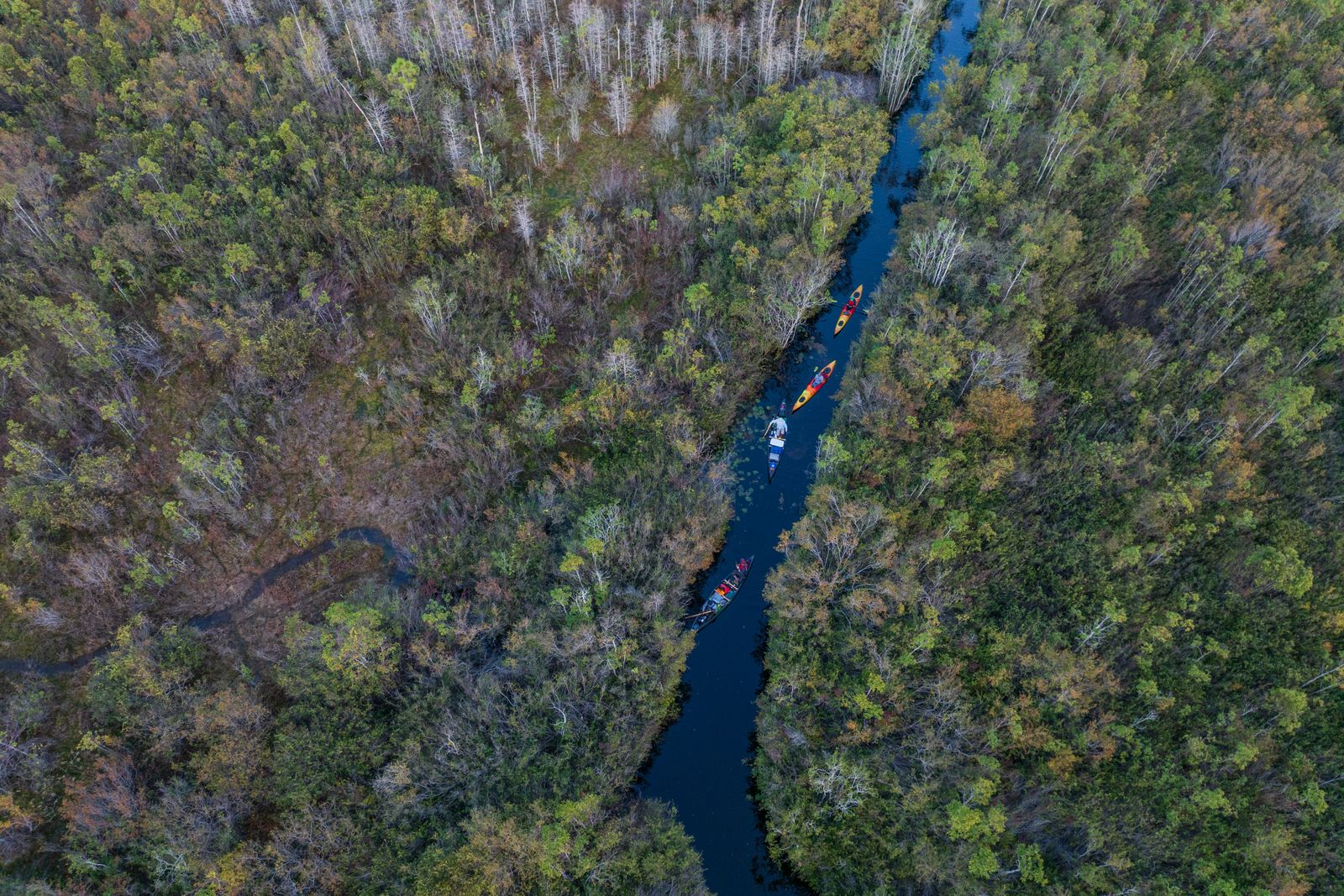
America’s Newest UNESCO World Heritage Site Is a Swamp—and That’s Exactly Why You Should Go Georgia’s Okefenokee National Wildlife Refuge is one of the world’s rarest surviving wetland ecosystems. Its new global recognition reveals why protecting this landscape matters far beyond the American South November 5, 2026 11:36 a.m. “It’s a national treasure,” says Sara Brown Aicher, a retired U.S. Fish & Wildlife Service biologist who spent 31 years at the refuge. “It is one of the last places like it.” Lauren Yoho/Live Wildly Known by a name of Indigenous origin, often translated as “land of the trembling earth,” Georgia’s Okefenokee Swamp became a UNESCO World Heritage Site this past July. It is the first World Heritage property managed entirely by the U.S. National Wildlife Refuge System—and one of the planet’s most remarkable surviving wetlands. For Sara Brown Aicher, a retired U.S. Fish & Wildlife Service biologist who spent 31 years at the refuge, the landscape is “a mosaic of all kinds of habitats,” shifting with fluctuating water levels and fire. Aicher studied the Okefenokee National Wildlife Refuge, monitoring wildlife, tracking environmental changes, and watching fire and water continually reshape one of America’s most unusual landscapes. She knew the swamp intimately. Yet it was when she began comparing the Okefenokee to ecosystems elsewhere in the world, during the long effort to secure UNESCO World Heritage recognition, that its extraordinary rarity came into sharper focus. “It’s a national treasure,” she says. “It is one of the last places like it.” In July, the rest of the world formally acknowledged what Aicher had come to understand. The Okefenokee National Wildlife Refuge, spanning southeastern Georgia and a small portion of northeastern Florida, joined the UNESCO World Heritage List, becoming Georgia’s first World Heritage Site. The recognition placed a sprawling blackwater wilderness alongside celebrated American landscapes such as Yellowstone, Yosemite and the Everglades. Spanning more than 400,000 acres, the Okefenokee World Heritage property encompasses a vast collage of open prairies, cypress forests, pine uplands and forested islands. Volo Project But unlike some of those more familiar destinations, the Okefenokee’s significance is not immediately apparent in a dramatic summit or monumental rock formation. Its extraordinary qualities lie beneath dark water, within cypress forests and in an ecological system that has remained remarkably intact despite the transformation of much of the surrounding region. The designation recognizes something increasingly difficult to find: a landscape where natural processes still shape the environment on an immense scale. Yet UNESCO recognition also raises questions about the Okefenokee’s future. The designation places the swamp under a global spotlight, potentially increasing public scrutiny and pressure for continued conservation, but it does not provide additional legal protections against development beyond the refuge’s boundaries. Whether that international attention translates into lasting support will be critical to protecting the water systems and natural processes that earned the Okefenokee its World Heritage status. A landscape shaped by water and fire Spanning more than 400,000 acres, the Okefenokee World Heritage property encompasses a vast collage of open prairies, cypress forests, pine uplands and forested islands. Its tannin-dark waters feed two rivers: the Suwannee, which flows toward the Gulf Coast, and the St. Marys, which empties into the Atlantic Ocean. Beneath the surface lies something even more remarkable—peat, or layers of partially decomposed vegetation that have accumulated over approximately 7,500 years. According to the International Union for Conservation of Nature (IUCN), which evaluated the Okefenokee's UNESCO nomination, the swamp is likely the world’s largest and most intact lowland freshwater peatland in the subtropical zone. These ancient deposits preserve a record of environmental change while storing carbon accumulated over millennia. The swamp is likely the world’s largest and most intact lowland freshwater peatland in the subtropical zone. Lauren Yoho/Live Wildly “It’s both old and young. It’s defined by water and by fire,” says Sarah Ratcliffe, an interpretive ranger at Okefenokee State Park, the refuge’s western gateway. That apparent contradiction is the key to understanding the landscape. Rainfall causes water levels to fluctuate, sometimes exposing vegetation and peat to fire during prolonged dry periods. As water returns, plant communities regenerate, and the swamp gradually rearranges itself. Open prairies can give way to denser vegetation, while fires can create openings that allow different habitats to emerge. What appears to be a timeless wetland is continually transforming. During her decades at the refuge, Aicher witnessed these transformations firsthand. Rather than attempting to hold the landscape in a fixed state, refuge managers use prescribed fire in surrounding uplands to maintain fire-adapted habitats and help manage wildfire risks near refuge boundaries. “A rich, dynamic mosaic of habitat patches is maintained by the interplay of fire and water,” explains conservation scientist Reed Noss, who helped establish the surrounding North American Coastal Plain’s recognition as a global biodiversity hot spot. The mosaic, he adds, has been minimally altered by humans. Quick fact: UNESCO's Tentative List The Tentative List currently features 1,864 sites from 182 countries and territories. Some of these spots get inscribed to the World Heritage List within a few years, while others wait decades. UNESCO's World Heritage Committee meets annually to name new World Heritage sites. The Okefenokee’s defining characteristic is not that it has escaped change. It is that, across such an immense landscape, the natural processes driving that change remain remarkably intact. Why this swamp matters to the world When UNESCO inscribed the Okefenokee on its World Heritage List, it recognized more than a vast wilderness. The refuge became the first World Heritage Site representing the subtropical habitats of the North American Coastal Plain, where centuries of land conversion and development have fragmented much of the original landscape. UNESCO inscribed the Okefenokee under two natural criteria: its outstanding ecological processes and its importance for biodiversity. According to the IUCN evaluation, the World Heritage property supports more than 1,270 plant and vertebrate species, including 24 considered globally threatened. Its interconnected wetlands, open prairies and pine uplands provide habitat for wildlife ranging from American alligators and wading birds to gopher tortoises, illustrating how different ecosystems sustain an exceptional diversity of life within a single landscape. The World Heritage property provides habitat for wildlife ranging from American alligators and wading birds to gopher tortoises. Lauren Yoho/Live Wildly However, the Okefenokee’s importance extends beyond the species living there today. The thousands of years of accumulated peat beneath its dark waters form an environmental archive. Preserved organic material offers scientists evidence of past vegetation, fires and environmental conditions, providing a window into how the landscape has evolved over millennia. Disturbing those deposits risks damaging a record that cannot readily be replaced. Those same peat deposits also serve as a significant carbon reservoir. Waterlogged conditions slow decomposition, allowing carbon to remain stored in the soil for thousands of years. Drainage or changes to the swamp’s hydrology could accelerate decomposition and release some of that stored carbon, making the protection of its water systems important well beyond the refuge’s boundaries. The swamp hasn’t escaped human intervention. Logging and attempted drainage altered portions of the landscape, but that was before the refuge was established in 1937. “Okefenokee is wild and intact, shaped by nature more than by humans,” says Noss. “Such places have become rare in the modern world and have immeasurable intrinsic value.” Four decades in the making The Okefenokee’s journey to World Heritage status began long before its 2026 inscription. First identified as a potential candidate in 1982, the swamp spent more than four decades on a winding path toward international recognition, despite its exceptional ecological credentials. For Aicher, the effort became part of her work at the refuge in 2006 and 2007, when officials revisited the Okefenokee’s place on the United States’ tentative list of potential World Heritage Sites. She helped assemble documentation and later contributed to comparative studies examining how the swamp measured against other wetlands around the world. UNESCO recognition will hopefully inspire greater local pride, encourage responsible tourism and build a broader constituency committed to protecting the landscape. Sara Sheehy But scientific evidence alone was not enough. Securing the nomination required coordination among federal and state agencies, conservation organizations, and local stakeholders, alongside the resources needed to prepare a case for international recognition. “The science was never the question. The politics and the money were always the issue,” says Kim Bednarek, executive director of Okefenokee Swamp Park & Adventures, who helped lead the final nomination effort and coordinate a public-private partnership supporting the bid. For Bednarek, the designation is as much an opportunity for the communities surrounding the swamp as it is an international honor. She recalls encountering residents who had lived near the Okefenokee through multiple generations without ever visiting it. UNESCO recognition, she hopes, will inspire greater local pride, encourage responsible tourism and build a broader constituency committed to protecting the landscape. Yet Bednarek is clear that the inscription is not the culmination of that work. She calls it “the starting line and not the finish line.” A designation is not a guarantee For all the prestige that comes with it, a World Heritage designation does not automatically provide new legal protections. The Okefenokee was established as a national wildlife refuge in 1937, and much of it received additional safeguards through federal wilderness designation in 1974. Its future, however, depends on more than the protections already in place. “Designation as a World Heritage Site is a huge honor,” Noss says. “It will not lead directly to any increased protection.” What recognition can provide, he argues, is greater public awareness, political support and potentially new resources to protect the larger ecosystem. That distinction is critical because some of the greatest threats to the Okefenokee originate beyond the refuge’s boundaries. Only about 10 percent of the refuge is accessible on foot or by boat. Volo Project On its eastern edge, Trail Ridge, a sandy geological formation, plays an important role in the region’s hydrology. A proposed titanium-mining operation by Twin Pines Minerals raised concerns among conservationists and scientists that excavation could affect the swamp’s water levels and ecological balance. In June 2025, the Conservation Fund announced the acquisition of nearly 8,000 acres of land and mineral rights associated with the proposal, effectively halting that particular mining project. The acquisition marked a significant conservation victory, but it did not eliminate every potential threat. Surrounding lands remain vulnerable to development and changes in land use, while shifts in rainfall, prolonged drought and wildfire patterns associated with climate change could place additional pressure on the ecosystem. For Noss, safeguarding the Okefenokee means thinking beyond the boundaries of the World Heritage property. Water systems and wildlife habitats are interconnected, and conservation efforts must account for neighboring landscapes that influence the swamp’s ecological health. The international evaluation process also revealed unfinished work. Although the IUCN found the refuge’s integrity and legal protections sufficient for inscription, it assessed management requirements as only partially met. Its recommendations included updating the property’s management plan, strengthening coordination and monitoring, and ensuring more meaningful involvement of the Muscogee (Creek) Nation, whose historical and cultural connections to the region deserve recognition in decisions about its future. For Aicher, long-term protection also depends on the less visible work of conservation: adequate staffing, continued scientific research, public education and management practices that allow the swamp’s natural processes to endure. How to experience the Okefenokee thoughtfully To experience the Okefenokee is to enter a landscape that operates on its own terms. Canoes glide through tannin-dark waterways beneath cypress trees draped in Spanish moss, while open prairies give way to seemingly endless skies. Alligators bask along the banks, wading birds move through the shallows, and the calls of frogs and insects create a soundtrack that shifts with the seasons. Here, the rewards of exploration come not from covering great distances, but from slowing down enough to notice what is happening around you. Yet much of the swamp remains beyond human reach. Noss estimates that at least 90 percent of the refuge is inaccessible on foot or by boat. That isolation is not an inconvenience to be overcome, but one of the reasons the Okefenokee has retained its wilderness character. Visitors can camp on elevated platforms above the water. Sara Sheehy Visitors can experience the swamp through three established gateways. Near Folkston, Georgia, the Suwannee Canal Recreation Area offers guided boat excursions, paddling routes and interpretive facilities. Okefenokee Swamp Park, near Waycross, provides boat tours and educational experiences. On the western side, Okefenokee State Park, renamed from Stephen C. Foster State Park in September, offers access to the swamp’s waterways and is recognized as an International Dark Sky Park. For those seeking deeper immersion, the refuge maintains designated canoe trails and wilderness campsites, including elevated platforms above the water. Overnight journeys require advance permits; limits on access help protect sensitive habitats while preserving the solitude that makes the experience so distinctive. Aicher has observed that visitors often arrive hoping to spot an alligator, only to discover that the swamp’s quieter details leave the strongest impression: the changing vegetation, the movement of water or the unexpected stillness of a forested channel. Experiencing the Okefenokee responsibly means remaining on designated routes, respecting wildlife from a distance and resisting the temptation to venture into fragile areas for a photograph. “It’s their world, and we’re just allowed to share a small part of it,” says Ratcliffe, the interpretive ranger at Okefenokee State Park. And that can be enough. What the world stands to lose In much of the world, wetlands have been drained, fragmented or developed. Yet in the Okefenokee, water continues to rise and fall, fire reshapes the vegetation, and an intricate web of life persists. Its survival is remarkable. Its future is not assured. Perhaps that is the most compelling reason to visit: not simply to photograph an alligator or add another UNESCO site to an itinerary, but to encounter a place that challenges the assumption that every remarkable landscape must be made more accessible to be appreciated. The Okefenokee’s greatest wonder is that, after thousands of years, so much of its natural world is still unfolding on its own terms. You Might Also Like Planning Your Next Trip? Explore great travel deals A Note to our Readers Smithsonian magazine participates in affiliate link advertising programs. If you purchase an item through these links, we receive a commission. More about: Conservation Ecology Forests Georgia Nature Tourism Water Wildfire Wildlife
America's Newest UNESCO World Heritage Site Is a Swamp—and That's Exactly Why You Should Go
Full Article
Original Source
Read the full article at Smithsonianmag →KhanList aggregates and links to publicly available news content. We do not host full articles from third-party sources. Always verify important information with original sources.