
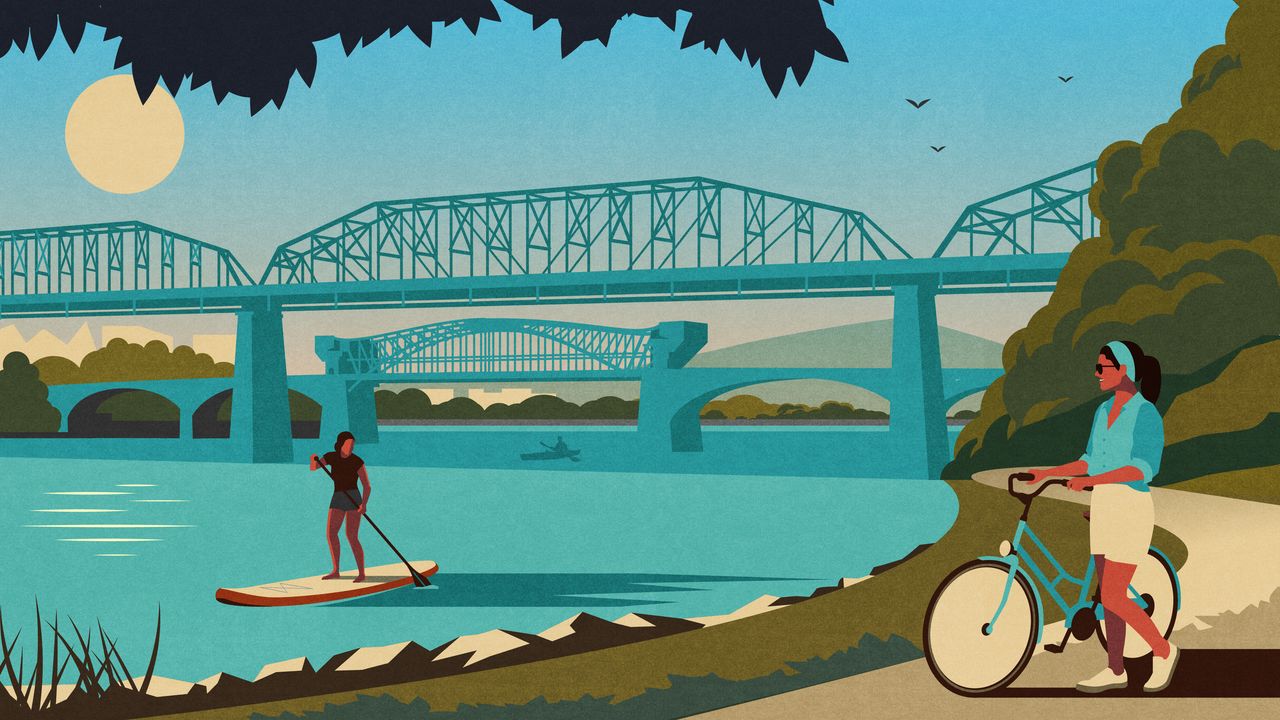
Chattanooga was featured on Condé Nast Traveler's Bright Ideas in Travel 2026. Read the full list of winners here.Maclellan Island is an overgrown wilderness of pine trees, pawpaw, and rivercane in the Tennessee River, across from downtown Chattanooga, Tennessee. The mile-long dirt trail I’m traipsing along crisscrosses the 24.5-acre site, where residents include raccoons, muskrats, American robins, osprey, and cormorants. Six goats—with names like Gilligan and MacLovin'—nibble on the leaves of bush honeysuckle and English ivy, clearing some of the invasive plant species that have choked out the native flora that once flourished on the uninhabited island.Those quick-spreading plants and erosion (both natural and human-caused) are threatening the nature sanctuary, which is losing about 0.8 acres each decade. To mitigate—and eventually correct—that loss, the Chattanooga Audubon Society, which owns the island, and a committed group of volunteers are rewilding the landscape. To invite more visitors, a renovated bunkhouse is slated to open this fall, and a botanical garden and gazebo will be constructed in the next year or so.“You’re in the forest in the middle of downtown,” says Laura Marsh, director of development at the nonprofit. “If we lose the island, we lose archaeological history. We lose biodiversity and a habitat for wildlife and birds—and a staple in downtown Chattanooga.”That kind of commitment to remedying, preserving, and enhancing Chattanooga’s natural assets is visible across the so-called Scenic City—and led to it being named the first National Park City in North America in April 2025. Once the country’s most polluted metropolis, the destination has transformed itself into one best known for its outdoor accessibility and recreation.The flashy designation was awarded by the National Park City Foundation, a UK-based charity that began in 2011 to encourage metro areas around the world to become greener, wilder, and healthier. Despite the name, it’s unrelated to National Parks systems that conserve and protect landscapes, but takes inspiration from that ethos. There are currently four named National Park Cities globally—London; Adelaide, Australia’ and Breda, Netherlands; alongside Chattanooga—and 10 additional locales are actively pursuing the designation.“National parks are obviously special places where people connect with nature, but up until now, the only types of ecosystems that didn’t have any type of protected or national park status globally were urban ecosystems in cities,” says Mark Cridge, executive director of the National Park City Foundation and London National Park City. “Cities are big, complex. They’re not pristine wilderness environments.” That can make it difficult for people to view them as natural areas worth protecting. After all, outdoor recreationists traditionally leave cities to hike, bike, climb, and fish.That was particularly true in Chattanooga. The first train arrived in the city in 1849. In the following decades, the southern town’s railroad and manufacturing industries boomed. Unregulated textile factories, iron and steel mills, and Coca-Cola production and chemical plants spewed pollution into the air and water well into the mid-20th century. People’s handkerchiefs would come away from their foreheads stained with soot.Ironically, the city’s position in a beautiful valley—encircled by the ridges of the Cumberland Plateau, at the foothills of the Appalachian Mountains—also led to some persistent environmental issues. The elevation differences cause temperature inversions, where the warm air traveling over the ridges traps the cooler air closer to the ground, along with the smog and pollution. In 1969, the US Department of Health, Education and Welfare declared that Chattanooga had the worst air pollution in the country, with dangerous particulate matter surpassing the federal safety level threefold. Shortly after, evening news broadcaster Walter Cronkite announced to the nation that Chattanooga was the “Dirtiest City in America."Recognizing the health, environmental, and tourism dangers of such a title, residents acted quickly to turn things around. They set restrictions on pollution-related activities through a new Air Pollution Control Ordinance introduced later in 1969. The city achieved compliance within three years, but it took nearly two decades, until the early 1990s, for the air quality to reach the federal health standard. Locals also fought to protect and honor the history of the Cherokee people and other Indigenous tribes. One example: In the 1980s, residents and officials began the designation process for Moccasin Bend, a 768-acre park with artifacts that trace back to 12,000 years of continuous human habitation. In 2003, it became the country’s first—and only—National Archeological District.“It's the landscape that shaped everything that happened here politically, economically, socially, and often religiously,” says Linda Moss Mines, Chattanooga–Hamilton County historian. “It is the landscape that defines us.” To Moss Mines and other active participants, the National Park City designation is recognition of work Chattanooga has been engaging in for decades—and continues to undertake.Recognizing the region’s unique flora and fauna, which were also harmed by the persistent pollution, conservation has become a key theme of the city’s revival. Chattanooga claims more than 220 unique native plant species and over 100 types of birds. The Tennessee River, which underwent remediation in the 1990s to mitigate significant degradation, is home to more than 1,400 aquatic species, including around 75% of native fish species in the US and more than 90% of all American mussel and crayfish species.Within the city itself, the opening of the Tennessee Aquarium in 1992 represented a "significant cultural turning point, as it transformed the riverfront from an industrial site into a shared, vibrant gathering space,” says Mayor Tim Kelly. Built along the riverbank, the $45 million tentpole was designed to bring people back to downtown Chattanooga while showcasing the area’s immense biodiversity—and continues to inspire efforts to build a nature-infused metropolis.Today, scientists at the Tennessee Aquarium Conservation Institute, for example, are actively working to not only conserve but to restore and improve habitats and wildlife population. In the Institute’s propagation room, staff are spawning once-overharvested lake sturgeon and red-bellied laurel dace (a minnow that’s among the 10 most endangered fish species in the country) as assurance to protect the populations and, in some cases, to be reintroduced into their natural habitats. More than 400,000 lake sturgeon have already found their way to local watersheds, and their conservation status was lowered from endangered to threatened.Many of the city's recent initiatives, like those of generations past, have been community-driven. More than 5,600 Chattanooga residents signed the city’s National Park City charter, and an ongoing NPC Seeds program invites residents to propose and fund new ideas, such as the seasonal Maclellan Island Eco Tours that launched in June and forthcoming “Chatt Spots”—specially painted benches that invite people to sit who want to have a conversation.Others are city- and nonprofit- led efforts to develop more opportunities for residents and tourists to more easily engage with the outdoors: Five thousand new trees are being planted to temper urban heat islands. A 15,000-square-foot inclusive playground, designed for kids of all abilities to enjoy, opened in mid-September. Chattanooga Public Library’s Adventure Library is stocked with camping and hiking gear (tents, lanterns, backpacks) that can be borrowed for up to two weeks for free.A plan to further enhance the Riverfront District with fishing piers, better seating, dining, and more is expected to get underway at the end of the year. Better connections between the Tennessee Riverwalk—a 16-mile-long paved pathway that follows the waterway’s southern bank through downtown and introduced its first two miles back in 1989—and underserved neighborhoods will improve accessibility.On a hot September day in the city center, two men stand in the shadow of the aquarium casting lines for fish. Kayakers paddle by, splashing under historic bridges. Within a 15-minute radius, there are more than 150 miles of hiking trails and mountain biking routes that connect urban residents directly to the area's surrounding wilderness. “We are a mecca and a basecamp,” says Gail Loveland Barille, director of Outdoor Chattanooga, a division of the city’s parks department.That’s critical to what made Chattanooga a compelling addition to the National Park City roster, Cridge says. “I’m a strong believer that one of the things that really underpins why progress in the climate crisis is so slow or not quick enough is because, as a society and individually, we’ve lost that connection with nature,” he explains. “We don’t see ourselves as part of our nature. It’s something we visit. So we want to bring it closer to home.”
America's First ‘National Park City’ is Chattanooga, Tennessee
Full Article
Original Source
Read the full article at Cntraveler →KhanList aggregates and links to publicly available news content. We do not host full articles from third-party sources. Always verify important information with original sources.