
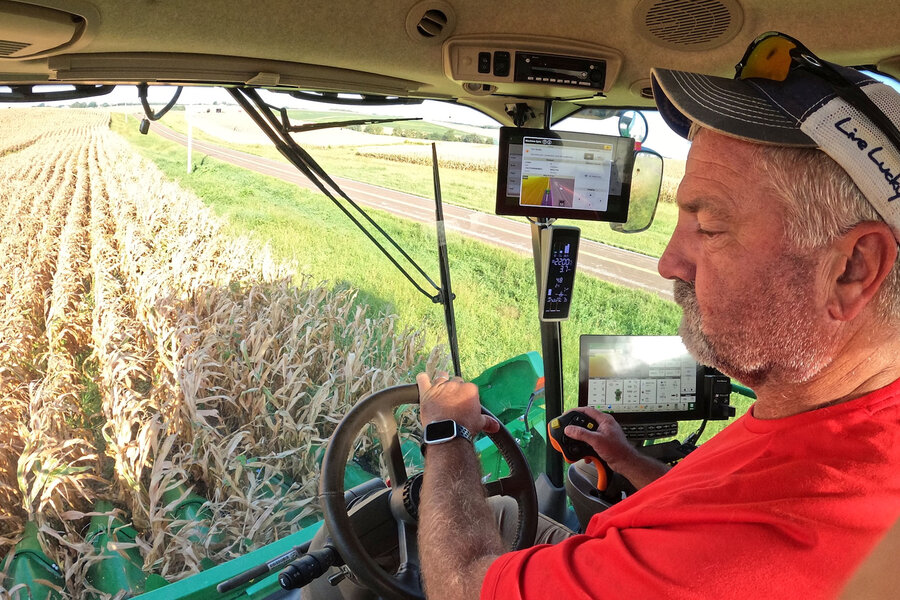
Morton, Illinois | Nov. 10, 2026, 1:34 p.m. ET | 4 min read America’s farmers are bringing in a plentiful harvest. What many aren’t bringing in is much profit.As the 2026 harvest winds down, rising production costs and inadequate crop prices are eating into farmers’ income, particularly among Midwest corn and soybean growers, even with a potential record in government subsidies.For consumers, weary of sticky, persistent inflation, the horizon is a bit brighter: The U.S. Department of Agriculture (USDA) early forecast predicts grocery prices will rise just 1% next year, the smallest annual increase since 2019. There’s “an affordability squeeze on the consumer end in terms of prices going up … but also at the farm,” says David Ortega, food economist and professor at Michigan State University in East Lansing, Michigan. “You have input costs, right? This is really squeezing producers, especially crop farmers.”Here in the Midwest, farmers have largely finished a bin-buster harvest. The corn crop is expected to be the second-largest ever. Soybeans are on track to set a record. As of Sunday, Illinois farmers had harvested 93% of their corn and 96% of their soybeans. Other key producing states, such as Iowa and Indiana, are not far behind, although Iowa’s corn harvest was lagging.Falling farm profitsBut net farm income is expected to fall 5.5% from last year’s total, once adjusted for inflation, according to USDA. A big reason: the rising costs of inputs.“Between diesel and fertilizer, that has made it hard to make a profit,” says John Ackerman, a fourth-generation farmer here in Morton, Illinois. In January, before the United States and Israel attacked Iran, the local price of diesel was $2.75 a gallon. Now, it’s double that. When he went to fill his 275-gallon tractor in September, it cost him about $1,500. Ellen Schmidt/APDave Legvold shows his strip till machine, which applies fertilizer to crops, at his corn and soybean farm in Northfield, Minn., Aug. 26, 2026. Fertilizer is an even bigger expense for many farmers. In 2022, when Ukraine was invaded by Russia, a big exporter of key fertilizer ingredients, prices skyrocketed and have remained elevated. This year’s war on Iran has boosted prices even higher, disrupting natural gas supplies and nitrogen fertilizer exports from the Middle East. As a result, “a lot of the farmers are break-even or not quite break-even on the crop side,” says Allen Featherstone, an agricultural economist at Kansas State University in Manhattan, Kansas. “The thing that saved them, though, is the amount of government program payments that have come out.”China is buying American soybeans again, but even with a recent price rebound, many U.S. farmers are still struggling to cover rising production costs.To compensate for the blow that its tariffs have inflicted on agriculture, the Trump administration has repeatedly funneled aid to farmers.Government aidIn addition to typical commodity payments, the administration had in place the Emergency Commodity Assistance Program, the Supplemental Disaster Relief Program, and the Farmer Bridge Assistance Program to funnel additional money to farmers. Then last month, two weeks before the midterm elections for Congress, President Donald Trump announced an additional $8 billion in aid through the Harvest Fuel Relief program. Altogether, these payments could double last year’s total of direct payments to farmers and set a record in agricultural aid, depending on whether the fuel-relief money is fully distributed before the end of the year.That additional money has certainly alleviated the financial stress on farmers, even if it doesn’t sit well with many of them. “It’s very hard to accept what could be looked at as charity,” says Mr. Ackerman here in Morton. “I’d much rather have a system in place where we’re able to just profit from a good market, good export ability.” Kendra Nordin Beato/The Christian Science MonitorJohn Ackerman, a fourth-generation farmer, stands at his farm in Morton, Illinois, Oct. 25, 2026. This year, Mr. Ackerman grew pumpkins, soybeans, and wheat across 300 acres. He says he got caught by skyrocketing prices from the Iran war because he didn't prepay for diesel. While government assistance is buoying crop farming, the cattle industry continues to boom. Beef prices, though projected to fall, remain elevated. When the Agricultural and Food Policy Center at Texas A&M University projected income for its farm models earlier this year, it found that 10 of 11 cattle operations were in a good position, with less than a 25% chance of losing value over the next five years. For farms growing corn, soybeans, and other feed grains, the picture was far bleaker. Only 1 in 25 was in a good position; 19 were at more than a 50% risk of losing net worth by 2031.Low and stable food prices are a boon to consumers. And grocery prices, in particular, help shape consumer perceptions of overall inflation, says Mr. Ortega, co-author of new research on the subject. But “we shouldn’t expect a quick bounce in sentiment,” he adds, because consumers have long memories and still remember pre-pandemic prices before food costs jumped more than 30%. Low inflation won’t bring those prices back. Deepen your worldviewwith Monitor Highlights.Politics with respectGet political stories with respectful analysis.There‘s a world of new ideas in everyBooks newsletter.There‘s more to life, enrich yours withCulture & Learning weekly.Follow humanity‘s discoveries withScience & Nature stories in your inbox.Gain a spiritual perspectivefrom the stories in your inbox.Want to understand the deeper impact of critical events? Learn the Monitor‘s insight.Already a subscriber? Log in to hide ads. On the farm side, where the clouds seem to be darkening for crop farmers, especially those corn and soybean producers in the Midwest, Mr. Ackerman chooses to remain optimistic.“Each of us has those years [where we] really struggle,” he says. “Is this a moment in time where farming is super profitable? No. Will we get through it? Most of us will.” ALREADY A SUBSCRIBER? LoginReal news can be honest, hopeful, credible, constructive.The Christian Science Monitor was founded in 1908 to lift the standard of journalism and uplift humanity. We aim to “speak the truth in love.” Our goal is not to tell you what to think, but to give you the essential knowledge and understanding to come to your own intelligent conclusions. Join us in this mission by subscribing.
America’s farmers are harvesting a bounty. Why are they struggling?
Full Article
Original Source
Read the full article at Csmonitor →KhanList aggregates and links to publicly available news content. We do not host full articles from third-party sources. Always verify important information with original sources.