
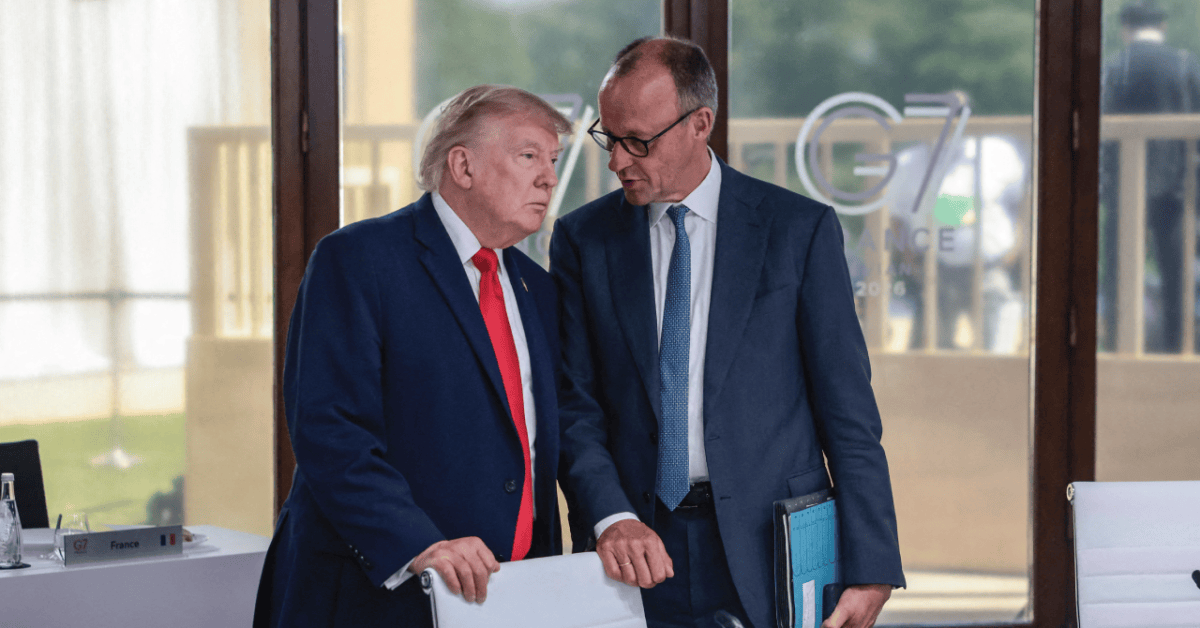
U.S. President Donald Trump and German Chancellor Friedrich Merz attend lunch during a G7 summit in Evian-les-Bains, France, on June 16, 2026. (Evelyn Hockstein/Pool/AFP via Getty Images) About this research Pew Research Center and Körber-Stiftung began collaborating on joint public opinion surveys in 2017 to gauge relations between the United States and Germany. The questions are developed together, and each organization fields their survey in its own country. Some questions are re-asked annually to track attitudes over time. The results are published in both the U.S. and Germany. Why did we do this? Pew Research Center does research to help the public, media and decision-makers understand important topics. As part of this work, we track U.S. attitudes toward other countries, including China, Russia, India, and traditional American allies in Europe and Asia. Previous Center analyses from this survey collaboration were published in November 2025, November 2024, November 2023, October 2022, November 2021, November 2020, May 2020, March 2020, March 2019 and February 2018. The Körber-Stiftung findings are contained within its larger annual report, “The Berlin Pulse.” Learn more about Pew Research Center and our work on international affairs. How did we do this? U.S. findings come from a Pew Research Center survey of 1,014 adults conducted Sept. 18-24, 2026. The survey was conducted by Ipsos on the Ipsos KnowledgePanel Government & Academic Omnibus. Ipsos’ KnowledgePanel is an online survey panel recruited using address-based sampling. The survey is weighted by gender, age, race, ethnicity, education, income and other characteristics. Germany findings come from a Körber-Stiftung survey of 1,501 eligible voters conducted Sept. 15-28, 2026. The survey was conducted by Forsa Institute via telephone. Here are the questions used for this report, along with responses, and the U.S. survey methodology. The 10th annual joint survey of the American and German publics by Pew Research Center and Körber-Stiftung finds that views of the two countries’ relationship continue to cool among Americans, while Germans remain deeply pessimistic about the current state of bilateral affairs. Views of the U.S.-Germany relationship % of U.S./German adults who say relations between the U.S. and Germany are … Note: Those who did not answer are not shown. Prior to 2022, U.S. surveys were conducted over the phone. All Germany surveys were conducted by phone. Source: Pew Research Center survey of U.S. adults conducted Sept. 18-24, 2026; Körber-Stiftung survey of German adults conducted Sept. 15-28, 2026.“Americans Increasingly See Strains in U.S.-Germany Ties as Germans Remain Pessimistic” PEW RESEARCH CENTER Views of the U.S.-Germany relationship % of U.S./German adults who say relations between the U.S. and Germany are … YearCountryGoodBad2017United States68222018United States69252019United States74172020United States74212021United States85122022United States80152023United States86102024United States8492025United States71242026United States62332017Germany42562018Germany24732019Germany34642020Germany18792021Germany71242022Germany82132023Germany77192024Germany74222025Germany27732026Germany2177 Note: Those who did not answer are not shown. Prior to 2022, U.S. surveys were conducted over the phone. All Germany surveys were conducted by phone. Source: Pew Research Center survey of U.S. adults conducted Sept. 18-24, 2026; Körber-Stiftung survey of German adults conducted Sept. 15-28, 2026.“Americans Increasingly See Strains in U.S.-Germany Ties as Germans Remain Pessimistic” PEW RESEARCH CENTER One-third of Americans now say the relationship between the United States and Germany is bad, the highest such measure in a decade of surveys. Still, 62% of Americans say the relationship is good, though that’s down from 71% in 2025 and 84% in 2024. Democrats and independents who lean toward the Democratic Party drive much of this decline. In 2024, during the Biden administration, 91% of Democrats said relations with Germany were good. But in 2025, that figure dropped to 65% and it stands at 51% today. Among Republicans and Republican leaners, 76% now say relations are good, statistically similar to the share in 2025 (81%) but down since 2024 (84%). Democrats are souring on the state of U.S.-Germany relations % of U.S. adults who say relations today between the U.S. and Germany are __, by party Note: Those who did not answer are not shown. Trend data prior to 2023 is not shown. Source: Pew Research Center survey of U.S. adults conducted Sept. 18-24, 2026.“Americans Increasingly See Strains in U.S.-Germany Ties as Germans Remain Pessimistic” PEW RESEARCH CENTER Democrats are souring on the state of U.S.-Germany relations % of U.S. adults who say relations today between the U.S. and Germany are __, by party YearGoodBadDem/Lean Dem2023918Dem/Lean Dem2024915Dem/Lean Dem20256531Dem/Lean Dem20265146Rep/Lean Rep20238512Rep/Lean Rep20248412Rep/Lean Rep20258117Rep/Lean Rep20267618 Note: Those who did not answer are not shown. Trend data prior to 2023 is not shown. Source: Pew Research Center survey of U.S. adults conducted Sept. 18-24, 2026.“Americans Increasingly See Strains in U.S.-Germany Ties as Germans Remain Pessimistic” PEW RESEARCH CENTER Germans, for their part, remain deeply skeptical of the countries’ current relations, with 21% saying they are good and 77% saying they are bad. These attitudes are similar to what they were early in the first Trump administration. And while there are partisan divides in Germany on a variety of topics related to foreign policy – especially between Alternative for Germany (AfD) supporters and nonsupporters – Germans are relatively aligned in the view that relations with the U.S. are bad. Are the U.S. and Germany seen as partners on global issues? In the past few years, fewer Americans and Germans see their countries as partners on various international issues. Free trade: 54% of Americans say Germany is a partner on promoting free trade, down from 72% in 2023. Around a quarter of Germans (23%) say the U.S. is a partner on free trade, similar to what we found last year but down from 65% in the Biden era. War in Ukraine: 47% of Americans see Germany as a partner on this issue, down from 64% in 2023. About a third of Germans (35%) see the U.S. as a partner. As recently as 2023, about two-thirds of Americans and Germans said their nations were partners in dealing with the war Ukraine. China: 45% of Americans see Germany as a partner on China policy, down from 60% in 2023. A quarter of Germans see the U.S. as a partner in dealing with China, down from about half in 2024 (49%). Iran: 33% of Americans see Germany as a partner in dealing with Iran, down from 56% in 2020. The share of Germans who see the U.S. as a partner on Iran policy has shrunk as well, from 45% in 2020 to 15% today. (The 2026 surveys were conducted in September, following U.S.-Israeli military action in Iran that began in February.) Artificial intelligence: Newly asked this year, 43% of Americans and a quarter of Germans say the other nation is a partner in regulating AI. Declining sense that Americans and Germans are partners on various issues % of U.S./German adults who say the other country is a partner on … Note: Prior to 2022, U.S. surveys were conducted over the phone. All Germany surveys were conducted by phone. Source: Pew Research Center survey of U.S. adults conducted Sept. 18-24, 2026; Körber-Stiftung survey of German adults conducted Sept. 15-28, 2026.“Americans Increasingly See Strains in U.S.-Germany Ties as Germans Remain Pessimistic” PEW RESEARCH CENTER Declining sense that Americans and Germans are partners on various issues % of U.S./German adults who say the other country is a partner on … CountryYearDealing with ChinaPromoting free tradeDealing with IranDealing with the war in UkraineRegulating AIUnited States20264554334743Germany20262523153525United States2025526254Germany2025312138United States2024556759Germany2024496470United States2023607264Germany2023476569United States202252Germany202248United States20215978Germany20214164United States2020607656Germany2020283545 Note: Prior to 2022, U.S. surveys were conducted over the phone. All Germany surveys were conducted by phone. Source: Pew Research Center survey of U.S. adults conducted Sept. 18-24, 2026; Körber-Stiftung survey of German adults conducted Sept. 15-28, 2026.“Americans Increasingly See Strains in U.S.-Germany Ties as Germans Remain Pessimistic” PEW RESEARCH CENTER Which nation is their most important foreign policy partner? Another longstanding question on this survey asks which country is the most important partner for U.S. and German foreign policy. Views among Germans Attitudes in Germany are similar to last year, with 40% of Germans naming France as their most important foreign policy partner and another 24% naming the U.S. China, the European Union and Russia sit at 4% each. What countries do Americans and Germans say are their top foreign policy partners? % of U.S./German adults who say __ is currently the most important partner for their country’s foreign policy Note: Open-ended question. Responses given by fewer than 3% of respondents are not shown; 1% of U.S. adults named Germany. Those who answered “No country,” those whose responses were coded as “Other” and those who did not answer are not shown. Source: Pew Research Center survey of U.S. adults conducted Sept. 18-24, 2026; Körber-Stiftung survey of German adults conducted Sept. 15-28, 2026.“Americans Increasingly See Strains in U.S.-Germany Ties as Germans Remain Pessimistic” PEW RESEARCH CENTER What countries do Americans and Germans say are their top foreign policy partners? % of U.S./German adults who say __ is currently the most important partner for their country’s foreign policy CountryMost important partner for foreign policy %United StatesCanada13United StatesU.K.12United StatesIsrael11United StatesChina8United StatesMexico3Germany France40Germany U.S.24Germany China4Germany EU4Germany Russia4Germany Canada3 Note: Open-ended question. Responses given by fewer than 3% of respondents are not shown; 1% of U.S. adults named Germany. Those who answered “No country,” those whose responses were coded as “Other” and those who did not answer are not shown. Source: Pew Research Center survey of U.S. adults conducted Sept. 18-24, 2026; Körber-Stiftung survey of German adults conducted Sept. 15-28, 2026.“Americans Increasingly See Strains in U.S.-Germany Ties as Germans Remain Pessimistic” PEW RESEARCH CENTER Prior to the second Trump administration, most Germans said the U.S. was their most essential partner. Most mainstream party supporters, including those who support the governing coalition – comprised of the Christian Democratic Union of Germany and the Christian Social Union in Bavaria, or CDU/CSU, and the Social Democratic Party (SPD) – as well as supporters of the Greens and the Left Party (Die Linke) say France is Germany’s most important parter. Supporters of Alternative for Germany (AfD), however, are more likely to name the U.S. as their most important partner, ranking France second. AfD supporters also have more positive views of Russia than supporters of other parties, and 10% name Russia as their top partner – a much higher share than other groups. Views among Americans In the U.S., 13% name Canada as their most important partner, nearly double the amount who said the same last year (7%) and approximately tripled from 3% in 2024. Previously, the United Kingdom was typically seen as the United States’ top partner by a large margin. In this year’s survey, 12% name the U.K., 11% name Israel and 8% name China. Only 1% of Americans say Germany is their top partner. Democrats are far more likely than Republicans to name Canada as their top partner, while Republicans are more likely than Democrats to name Israel. This pattern conforms with other recent Center research on partisans’ views toward those countries. Related: How Do Americans Feel About G20 Countries? Germans are down on the ‘West’ The Germany survey also included more hypothetical questions about Germany’s reliance on the U.S. for national security and the future of the “West.” Among these findings: 61% of Germans say they can’t rely on the U.S. nuclear umbrella to protect their country in event of a war; 69% instead want a French or British nuclear umbrella. 13% want Germany to acquire its own nuclear weapons, while 86% do not. 35% favor Germany taking on a military leadership role in Europe, while 64% oppose this. 61% say Western unity – the concept of political and cultural linkage between the U.S. and Europe – no longer exists. Around four-in-ten (37%) say this unity still exists. Which nations are seen to pose security concerns? Americans remain more concerned, on balance, than their German counterparts about security threats from other countries. Views of threats to American and German security % of U.S. adults who say each of the following poses (a) __ to U.S. security Note: Those who did not answer are not shown. Source: Pew Research Center survey of U.S. adults conducted Sept. 18-24, 2026; Körber-Stiftung survey of German adults conducted Sept. 15-28, 2026.“Americans Increasingly See Strains in U.S.-Germany Ties as Germans Remain Pessimistic” PEW RESEARCH CENTER Views of threats to American and German security % of U.S. adults who say each of the following poses (a) __ to U.S. security Country that may or may not pose a military threatCountryMajor military threatMinor military threatNo military threatGroupingChinaUnited States5824121RussiaUnited States5331101IranUnited States4236161EUUnited States928561% of German adults who say each of the following poses (a) __ threat to German security2ChinaGermany739522RussiaGermany4537172IranGermany1041482U.S.Germany730622 Note: Those who did not answer are not shown. Source: Pew Research Center survey of U.S. adults conducted Sept. 18-24, 2026; Körber-Stiftung survey of German adults conducted Sept. 15-28, 2026.“Americans Increasingly See Strains in U.S.-Germany Ties as Germans Remain Pessimistic” PEW RESEARCH CENTER China: 58% of Americans say China is a major threat to their nation’s security, compared with 7% among Germans. Republicans are 10 percentage points more likely than Democrats to describe China this way (64% vs. 54%). Russia: 53% of Americans say Russia is a major security threat, as do 45% of Germans. In Germany, CDU/CSU supporters are far more likely than AfD supporters to hold this view (67% vs. 21%). In the U.S., Democrats are 10 points more likely than Republicans to see Russia as a major security threat (59% vs. 49%). Iran: 42% in the U.S. see Iran as a major security threat, while 10% of Germans agree. In the U.S., Republicans are more likely to say this than Democrats (47% vs. 39%). U.S. and European Union: 7% of Germans see the U.S. as major security threat. Similarly, 9% of Americans describe the countries of the European Union as such. Majorities in each country do not see the other as a military threat. More specifically on China, 64% of Americans and 60% of Germans see the country as a major economic threat, mostly unchanged from previous years. Additionally, six-in-ten Americans see China’s rising influence in the world as mostly a bad thing for their nation, while 43% of Germans feel the same. In recent years, the share of Germans who feel neutral about China’s growing influence has increased steadily. In 2023, 62% of Germans said its influence was bad and 31% said it did not make a difference for their country. Today, 43% see China’s rising influence as a negative and 46% are neutral. Meanwhile, the share of Germans who say it’s a good thing has shifted only slightly (from 6% in 2023 to 10% in 2026). Views of American troops in Germany This year, President Donald Trump pledged to withdraw 5,000 American troops from among the approximately 35,000 troops currently based in Germany. Both Americans and Germans support U.S. troops in Germany, to varying degrees % of U.S. adults who say U.S. military bases with approximately 35,000 troops stationed in Germany are __ for U.S. national security % of German adults who say U.S. military bases with approximately 35,000 troops stationed in Germany are __ for German national security Notes: Those who did not answer are not shown. See topline for full question wording. Source: Pew Research Center survey of U.S. adults conducted Sept. 18-24, 2026; Körber-Stiftung survey of German adults conducted Sept. 15-28, 2026.“Americans Increasingly See Strains in U.S.-Germany Ties as Germans Remain Pessimistic” PEW RESEARCH CENTER Both Americans and Germans support U.S. troops in Germany, to varying degrees % of U.S. adults who say U.S. military bases with approximately 35,000 troops stationed in Germany are __ for U.S. national security YearCountryNot important at allNot too importantSomewhat importantVery importantGrouping2026United States510344612019United States5829561of German adults who say U.S. military bases with approximately 35,000 troops stationed in Germany are __ for German national security2026Germany1025412322019Germany153037152 Notes: Those who did not answer are not shown. See topline for full question wording. Source: Pew Research Center survey of U.S. adults conducted Sept. 18-24, 2026; Körber-Stiftung survey of German adults conducted Sept. 15-28, 2026.“Americans Increasingly See Strains in U.S.-Germany Ties as Germans Remain Pessimistic” PEW RESEARCH CENTER Eight-in-ten Americans say U.S. bases in Germany are somewhat or very important for U.S. national security. By comparison, 64% of Germans say these U.S. bases are somewhat or very important for their own national security, but views vary by geography: 66% of those living in former West Germany see U.S. bases as important to their security, compared with 52% among those living in former East Germany. Among Germans, there is an increasing sense that having American troops in their country is important for national security (up 12 percentage points since 2019). Among Americans, 46% now see American deployments in Germany as very important to U.S. national security, compared with 56% in 2019. Support for military assistance in Ukraine and elsewhere More Americans support sending military assistance to Ukraine in its war with Russia (42%) than Taiwan in its struggle with China (34%) or Israel in its war with Hamas (25%). Around a quarter to a third are not sure about whether the U.S. should provide military assistance in these cases. Sharp partisan divides on military assistance to Ukraine in the U.S. and Germany % of U.S./German adults who say their country should provide military assistance to Ukraine in its war with Russia, by party Note: Due to differing survey methodologies, the U.S. survey offered an explicit “Not sure,” while the Germany survey did not. Source: Pew Research Center survey of U.S. adults conducted Sept. 18-24, 2026; Körber-Stiftung survey of German adults conducted Sept. 15-28, 2026.“Americans Increasingly See Strains in U.S.-Germany Ties as Germans Remain Pessimistic” PEW RESEARCH CENTER Sharp partisan divides on military assistance to Ukraine in the U.S. and Germany % of U.S./German adults who say their country should provide military assistance to Ukraine in its war with Russia, by party Rep/Lean RepDem/Lean DemSPDCDU/CSUGreensDie LinkeAfDU.S.3054Germany6467736111 Note: Due to differing survey methodologies, the U.S. survey offered an explicit “Not sure,” while the Germany survey did not. Source: Pew Research Center survey of U.S. adults conducted Sept. 18-24, 2026; Körber-Stiftung survey of German adults conducted Sept. 15-28, 2026.“Americans Increasingly See Strains in U.S.-Germany Ties as Germans Remain Pessimistic” PEW RESEARCH CENTER Germans, for their part, are strongly opposed to military assistance for Israel (83%) or Taiwan (78%). But they are more evenly divided on Ukraine: 46% support sending military assistance and 53% oppose. Looking at the party differences on the Ukraine conflict, Democrats in the U.S. are much more likely than Republicans to support military assistance (54% vs. 30%). And in Germany, there is a massive gap in support for military aid to Ukraine between AfD supporters and those of other political parties. Around six-in-ten or more among supporters of the Greens, CDU/CSU, SPD and Die Linke favor sending military assistance to Ukraine, compared with 11% of AfD supporters. Is the UN important for resolving wars and conflicts? Americans and Germans generally agree that the United Nations plays an important role in resolving wars and conflicts around the world. Around half in Germany (48%) and 45% in the U.S. say that it is extremely or very important in this way. Americans and Germans agree that the UN is important for resolving conflicts around the world % of U.S./German adults who say the United Nations is __ for resolving wars and conflicts around the world Note: Those who did not answer are not shown. Source: Pew Research Center survey of U.S. adults conducted Sept. 18-24, 2026; Körber-Stiftung survey of German adults conducted Sept. 15-28, 2026.“Americans Increasingly See Strains in U.S.-Germany Ties as Germans Remain Pessimistic” PEW RESEARCH CENTER Americans and Germans agree that the UN is important for resolving conflicts around the world % of U.S./German adults who say the United Nations is __ for resolving wars and conflicts around the world Extremely importantVery importantSomewhat importantNot too importantNot important at allU.S.1926261113Germany153329139 Note: Those who did not answer are not shown. Source: Pew Research Center survey of U.S. adults conducted Sept. 18-24, 2026; Körber-Stiftung survey of German adults conducted Sept. 15-28, 2026.“Americans Increasingly See Strains in U.S.-Germany Ties as Germans Remain Pessimistic” PEW RESEARCH CENTER Mirroring to their general attitudes toward international organizations, Democrats in the U.S. are much more likely than Republicans to say that the UN is important for resolving conflicts. Nearly six-in-ten Democrats say it is extremely or very important (58%) compared with around a third of Republicans (32%). Similarly, 34% of AfD supporters say the UN is not very or not at all important for resolving wars and conflicts around the world, while roughly two-or-ten or fewer among the mainstream party supporters say the same. And on a new question asking whether the rise of artificial intelligence will increase or decrease conflict around the world, both Germans and Americans are more likely to say AI will increase conflict rather than decrease it. But in the U.S., nearly four-in-ten are not sure.
Americans Increasingly See Strains in U.S.-Germany Ties as Germans Remain Pessimistic
Full Article
Original Source
Read the full article at Pewresearch →KhanList aggregates and links to publicly available news content. We do not host full articles from third-party sources. Always verify important information with original sources.