
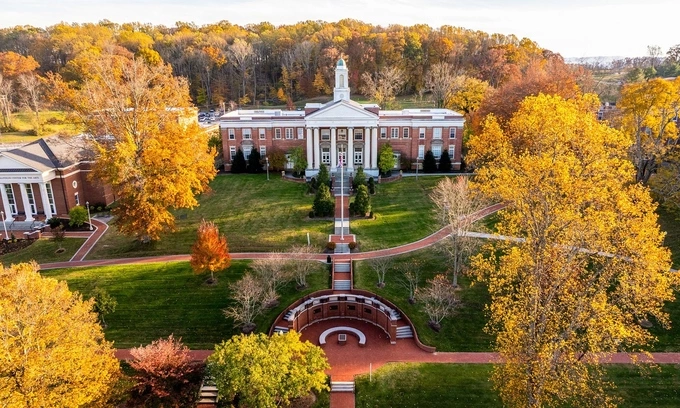
Facing a decline in new student enrollment, several private U.S. universities are taking a drastic action just as the latest admissions season gets underway: cutting their tuition fees by over 50%. At least two institutions have announced major price resets in the Fall 2026 semester. Emory & Henry University in Virginia halved its annual tuition from $40,000 to $19,900. Arizona’s Prescott College followed suit with a nearly 56% reduction, dropping its on-campus undergraduate rate to $15,000.Others are rolling out similar cuts for the coming years.Starting in fall 2027, the University of Tulsa plans to slash its costs by nearly 54% to $25,000, while Coe College in Iowa and Carroll College in Montana will drop their fees to $31,850 and $26,800, respectively, according to The New York Post.Concordia University, St. Paul is also shaving $5,500 off its tuition to $21,700 for on-campus undergraduates starting fall 2027. Wiley Hall and the surrounding campus of Emory & Henry University surrounded by autumn foliage in Emory, Virginia, Sept. 23, 2026. Photo from the university's Facebook page "We just knew that we couldn't be a school with a price tag of $40,000 and attract students, particularly those in the socioeconomic groups that are in our region," Emory & Henry University President Lou Fincher told Bloomberg, adding, "We couldn't continue on that same path."These sudden reductions mark a sharp reversal for an industry defined by decades of price hikes. Since 1963, average annual tuition at public colleges has skyrocketed 40-fold—a 312% increase even after adjusting for inflation, according to a 2025 Education Data Initiative report. Private colleges have hiked prices even faster, with costs now nearly 35 times their 1963 levels.By the 2025-26 academic year, the College Board reported that private colleges charged an average of $45,000, while public four-year institutions billed out-of-state students nearly $32,000.Shifting perceptions, shrinking demographicsThis breaking point has been triggered by a combination of stagnating wages, shifting public attitudes, and a looming demographic cliff.As college costs have soared, more prospective students are questioning whether a bachelor's degree justifies the financial burden. A 2024 Pew Research Center study found that 29% of American adults believe college simply isn't worth the cost, while 78% said a degree is only valuable if students can graduate debt-free.A recent Gallup poll revealed that just three in 10 Americans now view post-high-school education as "very important."Compounding this cultural shift is a shrinking pool of applicants. According to higher education consulting firm Ruffalo Noel Levitz, the number of 18-year-olds in the U.S. is projected to decline steadily starting in 2033. By 2039, the annual population of this age group could shrink by 15%, or 650,000 people. This aligns with a December 2025 report by the Western Interstate Commission for Higher Education, which forecasts a drop of nearly 500,000 college-aged high school graduates by 2041.To survive this tightening market, schools are being forced to rethink the traditional "high-tuition, high-aid" model. Historically, colleges have advertised a massive sticker price but offered large scholarships, meaning very few students actually paid the published rate."The high sticker price existed partly to make large scholarships feel valuable," Nick Standlea, founder of the college-planning platform High School Reach, told the New York Post.Now, colleges are abandoning that psychological pricing, simultaneously reducing both their sticker prices and their scholarship offers to present a more transparent, upfront cost. As families become increasingly price-conscious, Standlea noted, the old strategy of charging premium tuition to fund generous financial aid is no longer a sustainable way to fill classrooms.
American private universities halve tuition amid projections of enrollment decline
Full Article
Original Source
Read the full article at E →KhanList aggregates and links to publicly available news content. We do not host full articles from third-party sources. Always verify important information with original sources.