
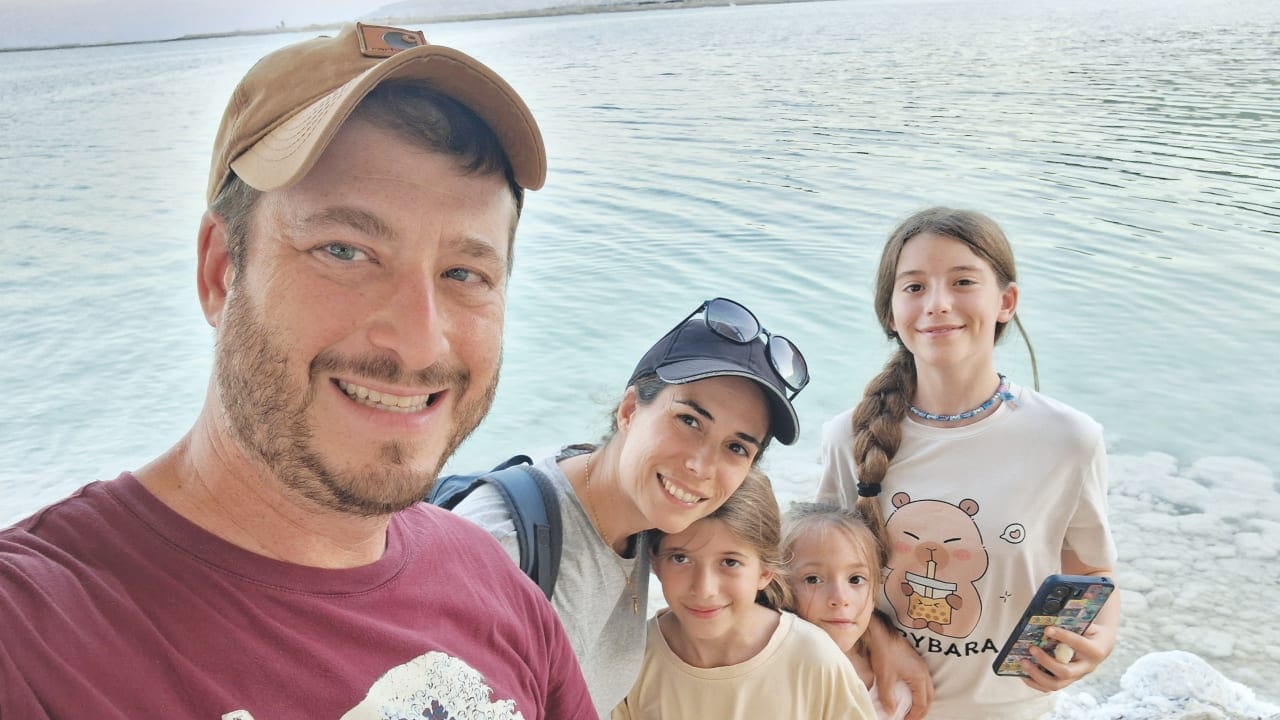
NOVEMBER 28, 2026 20:20Aaron Kahn’s devotion to the Land of Israel runs exceptionally deep. Working as a geoscientist across the Jewish state, he probes the ground beneath our feet in the interest of oil, gas, and water exploration, among other civil-engineering and geotechnical projects.His primary passion is getting Israelis pumped about the potential of abundant, renewable geothermal energy and using that subsurface natural resource to power ground-source heat pumps (GSHPs) for heating and cooling buildings.While fossil fuels are still necessary for industries such as aerospace, geothermal is “the ultimate goal” for regulating the temperature of homes and offices.“Oil and gas on land is extremely limited, and much has been drilled. Offshore, you have reserves, but it’s really a small scene,” Kahn says.His fascination with geology began during a college anthropology course, when he became curious about what the scientific study of the Earth’s solid materials, physical structure, and composition could reveal about prehistoric Flood myths. KAHN (NOT PICTURED) worked with these drillers at the Mishash Formation in Arad. (credit: COURTESY OF AARON KAHN)Subsequently, Kahn earned a bachelor’s degree in geology from Ohio State University, where he also studied saxophone and Hebrew. He has a master’s degree in marine geosciences from the University of Haifa and is working toward a doctorate in geophysics at Tel Aviv University.Alongside his PhD research, which involves mapping subsurface thermal properties, he is a professional consultant for projects ranging from environmental geology to tunnel location. His primary day-to-day work is analyzing soil samples drilled from Israel’s myriad construction sites.“I personally like to see rocks that exemplify tectonic and thermal historical patterns in Israel. Occasionally, I see beautiful crystals, faulting, caves, trace oil, sinkholes, antiquities, and much more,” he says.During a recent project in Arad at the Mishash Formation, which is composed of layered flint, chalk, porcellanite, and phosphorite, he noticed large crystals that were “highlighter yellow” in color.Knowing that trace uranium is present in that region, he was curious to determine if the color was due to uranium, a radioactive metal. When he examined it under UV spectra, the crystal glowed pink – indicating it was not uranium but fluorapatite, a common calcium phosphate mineral.Finding true love on the railroadBefore making aliyah, Kahn arrived in Israel in 2006 and studied for nine months at Ohr Somayach Yeshiva Center Program in Jerusalem.While at the yeshiva, Kahn lined up a job with Zion Oil and Gas. The company sent him for training in well log analysis at the Colorado School of Mines and for mud logging training in Houston, Texas.He officially made aliyah on July 11, 2007, and began working for Zion. Because the headquarters was in Caesarea, he lived in Netanya and then in Herzliya, before settling in Zichron Ya’acov in 2010.One evening, after spending Shabbat in Ra’anana with friends, he boarded a train from Herzliya to Binyamina. He found just one available seat and got to talking to the woman sitting next to him. They married in 2012.Kahn’s wife, Inbar, is a teacher and is also learning bibliotherapy. They have three daughters, aged 13, 10, and seven. The family spent 2014 to 2020 in the United States in Kansas City and then in Baltimore, where he gained experience in geotechnical work. When job prospects grew slim during the pandemic, the Kahns took that as their cue to return to Zichron.“I transitioned to the geotechnical geology scene here in Hebrew, which was a challenge because my prior work had been in English,” he says. “It was like a second aliyah – thank God.”Get on the geothermal bandwagonThe underground heat maps that Kahn is creating utilize thermal data collected by temperature probes on logging tools. Mapping this data provides a new visualization tool for many possible applications – including geothermal energy and the ground-source heat pumps that he sees as critical to Israel’s energy future.Here’s his brief description of how GSHPs work: “You build horizontal or vertical tubing or well systems near your structure and use the ground to regulate the temperature in place of AC/heating. When it's hot outside, you put the heat into the ground. When it's cold outside, you retrieve that heat from the ground,” he explains.“It would be a smart move for the Start-Up Nation to establish this method here. We have the right geology and infrastructure. The moderate maritime climate is perfect.”GSHPs are already being used to thermally regulate government buildings in Jerusalem. With proper insulation, Kahn explains, this method could replace most heating and cooling systems in buildings across the country.Additionally, Kahn says the hot springs along the Dead Sea Transform fault system, as well as other locations, could provide enhanced geothermal energy for electricity and heating.Although Israel also has plentiful sun and wind, Kahn explains that geothermal energy has practical engineering and environmental advantages over solar and wind energy.“When you build enormous solar and wind farms, not only do you create ecological problems, but the panels and turbines require serious maintenance and only last so many years. They result in unrecyclable, often toxic, waste.”GSHPs, by contrast, last at least 50 years and can be set up by a foundation or structural engineer. “They require minimal electricity for operation and because they are built at the point of use, energy is not lost in transmission. They can cut electricity costs in half, given that most people’s energy consumption is primarily for heating and cooling.”Build itOn the home front, Kahn is active in many volunteer capacities – first aid; security; agriculture; equipment and food logistics; and search and rescue.He manages an assortment of neighborly social-media initiatives, helping a few hundred Zichron residents find or offer everything from secondhand goods to shared rides, professional services to synagogue services.This immigrant, who is so firmly rooted in the Land of Israel, says his favorite aspect of Israeli life is “our people, our culture. I’m proud that in this generation we can be here, and we can grow here. It’s really humbling that we get to be here, and we need to make the most of it.”Kahn’s advice to newcomers: “Make this your land. Build it. If anybody has complaints or problems, it means that they need to get to work.” ■Aaron Kahn, 46From Columbus, Ohio to Netanya, 2007; to Zichron Ya’acov, 2010Follow us on Google
American oleh sees geothermal energy as the future of Israel’s energy sector
Full Article
Original Source
Read the full article at Jpost →KhanList aggregates and links to publicly available news content. We do not host full articles from third-party sources. Always verify important information with original sources.