
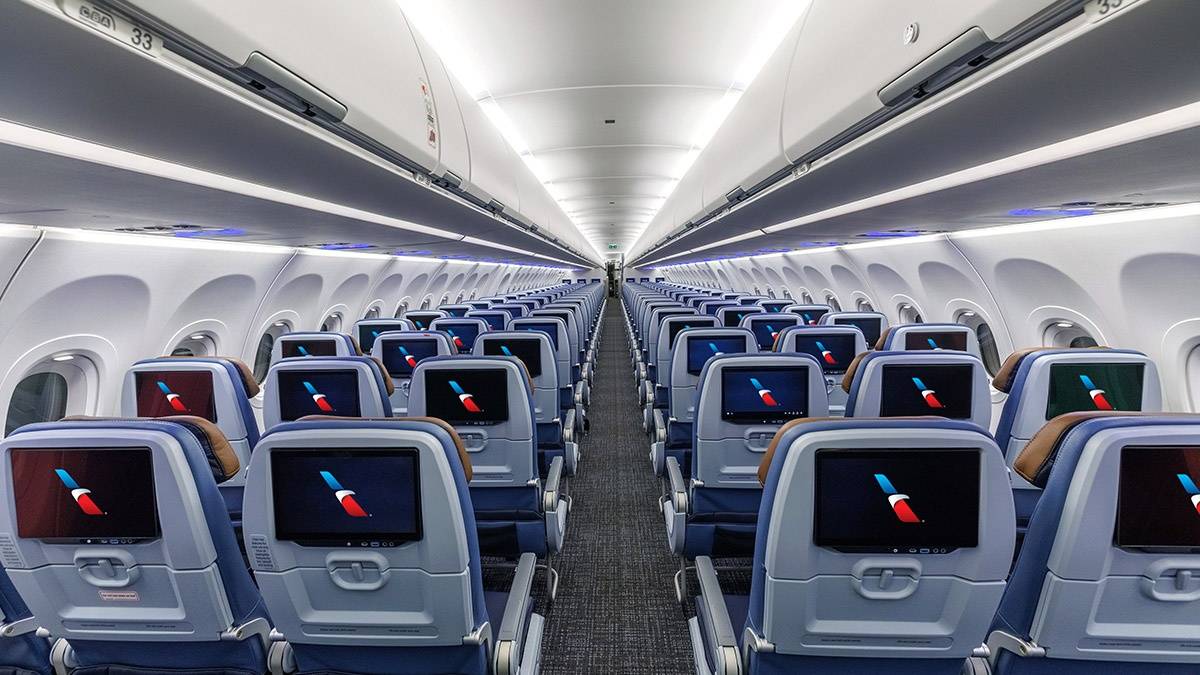
Published Sep 7, 2026, 6:00 PM EDT Based in Maastricht, the Netherlands, Nick joined Simple Flying in October 2025 and has a strong passion for travel and tourism, and in particular, the aviation industry, for as long as he can remember. Nick's focus is on aviation economics, airline strategy, and digital innovation. Before joining Simple Flying, he gained industry experience in ground handling and in a leading European airline group. Academically, Nick holds a Bachelor's degree in Aviation Management and is currently pursuing a Master's degree in Strategy & Innovation. American Airlines recently announced that its narrowbody fleet is set to receive a significant overhaul in the coming years. This investment aims to improve the passenger experience at a time when the airline is trying to close its profit gap with competitors United Airlines and Delta Air Lines. Part of this overhaul is an increase in what the airline categorizes as premium seating to around 40%. While the scale of the change is significant, it does not mean that 40% of American's narrowbody seats will suddenly become first class, as the airline's definition of premium seating also includes Main Cabin Extra, its extra-legroom economy product. These changes will help American to capture more revenue per passenger, shifting away from its current strategy of maximizing capacity. American Wants 40% Of Narrowbody Seats To Be Premium Credit: Shutterstock On August 18, American Airlines announced what it described as a "sweeping transformation" of its narrowbody fleet. The most important number was not a specific aircraft seat count, but rather the proportion of premium seating the airline expects to offer across its narrowbody departures. Today, approximately 25% of these seats are categorized as premium, while American expects this figure to reach around 40% in the coming years. Despite this being an impressive number, there is an important distinction in American's wording. The 40% figure includes both domestic First Class and Main Cabin Extra. The latter uses a regular economy seat but provides additional legroom along with other benefits such as priority boarding and improved onboard service. American is thus not planning cabins where almost half the aircraft consists of large First Class recliner seats. According to American’s Chief Customer Officer Heather Garboden: "We’re making one of the most significant investments in the onboard experience in our history, from next-generation seatback entertainment at every seat to substantially more premium seating options. These enhancements will give our customers more ways to relax, stay connected and enjoy their journey.” Another caveat is that the figure applies to seats offered across narrowbody departures rather than requiring every individual aircraft to contain exactly 40% premium seating. Aircraft configuration, fleet mix, and how frequently different aircraft operate will therefore influence the actual number. However, moving the proportion across the carrier's network from approximately one in four seats to two in five still requires a substantial change to the cabins American operates today. This Is How American's Narrowbody Fleet Will Change Credit: Shutterstock According to the Fort Worth-based carrier, it has already started retrofitting its Airbus A319 and A320 fleets, with each receiving an additional row of domestic First Class. The standard A319 configuration previously offered eight First Class seats; retrofitted aircraft have 12, and the A320 has 16. American's Narrowbody Retrofit Aircraft Current/Previous First Class Planned First Class What Is Changing Airbus A319 8 12 Additional First Class row Airbus A320 12 16 Additional First Class row Airbus A321neo 20 Not yet disclosed Additional First Class seats Boeing 737 MAX 10 N/A 24 Premium-heavy configuration from delivery American's Airbus A321neo fleet will also be reconfigured with additional First Class capacity. However, as of writing, the airline has not disclosed exactly how many premium seats the new configuration will contain. Today, its 196-seat Airbus A321neo has 20 First Class seats, 35 Main Cabin Extra seats, and 141 standard Main Cabin seats. Meanwhile, American's incoming Boeing 737 MAX 10s will feature 24 First Class seats from delivery. Main Cabin Extra Is Doing Much Of The Heavy Lifting Credit: Shutterstock For American Airlines, the Main Cabin Extra is particularly attractive from a revenue perspective because it allows the carrier to create a differentiated product without installing an entirely different type of seat. Passengers essentially receive a standard Main Cabin seat with more legroom and several additional benefits. At the same time, American can sell the seat at a higher price or use it as a benefit for eligible AAdvantage members. That makes the economics significantly different from First Class, since creating another row of domestic First Class requires considerably more cabin floor space because four wider seats replace the space that could otherwise accommodate six economy passengers. Main Cabin Extra requires less additional space while still creating another opportunity to upsell passengers beyond the base fare. Not every Main Cabin Extra seat will incur an additional fee, particularly because eligible elite members can select them for free, but the product also enhances the value of the broader AAdvantage loyalty proposition. US Big Three A321neo Premium Seating Comparison Airbus A321neo First Class Extra-Legroom Economy Standard Economy Total "Premium Seating" (%) American Airlines 20 35 141 196 28% Delta Air Lines 20 60 114 194 41% United Airlines 20 57 123 200 39% When benchmarking American's 40% target against competitors Delta Air Lines and United Airlines, the airline's target doesn't appear very odd. On an aircraft, like the Airbus A321neo, both Delta and United also offer roughly 40% "premium seating" when following American's broad definition, including extra-legroom seating. Through this lens, American's 40% target suddenly looks considerably less extreme. Instead, it highlights how much room American believes it has to expand the higher-yielding part of its narrowbody cabins and catch up to its competitors. American Is Reversing Its Seatback Screen Strategy Credit: Shutterstock Another change American is making is the re-introduction of IFE screens on its narrowbody fleet. Back in 2017, when announcing that its new Boeing 737 MAX aircraft would arrive without seatback screens, the airline argued that more than 90% of passengers were already bringing a personal device onboard. Since, phones and tablets have been continuously improving, while permanently installed screens risked becoming technologically obsolete, the carrier argued they were no longer needed onboard its aircraft. That philosophy subsequently became a defining feature of American's domestic narrowbody product. Passengers could access complimentary entertainment on their own phones, laptops, or tablets, while the airline focused on Wi-Fi connectivity and power rather than installing a display at every seat. Nevertheless, American has now decided to move in the opposite direction. All new Airbus and Boeing aircraft deliveries starting in 2028 will have seatback screens, while existing narrowbody aircraft will gradually receive them through retrofits. American expects the fleetwide installation program to be completed early next decade. The new system will be substantially more advanced than the screens American decided against installing almost a decade ago. The carrier is promising 4K displays, Bluetooth audio connectivity, USB-C fast charging, personalized content recommendations, and interactive flight maps. Premium seats will receive particularly large displays, which American says will be among the largest offered on narrowbody aircraft in North America. At the same time, American is not abandoning the connectivity strategy that originally helped justify the removal of the screens. High-speed Starlink installations are scheduled to begin across the narrowbody fleet in 2027. In other words, American increasingly wants passengers to have both options rather than choosing between connectivity and built-in entertainment. Premium Demand Explains Why American Is Doing This Now Credit: American Airlines The timing of American's narrowbody overhaul is hardly coincidental. In the second quarter, premium passenger unit revenue increased 13.4% year-over-year, compared with an already strong 8.8% increase in Main Cabin passenger unit revenue. Managed corporate revenue simultaneously increased 26%, marking the fifth consecutive quarter of double-digit growth. In other words, some of American's strongest revenue growth is currently coming from exactly the passengers these changes are designed to attract. The narrowbody changes also fit into a much broader shift taking place across American Airlines. Its latest Boeing 787-9 configuration has 51 lie-flat Flagship Suite seats compared with 30 Business Class seats in the older configuration, despite carrying fewer passengers overall. The Airbus A321XLR similarly gives American a premium-heavy aircraft for thinner long-haul routes. Increasing First Class and Main Cabin Extra across the domestic fleet extends the same strategy to the aircraft that carry the majority of American's passengers and feed its international network. This could become particularly important as American attempts to close the profitability gap with Delta Air Lines and United Airlines. The airline is rebuilding corporate relationships, expanding its international network, adding more premium capacity, and now investing considerably more in the onboard experience. None of those changes alone will be enough to catch up to its two largest competitors, but together they give American a considerably stronger proposition for the higher-yield passengers it struggled to retain in recent years. This also makes the narrowbody overhaul a test of American's broader strategy, since increasing premium seating from around 25% to 40% represents a significant bet on where American believes future revenue growth will come from. The airline is deliberately giving up space that could otherwise accommodate additional standard economy seats in favor of products that generate more revenue per passenger. Whether that helps American meaningfully narrow its profit gap with Delta and United Airlines will depend on something much harder than installing new seats and screens: consistently convincing enough travelers that the upgraded American Airlines experience is worth paying more for.
American Is Changing One Narrowbody Strategy, And Premium Seats Are Jumping From 25% To 40%
Full Article
Original Source
Read the full article at Simpleflying →KhanList aggregates and links to publicly available news content. We do not host full articles from third-party sources. Always verify important information with original sources.