
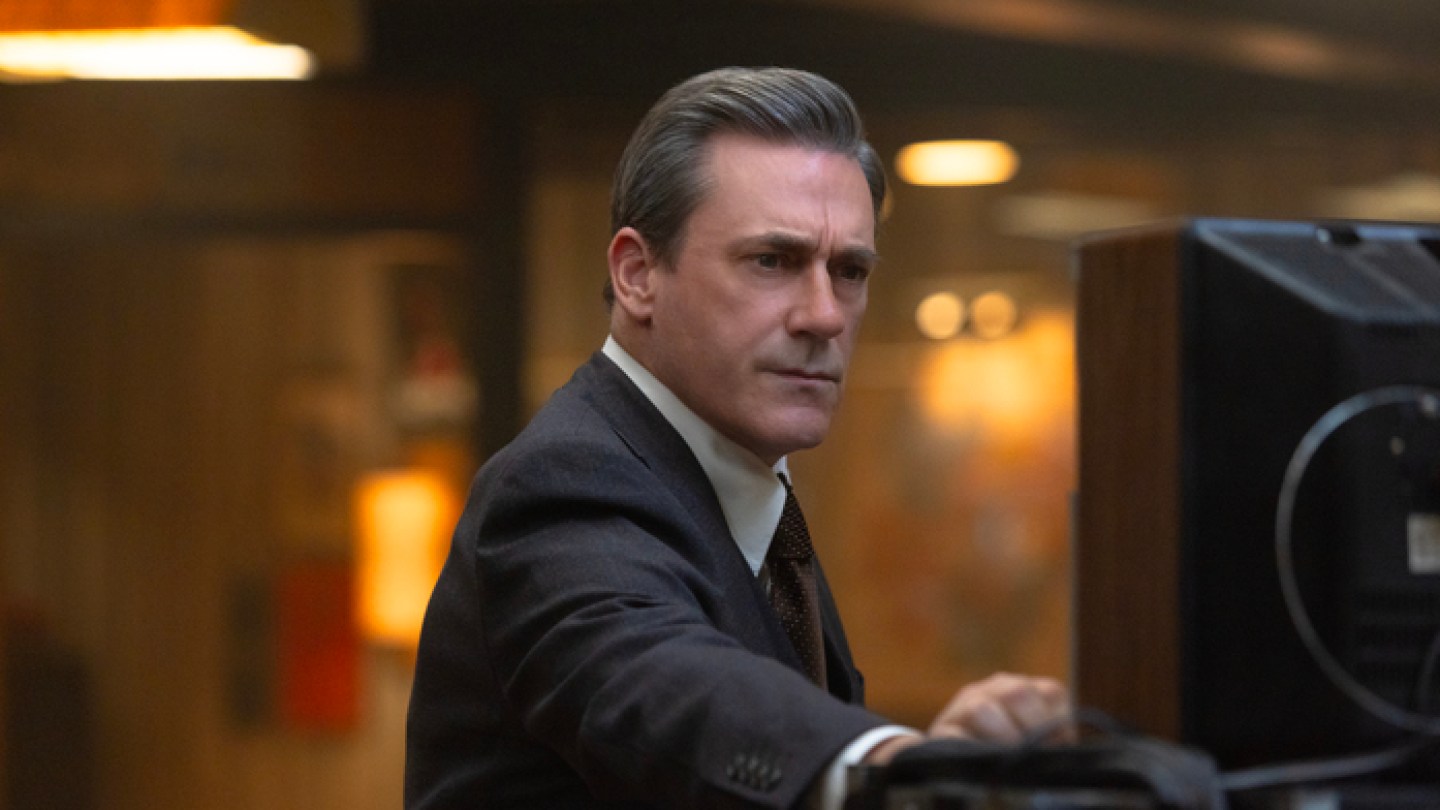
Logo text MGM+‘s American Hostage is a TV show based on a podcast about the power of radio, a chaotic media-hopping smorgasbord that feels oddly appropriate when you watch the eight-part series that flirts with a number of contemporary topics but ends up being mostly well-acted, over-extended nostalgia for landline telephones and manageable institutional corruption. Created by the talented Shawn Ryan and Eileen Myers (The Night Agent) and boasting an ensemble led by a likably understated Jon Hamm and a convincingly overstated Giovanni Ribisi, American Hostage starts off promisingly, peaks in the middle and overstays its welcome — in part because after initially focusing on what were apparently the wrong characters, few of its storylines end up being interestingly resolved. American Hostage The Bottom Line Great story, great cast, squandered execution. Airdate: Sunday, September 20 (MGM+)Cast: Jon Hamm, Mireille Enos, Giovanni Ribisi, William Jackson Harper, Kristoffer PolahaCreators: Shawn Ryan and Eileen Myers The series is set in 1977, and if you’ve seen Gus Van Sant’s 2025 Dead Man’s Wire, you already know a somewhat fictionalized version of the story, which was the subject of the first season of the American Hostage podcast from Criminal Content. Hamm plays Fred Heckman, an Indianapolis news radio legend. Heckman, who has a wonderfully supportive marriage to Barbara (Mireille Enos) plus three kids who are irrelevant to the series, is described on bus ads as “the most trusted voice in news.” Heckman has largely given up on the reporting that launched his career and, after 22 years in Indianapolis, he’s weighing a lucrative offer to move to CBS Radio in New York City. Then he becomes part of the biggest story to hit Indianapolis in years. Tony Kiritsis (Ribisi), a former used car salesman, has walked into a mortgage office and taken Dick Hall (Kristoffer Polaha) hostage, accusing Dick and his family of complicity in granting him a mortgage they knew he could never repay, in order to seize control of the 17-acre plot of land that Tony hoped to turn into a shopping destination anchored by a steakhouse. All Tony wants is an apology, immunity and the chance to resume his quest for the American dream. The only person Tony will talk to is the most trusted voice in news, forcing a connection that rekindles Fred’s interest in journalism and torches his sense of journalistic ethics, much to the concern of co-worker Ben Hairston (William Jackson Harper). With local cops, plagued by rumors of departmental misdeeds, looking for a peaceful solution and federal authorities contemplating extreme action, the situation escalates. In a country pushed by the counterculture and Watergate into a pervasive distrust of authority, Tony briefly becomes as famous as his chosen mouthpiece, which won’t come as a surprise to anybody who has seen Sidney Lumet’s Dog Day Afternoon, one of several stories that America Hostage calls to mind. The recent Broadway adaptation of Dog Day Afternoon — admirable in terms of stagecraft, but marred by odd choices like star Jon Bernthal’s slavish Al Pacino impression — aggressively underlined the period’s paranoia and suspicion toward establishment power as timeless and contemporary. It wasn’t subtle, but it had a point. American Hostage spends a couple of episodes suggesting that it wants to refract its story through a modern lens. We’re only a month after Luigi Mangione admitted to killing a healthcare executive, an act seen by many people as an extreme but understandable expression of rage at a rigged system. Tony Kiritsis’ crime, conducted with the use of a shotgun affixed with a so-called “dead man’s switch,” is meant to resonate similarly. He’s doing the wrong thing, but his reasoning is as familiar today as it would have been 50 years ago. Ribisi and the series writers don’t overly sanitize Tony. He’s a mess of a man with a predilection for expressing himself in operatic and intense (and illegal) ways, but he’s a good neighbor, a good brother and his dream of a restaurant that’s fancy but inclusive is universal. He talks fast and he’s bursting with nervous energy, which the series smartly contrasts with Polaha’s low-key resignation faced with a plight that interrupts what Tony thinks is a perfect life, even as viewers are coming to realize it might be the opposite. The captor/captive dynamic is a good one and it’s given ample screen time. But star power causes the narrative to gravitate toward Fred, played by Hamm as a sincere and genuine man hollowed out by personal tragedy and the writers running out of things to say about him after a fragmented, flashback-looping sixth episode that reduces everyone in the series to interchangeable daddy issues. The series has a lot of initial fun with the mechanics of 1970s radio — phone-call transferring and impromptu recordings, with a technological fascination that reminded me of the Munich Olympics drama September 5 — and hints at a pragmatic approach to journalistic ethics, only to go nowhere with it. The early episodes, with their nervousness about FCC crackdowns and government interference in the news-gathering apparatus, suggest that American Hostage is going someplace provocative, only to have the series run out of things to say. This hampers several of my favorite performances, especially Harper, whose Ben is full of sarcastic indignation, and June Laporte as Ginny, an aspiring reporter in need of proper mentoring. In the middle of the season, Ben is presented as the show’s moral compass and Ginny as its heart. By the end, both characters are thoroughly stranded, almost as if the series creators finally realized that the people covering the story weren’t the real story after having already committed in that direction. It’s a series of strange decisions that, as the show progresses, leave Enos’ Barbara and Kat Cunning’s Ibby (Dick Hall’s wife) to take up the prominence that the journalistic side of the story has surrendered. Barbara and Ibby forge a friendship that’s unexpectedly compelling because of the strength of the two actors, radiating an interiority that isn’t on the page. But Barbara and Ibby are left unresolved by the end too, as the series becomes a veritable graveyard of things and people that it could have been about, when suddenly it’s recreating things that actually happened yet aren’t all that dramatically satisfying. Everything in the show just runs out of creativity and energy, even giving up the flourishes that fueled the first half of the season, like an often-clever use of split-screens to wordlessly develop characters and build tension. It’s a device that’s everywhere and then nowhere, though formal kudos to production designer Caroline Hanania, who ends up being responsible for the best of the series’ world-building, turning sets like the radio offices and Tony’s dingy apartment into living spaces that defy claustrophobia. From Ryan and Myers to directors Adam Arkin, guest starring as a shady lawyer to boot, and Nina Lopez-Corrado, everybody on American Hostage deserves credit for introducing all these good elements. Jonathan Tucker as a fledgling FBI profiler, Mark McKinney as the local chief of police, Joe Cobden as the radio station’s head of ad sales and Fred Ewanuick as Tony’s weary brother are other standouts. Somebody, though, had to recognize that there wasn’t eight episodes worth of story here, or at least not eight episodes of the story being told. There’s so much potential in American Hostage, mostly squandered.
‘American Hostage’ Review: Jon Hamm and Giovanni Ribisi in an MGM+ Kidnapping Thriller With Lots of Potential but Little Payoff
Full Article
Original Source
Read the full article at Hollywoodreporter →KhanList aggregates and links to publicly available news content. We do not host full articles from third-party sources. Always verify important information with original sources.